
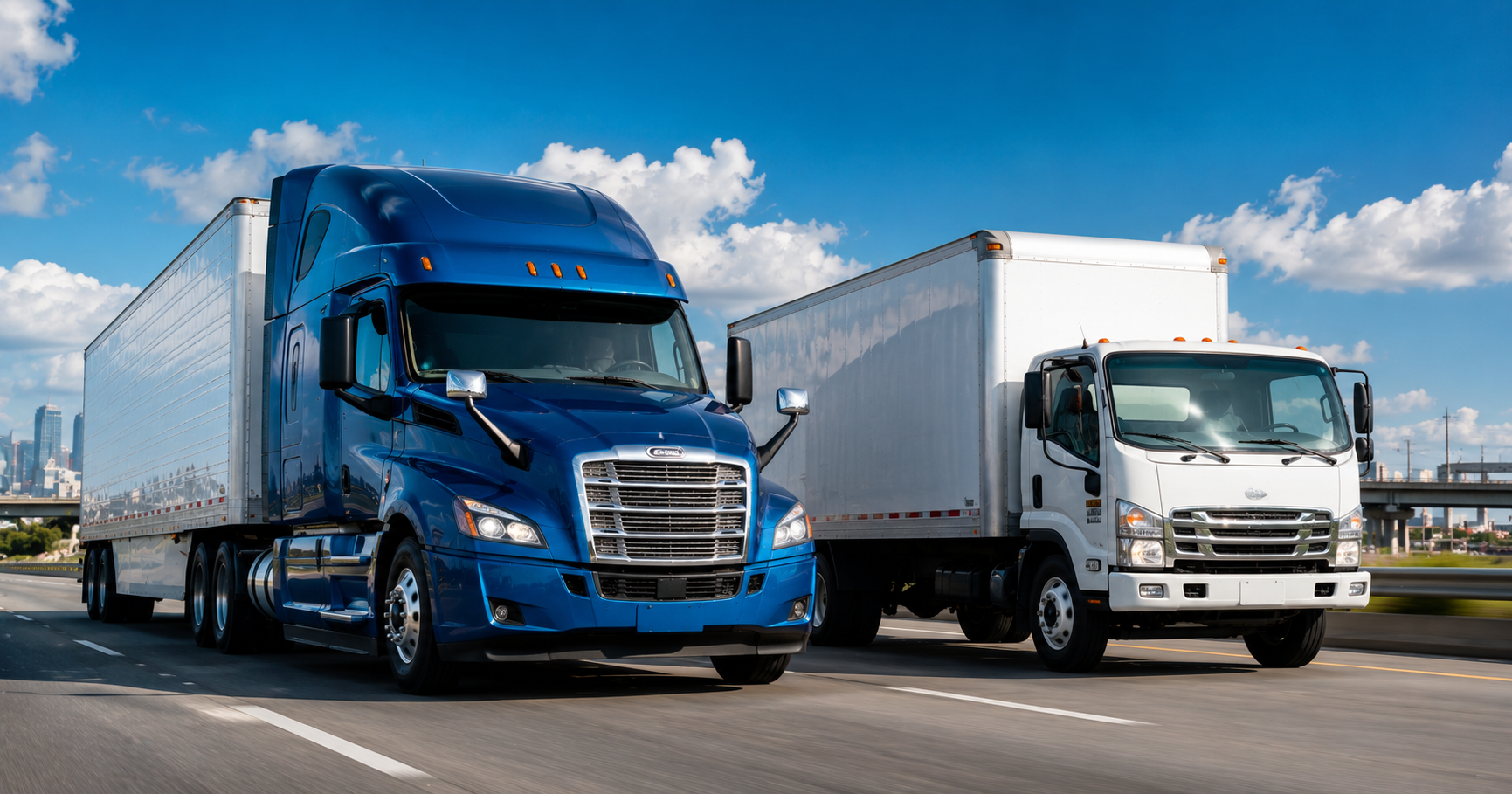
The difference between a semi-truck and a full truck comes down primarily to how each vehicle carries cargo. While the two are often confused, their designs serve different purposes, with semi-trucks using detachable trailers and full trucks incorporating the cargo area into the same frame as the vehicle.
What Makes a Semi-Truck Different From a Full Truck?
A semi-truck is designed to pull cargo carried in a separate trailer, while a full truck—also known as a box truck or straight truck—has its cargo compartment permanently integrated into the vehicle’s frame.
According to the article, one reason the terminology causes confusion is that the word “semi” refers to the trailer rather than the truck itself.
How the Term “Semi-Truck” Originated
The article traces the concept back to Alexander Winton, head of the Winton Motor Carriage Company in Cleveland. After beginning automobile sales in 1898, Winton sought a way to transport completed vehicles to customers without adding wear and tear.
His solution was a two-wheeled trailer that could be attached to one of his existing vehicles. According to the article, this two-part configuration is considered the world’s first semi-truck, although it was not known by that name at the time.
In 1914, August Charles Fruehauf developed a similar trailer for the same purpose and introduced the term “semi-trailer.” The trailer was only partially supported by the towing vehicle, with two rear wheels but no front axle where it connected to the tow vehicle. The article states that the name eventually evolved into the modern term “semi-truck.”
Cargo Capacity and Size Differences
Semi-trucks generally carry more cargo than full trucks because they are permitted to use larger trailers and higher weight ratings.
According to the article, the legal length of full trucks is regulated by individual states, but they are generally limited to approximately 40 feet. Even the largest models are typically classified as Class 7 trucks, with gross vehicle weight ratings (GVWR) of up to 33,000 pounds.
By comparison, states commonly allow semi-trailers ranging from 48 feet to 59 feet 6 inches in length. Many semi-trucks fall into the Class 8 category, which includes vehicles with GVWRs exceeding 33,000 pounds. The article also notes that many are permitted to carry a gross combined weight rating of up to 80,000 pounds when the trailer is included.
When a Full Truck Is the Better Choice
Despite their lower cargo capacity, full trucks offer advantages in situations where maneuverability is more important than maximum hauling capability.
The article says straight trucks are often better suited for local deliveries on surface streets because of their smaller size and tighter turning radius. They can also cost less to purchase and maintain than larger semi-trucks.
Licensing requirements may also differ. According to the article, drivers do not necessarily need a commercial driver’s license (CDL) to operate a full truck if its GVWR is below 26,000 pounds, similar to the rules that apply to some recreational vehicles.
While both vehicle types are designed to transport cargo, semi-trucks and full trucks serve different roles. Semi-trucks provide greater hauling capacity through detachable trailers, while full trucks offer a more compact solution for local transportation and delivery operations.