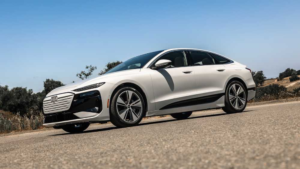

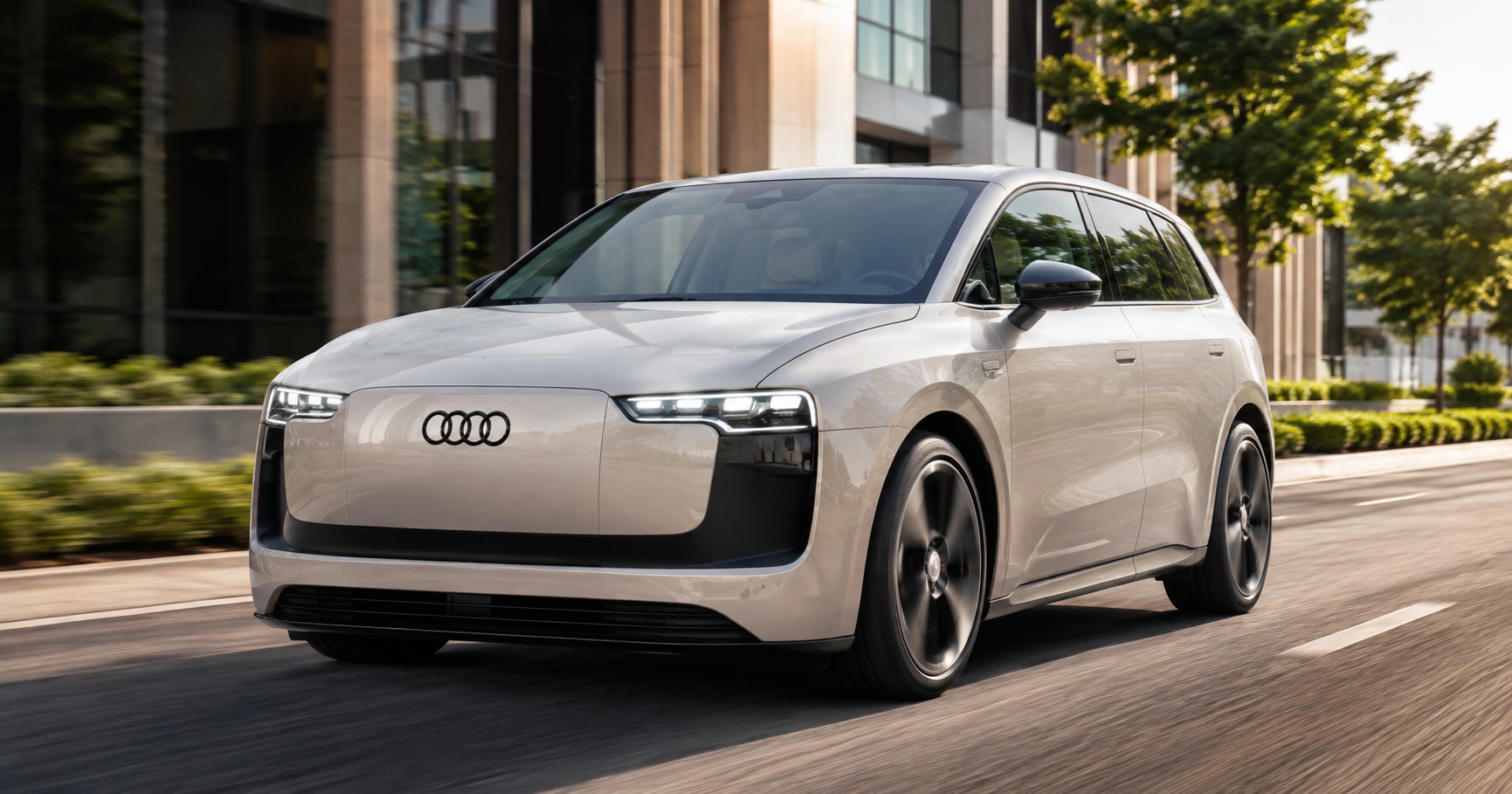
The 2026 Audi A2 Electric Vehicle could become one of the most efficiency-focused electric cars Audi has ever built. The upcoming subcompact EV is reviving the A2 nameplate while introducing technology designed around one central goal: using less electricity to travel farther.
Audi says the new A2 e-tron can achieve a preliminary 12.8 kWh per 100 kilometers under the WLTP test cycle, equivalent to about 20.6 kWh per 100 miles. That figure applies to the 140-kW version equipped with the optional efficiency package.
That number is important because EV efficiency is about much more than battery size. A larger battery can provide more range, but reducing the energy required to move the vehicle can deliver benefits every time the car is driven or charged.
The new Audi takes a comprehensive approach. Its efficiency comes from aerodynamics, an upgraded electric motor and power electronics, a 61-kWh lithium iron phosphate battery, improved thermal management, software integration and even charging technology.
Here are the five biggest efficiency secrets behind the new Audi A2 e-tron and what they could mean for drivers.
What Makes the 2026 Audi A2 Electric Vehicle So Efficient?
“`
The easiest way to understand the A2 e-tron’s efficiency is to think of the vehicle as an integrated system rather than a collection of individual components.
Audi has worked on virtually every major area that affects energy consumption. The body is shaped to move through the air more efficiently. Active aerodynamic components automatically adjust airflow. The electric motor has been redesigned to reduce losses. Silicon carbide electronics help limit switching losses, while a new battery and thermal-management strategy are designed to make better use of available energy.
The result is a vehicle designed to minimize energy losses before they happen.
5 Efficiency Secrets Behind the New Audi A2 e-tron
- Aerodynamic body design and active airflow management
- A highly optimized 61-kWh LFP battery
- A more efficient electric motor and transmission
- Silicon carbide power electronics and integrated thermal management
- Software, charging efficiency and bidirectional energy management
1. Aerodynamics Are One of the Biggest Efficiency Secrets
At highway speeds, air resistance becomes one of the most important forces an electric vehicle has to overcome. That makes aerodynamic design particularly important for an efficiency-focused EV such as the 2026 Audi A2 Electric Vehicle.
Audi gives the A2 e-tron a drag coefficient of 0.24. While drag coefficient alone does not determine how efficient a vehicle will be, it provides an important indication of how effectively the body moves through the air.
The design uses a rounded front end, a flowing roofline and a sharply cut rear section. These elements are intended to help manage airflow and reduce turbulence.
Active Aerodynamics Reduce Energy Waste
The A2 e-tron goes beyond simply designing a slippery body. Audi has incorporated active aerodynamic systems that can change the way air moves around the vehicle depending on driving conditions.
According to Audi, these systems can reduce WLTP energy consumption by as much as 0.9 kWh per 100 km compared with an otherwise identical vehicle without the active aerodynamic features.
That may sound like a small number, but efficiency gains become meaningful when they are repeated across thousands of miles. A vehicle that consistently requires less electricity can potentially reduce charging frequency and energy costs over its lifetime.
The Active Cool-Air Intake
One particularly interesting feature is the active cool-air intake. During normal driving, the intake can remain closed to reduce aerodynamic drag.
When additional cooling is needed, the system can open. Audi says that can occur during charging, rapid acceleration or periods of high ambient temperature.
This is a good example of the broader philosophy behind the A2 e-tron: don’t expose the vehicle to aerodynamic penalties unless they are necessary.
Air Curtains and Wheel-Arch Management
Airflow around the front wheels can also create turbulence. To address that problem, the A2 e-tron uses air curtains in the front flanks, along with gap reducers and gap breathers around the wheel arches.
These details may not be obvious to someone looking at the car, but they demonstrate how modern EV efficiency increasingly depends on small improvements working together.
2. The 61-kWh LFP Battery Is Designed for Everyday Efficiency
The second major efficiency secret is the battery itself. The 2026 Audi A2 Electric Vehicle uses a 61-kWh lithium iron phosphate, or LFP, battery with a cell-to-pack design.
Instead of treating battery cells as completely separate modules, the cell-to-pack architecture integrates the cells more directly into the battery housing. Audi says this increases packing density and allows more energy to be stored within a smaller footprint.
Why LFP Chemistry Matters
LFP batteries have become increasingly important in the EV industry because of their combination of durability and practical charging characteristics.
For the A2 e-tron, Audi says the battery chemistry allows repeated charging to 100% without issues while maintaining high voltage as the state of charge decreases.
That characteristic can be particularly useful for drivers who want a straightforward daily charging routine. Instead of treating 100% charging as an occasional event, the battery technology is designed around everyday usability.
Battery Size Isn’t the Whole Story
One of the most important lessons from the A2 e-tron is that battery capacity should not be viewed in isolation.
A 61-kWh battery may sound modest compared with some large electric SUVs that use batteries exceeding 100 kWh. But if a smaller and lighter vehicle requires substantially less electricity to travel a given distance, it may not need an enormous battery to provide useful driving range.
This is a fundamentally different approach to EV development.
Rather than simply adding battery capacity to compensate for inefficient design, Audi is trying to reduce the amount of energy the vehicle needs in the first place.
3. A New Electric Motor Cuts Losses
Battery energy does not go directly to the wheels. It passes through multiple systems, including power electronics, the electric motor and transmission. Every stage can introduce energy losses.
Audi has therefore redesigned the A2 e-tron’s rear-mounted electric drive system with efficiency as a major objective.
The vehicle uses an APP 350 permanently excited synchronous electric motor. The motor is rated at 140 kW, or approximately 188 horsepower in the configuration associated with Audi’s 12.8-kWh-per-100-km preliminary efficiency figure.
Thinner Laminations Reduce Iron Losses
The electric motor incorporates thinner laminations designed to reduce iron losses.
Iron losses occur within the motor’s magnetic components as the magnetic field changes. Reducing those losses helps the motor operate more efficiently, particularly when it is working across a wide range of operating conditions.
Star-to-Delta Switching Improves Efficiency Across Motor Speeds
Another unusual detail is the motor’s ability to switch its stator winding configuration from star to delta.
This allows the motor to adapt its electrical characteristics to different operating conditions. The objective is to maintain better efficiency across a broader range of motor speeds rather than optimizing the motor for only one particular operating point.
That matters because a road-going EV rarely operates at a single speed. City traffic, highway cruising, acceleration and regenerative braking all place different demands on the electric drive system.
A Tall 10.2:1 Gear Ratio
Audi has also selected a 10.2:1 gear ratio for the transmission.
The relatively tall gearing helps reduce motor speed at higher road speeds. Lower motor speed during highway cruising can reduce energy consumption and contribute to the A2 e-tron’s overall efficiency strategy.
The transmission also uses a new low-friction oil intended to reduce mechanical losses.
4. Silicon Carbide Electronics and Thermal Management
One of the least visible efficiency upgrades in the 2026 Audi A2 Electric Vehicle is found in its power electronics.
Audi is using silicon carbide semiconductors instead of conventional silicon technology. These components can reduce switching losses, particularly when the vehicle is operating under partial load.
That is significant because an EV spends much of its life operating away from maximum power. Everyday driving typically involves modest acceleration, cruising and frequent changes in power demand.
Improving efficiency during those common operating conditions can have a larger real-world impact than optimizing the system exclusively for peak output.
The Vehicle’s Systems Work Together
Audi says some of the biggest gains come from integrating the battery, thermal-management system, charging electronics and software.
This is an important distinction. Modern EV efficiency is increasingly a software-and-hardware problem rather than simply a battery problem.
The vehicle constantly has to manage temperature, power delivery, battery state of charge and charging requirements. Better coordination among these systems can reduce unnecessary energy consumption.
89.6% Wallbox Charging Efficiency
Audi says the A2 e-tron’s battery achieves 89.6% charging efficiency at a wallbox through an adapted cooling strategy.
In simple terms, not all electricity drawn from a charging source becomes stored battery energy. Some energy is lost during conversion and thermal management.
Improving charging efficiency means less electricity is wasted between the wallbox and the battery.
For an EV owner who charges frequently, even incremental improvements in this area can become meaningful over months and years of ownership.
5. Software and Bidirectional Charging Add Another Layer
The final efficiency secret is not a single mechanical component. It is the way the vehicle manages energy through software and bidirectional charging technology.
The Audi A2 e-tron is designed to support Vehicle-to-Load (V2L) and Vehicle-to-Home (V2H) capabilities.
What Is Vehicle-to-Load?
Vehicle-to-Load allows an electric vehicle to supply electricity to external equipment. In practical terms, the car can function as a mobile energy source rather than simply consuming electricity.
That could be useful for powering compatible equipment during outdoor activities, emergencies or other situations where access to conventional electrical power is limited.
What Is Vehicle-to-Home?
Vehicle-to-Home takes the concept further by allowing compatible home energy systems to draw electricity from the vehicle’s battery.
In a suitable setup, the A2 e-tron could effectively become part of a home’s energy-storage system.
This doesn’t necessarily make the vehicle more efficient while driving, but it increases the usefulness of the energy stored inside its battery. Instead of the battery serving only one purpose, it can potentially become part of a larger energy-management ecosystem.
How Efficient Is the 2026 Audi A2 Electric Vehicle?
Audi’s preliminary figure is 12.8 kWh per 100 km under the WLTP testing procedure for the 140-kW model with the optional efficiency package.
That converts to approximately 20.6 kWh per 100 miles.
It is important to emphasize that this is a preliminary WLTP rating. WLTP is a European testing standard, while EPA testing is used for official U.S. fuel-economy and EV efficiency ratings. The two procedures are not directly interchangeable.
Consequently, the Audi’s European figure should not be presented as an official U.S. EPA rating.
How Does It Compare With Efficient U.S. EVs?
Using the figures supplied in Audi’s research context, the A2 e-tron’s 20.6 kWh per 100 miles compares favorably with several highly efficient EVs sold in the United States.
- 2026 Audi A2 e-tron: approximately 20.6 kWh/100 miles based on the preliminary WLTP figure.
- Lucid Air Pure RWD: about 23 kWh/100 miles.
- Hyundai Ioniq 6 Long Range RWD: about 25 kWh/100 miles.
- Tesla Model 3 RWD: about 25 kWh/100 miles.
These comparisons are useful for illustrating the A2 e-tron’s efficiency target, but they should not be interpreted as an apples-to-apples EPA ranking because the testing standards differ.
Why EV Efficiency Matters More Than Range Numbers
The EV market often focuses heavily on maximum range. That is understandable, but range alone does not tell the whole story.
Consider two hypothetical electric vehicles, both with 60 kWh of usable battery capacity. If one consumes significantly less energy per mile, it can travel farther on the same amount of stored energy.
That creates several potential advantages:
- Less electricity required for the same distance.
- Potentially lower charging costs.
- Less frequent charging for a given driving routine.
- Less battery capacity required to achieve a useful range.
- Potentially lower vehicle weight than an equivalent long-range EV with a much larger battery.
This is why the 2026 Audi A2 Electric Vehicle is an interesting case study in EV engineering. Audi isn’t simply chasing the biggest battery or highest horsepower figure. It is targeting efficiency throughout the vehicle.
What Could the A2 e-tron’s Efficiency Mean for Daily Drivers?
Imagine a commuter driving 40 miles per day.
An extremely efficient EV can require substantially less electricity over that commute than a larger, less aerodynamic vehicle. Over hundreds of commuting days, those differences accumulate.
For urban drivers, the A2 e-tron’s compact dimensions could also complement its efficiency-focused powertrain. For highway drivers, the aerodynamic body and tall gearing are particularly relevant because aerodynamic resistance becomes increasingly important as speed rises.
The combination could make the A2 e-tron especially interesting to buyers who prioritize operating efficiency over outright performance.
Efficiency Doesn’t Mean Sacrificing Technology
The A2 e-tron also demonstrates that efficiency does not necessarily require a stripped-down vehicle.
Its technology package includes active aerodynamics, advanced power electronics, an integrated thermal-management strategy, sophisticated motor controls and bidirectional charging capability.
In other words, efficiency is being achieved through engineering complexity that operates behind the scenes.
What We Know About the A2 e-tron’s Battery and Powertrain
The key specifications currently provided by Audi paint a clear picture of the vehicle’s engineering priorities:
| Feature | Audi A2 e-tron Detail |
|---|---|
| Battery | 61-kWh LFP |
| Battery construction | Cell-to-pack |
| Motor | Rear-mounted APP 350 permanently excited synchronous motor |
| Power | 140 kW / approximately 188 hp |
| Drag coefficient | 0.24 |
| Preliminary WLTP consumption | 12.8 kWh/100 km |
| Approximate converted figure | 20.6 kWh/100 miles |
| Wallbox charging efficiency | Up to 89.6% according to Audi |
| Charging technology | Bidirectional charging, including V2L and V2H |
| Efficiency package | Optional equipment associated with the preliminary 12.8 kWh/100 km figure |
Is the 2026 Audi A2 Electric Vehicle Coming to the U.S.?
The information provided describes the Audi A2 e-tron as an upcoming European entry-level electric vehicle scheduled to make its debut in Europe this fall.
A U.S. launch has not been established in the research provided. Therefore, American shoppers should not assume that the vehicle will be sold in the United States simply because its efficiency figure can be compared with U.S.-market EVs.
If Audi eventually brings the A2 e-tron to America, its efficiency could give it an interesting position in the U.S. EV market. However, an American version would ultimately need to be evaluated using EPA-rated consumption and range figures rather than the preliminary WLTP number.
When Will the Audi A2 e-tron Debut?
Audi says the new A2 e-tron is scheduled to make its debut in Europe this fall. It is positioned as the brand’s entry-level electric vehicle and represents the return of the A2 nameplate.
The revival is significant because the original Audi A2 was known for emphasizing compact packaging and efficiency. The electric successor appears to carry that philosophy into the EV era, but with substantially more sophisticated technology.
The Bigger Picture: Audi Is Treating Efficiency as a System
The most interesting aspect of the 2026 Audi A2 Electric Vehicle may not be any single specification.
Its 61-kWh battery is notable. Its 0.24 drag coefficient is impressive. The silicon carbide electronics are important. The 140-kW motor is sophisticated. But the bigger story is how these components are designed to work together.
Audi says the updated drive system alone is up to 10% more efficient than before. Meanwhile, aerodynamic improvements can provide additional savings, while battery and thermal-management changes aim to reduce losses during charging and operation.
This approach reflects an important direction for the electric-car industry. As EV technology matures, manufacturers have fewer opportunities to deliver dramatic improvements simply by installing larger batteries. Efficiency becomes an increasingly valuable engineering target.
The A2 e-tron therefore represents more than the return of a familiar badge. It is a demonstration of how an automaker can pursue efficiency through dozens of small engineering decisions that collectively produce a major result.
Bottom Line
The new Audi A2 e-tron is shaping up to be one of the brand’s most efficiency-focused electric vehicles yet. Audi’s preliminary WLTP consumption figure of 12.8 kWh per 100 km puts the vehicle’s energy efficiency at the center of its identity.
Five technologies stand out: its aerodynamic body and active airflow systems, the 61-kWh LFP cell-to-pack battery, the redesigned electric motor and transmission, silicon carbide power electronics with integrated thermal management, and sophisticated charging and energy-management capabilities.
For American EV shoppers, the most important caveat is that the 12.8-kWh figure is a preliminary WLTP result rather than an EPA rating. Still, it offers a compelling preview of what Audi is trying to accomplish.
If the final production vehicle delivers performance close to Audi’s preliminary efficiency target, the A2 e-tron could demonstrate that an EV does not need an enormous battery to be highly useful. Sometimes, the smarter solution is simply to waste less energy.
Frequently Asked Questions About the 2026 Audi A2 Electric Vehicle
How efficient is the 2026 Audi A2 Electric Vehicle?
Audi says the A2 e-tron has a preliminary WLTP energy consumption rating as low as 12.8 kWh per 100 km, equivalent to approximately 20.6 kWh per 100 miles. The figure applies to the 140-kW version with the optional efficiency package.
What battery does the Audi A2 e-tron use?
The Audi A2 e-tron uses a 61-kWh lithium iron phosphate (LFP) battery with a cell-to-pack design. Audi says the battery is engineered to support repeated charging to 100% while maintaining high voltage as the state of charge falls.
How much power does the Audi A2 e-tron have?
The efficiency-focused A2 e-tron configuration described by Audi uses a 140-kW rear-mounted electric motor, which is approximately 188 horsepower.
What is the Audi A2 e-tron’s drag coefficient?
The new A2 e-tron has a reported drag coefficient of 0.24. Audi also uses active aerodynamic technology that can reduce WLTP energy consumption by up to 0.9 kWh per 100 km compared with an otherwise identical vehicle without those features.
Does the Audi A2 e-tron support bidirectional charging?
Yes. Audi says the A2 e-tron supports bidirectional charging, including Vehicle-to-Load (V2L) and Vehicle-to-Home (V2H) functions.
Is the Audi A2 e-tron coming to the United States?
The research provided identifies the A2 e-tron as an upcoming European entry-level EV scheduled to debut in Europe this fall. It does not establish a U.S. launch date or confirm that the model will be sold in America.
Is the 12.8 kWh/100 km figure an EPA rating?
No. The 12.8 kWh/100 km number is a preliminary WLTP figure. WLTP and EPA testing procedures differ, so the number should not be treated as an official U.S. EPA efficiency rating.
Why is the Audi A2 e-tron so efficient?
Its efficiency comes from several technologies working together, including aerodynamic optimization, active airflow management, an LFP battery, a redesigned electric motor, silicon carbide power electronics, improved thermal management, low-friction transmission components and software designed to coordinate the vehicle’s energy systems.