
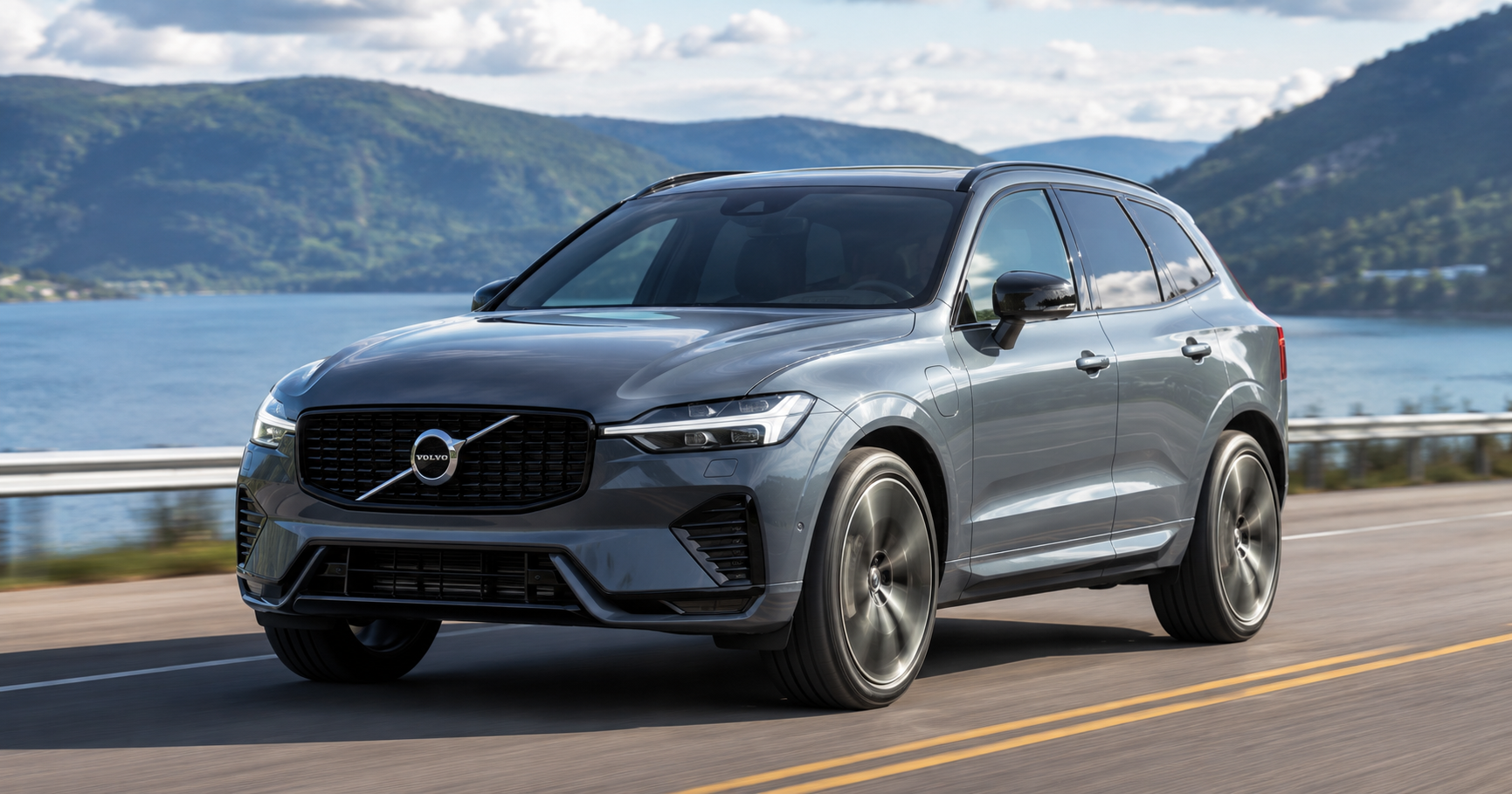
The Volvo XC60, Volvo’s best-selling model worldwide, is set to receive major updates later this year, including powertrain improvements, refreshed styling, and upgraded cabin technology. At the same time, Volvo will begin producing the compact luxury SUV in the United States for the North American market, marking a significant manufacturing change for the brand.
Volvo XC60 Receives Major Updates
The second-generation Volvo XC60, which has been on the market since 2017, is expected to gain an upgraded plug-in hybrid battery that delivers more driving range.
The refreshed model is also expected to feature updated styling inspired by Volvo’s latest EX60 and XC90 models, along with enhanced interior technology designed to keep the XC60 competitive in the compact luxury SUV segment.
U.S. Production to Begin in South Carolina
Volvo will shift production of the XC60 for North American markets to its manufacturing facility in Ridgeville, near Charleston, South Carolina. Production is scheduled to begin in late 2026, with full-scale manufacturing expected to ramp up in 2027.
The South Carolina plant currently builds the all-electric Volvo EX90 and Polestar 3 models and operates well below its annual production capacity of 150,000 vehicles. According to Automotive News, adding the XC60 is expected to increase the factory’s output by approximately two-thirds.
Early projections indicate that at least 20,000 XC60 SUVs will be built during the first year of U.S. production. According to Automotive News, the facility will initially manufacture the updated XC60 in its mild-hybrid configuration.
The XC60 accounted for more than 33% of Volvo’s U.S. sales in 2025 and remains the company’s best-selling model globally, with more than 2.7 million units sold worldwide, surpassing the iconic Volvo 240 wagon.
Factory Expansion Plans Continue
Production at the South Carolina facility is expected to expand further by 2030, when Volvo plans to add a next-generation hybrid model.
Volvo Cars CEO Håkan Samuelsson previously indicated that the future hybrid vehicle will be a full-size SUV, describing it as a “bigger size car primarily for America.”
Import Tariffs and Local Manufacturing Strategy
Volvo’s decision to expand production at its South Carolina facility, its only manufacturing plant in North America, is tied to both the factory’s available capacity and the company’s effort to avoid U.S. import tariffs.
Building the XC60 in the United States allows Volvo Cars to avoid the 25% import tariff on vehicles produced in Sweden, where North American XC60 models are currently manufactured. The move also supports the company’s long-term strategy of “building where we sell,” strengthening its presence in the U.S. market and increasing its appeal to American consumers.
The company’s expanded U.S. manufacturing strategy may also help explain why Volvo Cars received specific authorization from the U.S. Department of Commerce related to its software and Chinese ownership links, while sister company Polestar did not.
Investment and Workforce Growth
Volvo says the production expansion will also support local employment. The company expects the South Carolina plant’s workforce to grow to at least 3,910 employees by the end of 2027, up from its current workforce of around 2,500 employees.
Since breaking ground on the facility in 2015, Volvo Cars has invested approximately $1.2 billion in its South Carolina manufacturing plant. The addition of the refreshed XC60 is expected to play a key role in expanding production while reinforcing the company’s commitment to the U.S. market.