
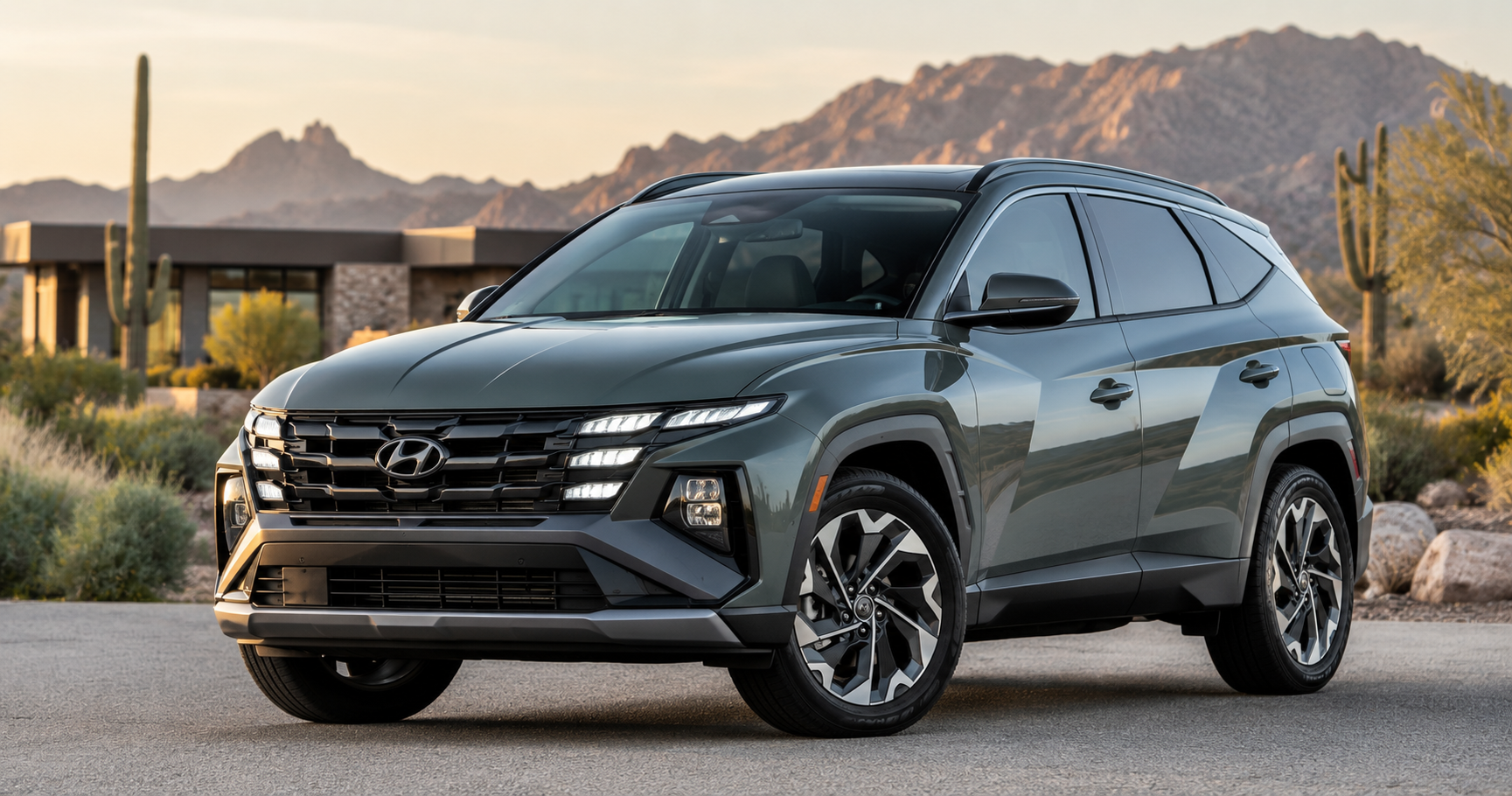
The 2026 Hyundai Tucson carries over unchanged after last year’s facelift, preserving a design customers already liked while retaining the updated interior’s physical buttons and knobs. With gas, hybrid and plug-in hybrid powertrains available, the Tucson continues to offer buyers several ways to power the popular crossover.
2026 Hyundai Tucson Keeps Its Updated Design
Hyundai redesigned the Tucson for 2025, and the 2026 model carries those changes forward without major alterations. The exterior looks only slightly different from the previous version, a deliberate decision because customers responded positively to the existing design.
An all-new Tucson is currently in development, but Hyundai did not see a need to radically change the exterior styling in the meantime.
The 2025 update brought a revised front end with a new lighting signature, reducing the number of light areas from 10 to eight. Hyundai also introduced different wheel designs.
Physical Buttons and Knobs Return
The larger changes are inside the cabin. Higher trims of the pre-facelift Tucson used touch-capacitive controls for functions such as climate and audio, but the updated model replaces them with more traditional controls.
The interior has a simpler steering wheel, a more open center console and more physical buttons and knobs. Hyundai also added physical shortcut buttons that give drivers quick access to menus, while dedicated volume and tuning knobs make basic audio controls easier to use.
A new 12.3-inch touchscreen is paired with either a 12.3-inch gauge cluster or a smaller 4.2-inch multi-information display. The setup gives the cabin a more modern appearance than the previous split arrangement.
The redesigned center console also provides more open storage space for items such as phones and keys. A shelf in front of the passenger adds another useful storage area.
Gas, Hybrid and Plug-In Hybrid Powertrains
Hyundai continues to offer the Tucson with gas, hybrid and plug-in hybrid powertrains, recognizing that not every driver is ready to switch to an electric vehicle.
The gas-powered Tucson uses a 187-horsepower 2.5-liter four-cylinder paired with an eight-speed automatic. The combination is not the preferred choice here, but it gives buyers another option.
The Tucson Hybrid uses a smaller 1.6-liter turbo-four combined with an electric motor to produce 231 hp. It is also more fuel efficient, achieving 36 mpg combined compared with 26 mpg for the all-wheel-drive gas model.
Tucson PHEV Adds Power and Electric Range
The Tucson plug-in hybrid increases total output to 268 hp and provides a 32-mile electric range from a 13.8 kWh battery.
In testing, the Tucson PHEV reached 60 mph in 7.14 seconds. By comparison, the latest Toyota RAV4 PHEV takes 5.4 seconds and produces 324 hp.
The additional power does not fully offset the added battery weight, making the PHEV less compelling despite its electric range.
Tucson Hybrid Is the Preferred Choice
The Tucson did not need a dramatic facelift, and Hyundai’s decision to preserve much of the existing design while addressing customer feedback has made the crossover stronger.
The Tucson Hybrid stands out as the preferred choice in the lineup, with pricing ranging from around $30,950 for the base SE to $41,825 for the Limited.
The PHEV starts at $40,325 for the SEL and reaches $48,550 for the Limited. Even for drivers with short commutes who could make full use of its 32-mile electric range, the $6,725 premium would take a long time to offset.
A $7,500 federal tax credit previously made the PHEV a more straightforward choice, but that credit is now gone, making the plug-in hybrid more difficult to recommend.