
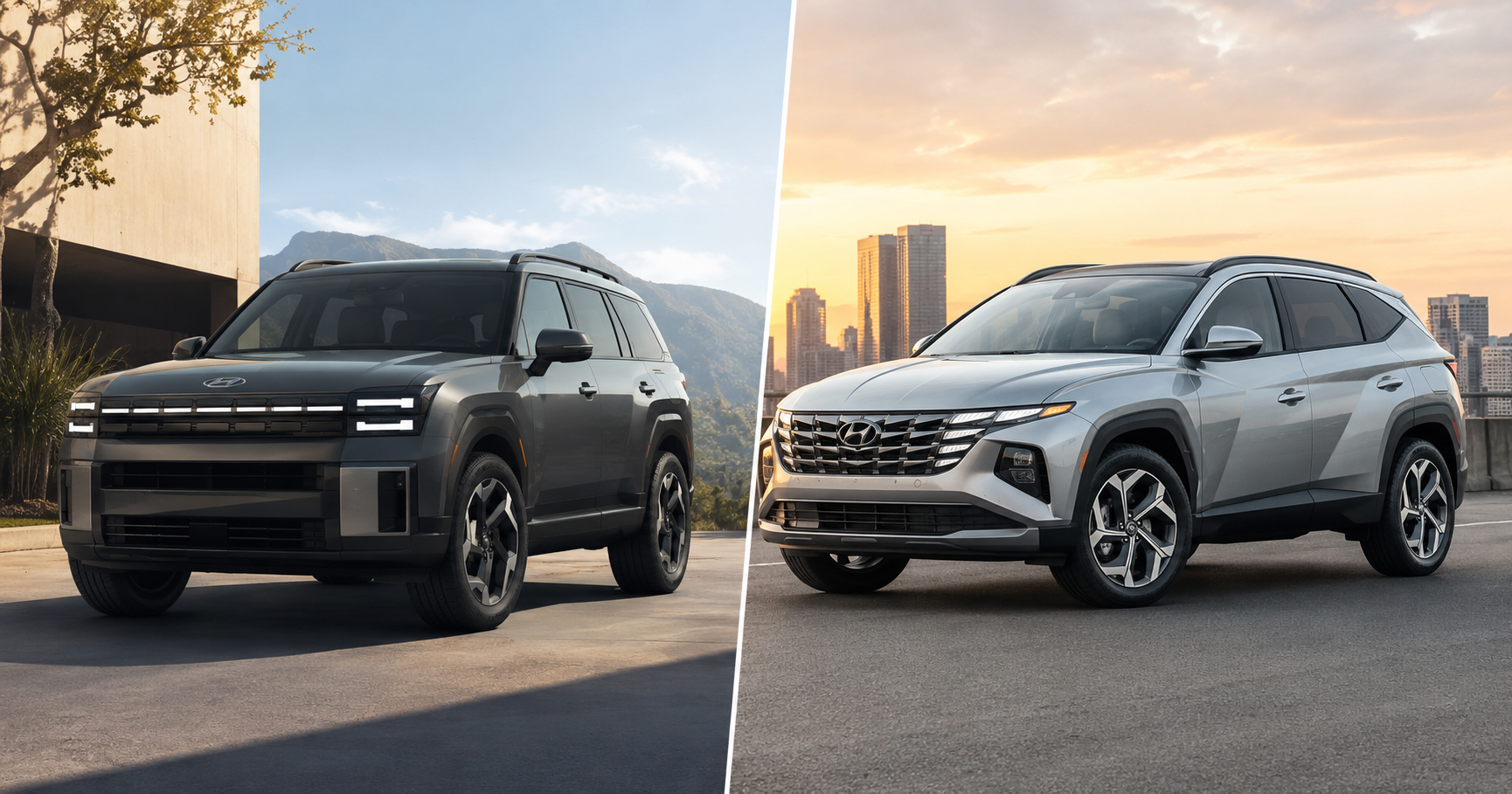
The 2027 Hyundai Tucson vs 2026 comparison is not a typical model-year update story. Hyundai has taken one of its most important global vehicles and given it a dramatically different identity, with a larger body, a boxier exterior, a completely redesigned cabin and a new technology direction centered on the company’s Pleos infotainment system.
That makes the new Tucson particularly interesting because the outgoing 2026 model was hardly a failure. It already offered a roomy interior, refined road manners, extensive technology and a distinctive design. The 2027 model instead appears to be Hyundai’s answer to an increasingly competitive compact SUV market, where buyers expect practicality but also want something that looks and feels more expensive.
So, what actually changed between the 2026 and 2027 Hyundai Tucson? Quite a lot visually and dimensionally, while the mechanical story remains much less certain. Hyundai has revealed the next-generation Tucson primarily through its design, withholding complete technical specifications for now.
Here is everything we know about the 2027 Tucson vs 2026 Tucson comparison, including size, styling, interior technology, cargo and passenger space, expected engines, all-wheel drive, hybrid options and what buyers should realistically expect when the new model reaches showrooms.
2027 Hyundai Tucson vs 2026: The Biggest Changes at a Glance
The easiest way to understand the new Tucson vs old Tucson debate is to separate the confirmed changes from the details Hyundai has not yet announced.
- Exterior: The 2027 Tucson receives a completely redesigned, more upright and angular body.
- Dimensions: The new model is longer, wider and taller, with a longer wheelbase.
- Interior: The cabin gets a completely new dashboard and a more premium appearance.
- Infotainment: Hyundai’s new Pleos software platform is expected to become a central part of the cabin experience.
- Rear-seat access: Rear doors open to 83 degrees instead of 73 degrees.
- Rear headroom: Second-row headroom increases by 1.1 inches.
- Powertrains: Hyundai has not yet released complete specifications for the next-generation model.
- Gas, hybrid and plug-in hybrid: The existing lineup is expected to remain an important part of the Tucson strategy, although final specifications have not been confirmed.
- XRT: Hyundai has shown that a new Tucson XRT is planned.
- Sportier variants: An N Line or N version remains unconfirmed, although at least one has reportedly been rumored.
In other words, the 2027 Hyundai Tucson vs 2026 story is primarily about a major generational redesign rather than a simple refresh.
2027 Tucson vs 2026 Tucson: A Completely New Design
The most obvious difference is the exterior.
The 2026 Tucson already has a distinctive appearance, but the 2027 model pushes Hyundai’s design philosophy considerably further. Instead of simply sharpening the existing shape, Hyundai has created a more upright, architectural SUV with pronounced horizontal lines, squared-off surfaces and heavily sculpted fenders.
The approach follows the broader design direction established by Hyundai’s newer Santa Fe and Palisade. Those vehicles adopted boxier proportions to emphasize their outdoor-oriented character. The Tucson takes that formula and applies it to a smaller, more urban-focused crossover.
A More Upright, Architectural Shape
The new Tucson’s proportions are immediately recognizable as those of a larger vehicle. The body is longer and wider, while the wheelbase has also grown. Hyundai has used that additional size not simply to make the SUV look imposing but to create more usable space inside.
The design also introduces a stronger visual contrast between horizontal and vertical surfaces. Instead of the softer crossover appearance found on many compact SUVs, the 2027 Tucson looks almost deliberately geometric.
That is a significant distinction in the Tucson redesign comparison. Hyundai isn’t merely changing headlights, bumpers and trim. It is changing the visual character of the vehicle.
New Lighting Defines the Front and Rear
Lighting is another major part of the transformation.
The 2027 Tucson uses a slim front light bar for the daytime running lights, complemented by a full-width rear lighting treatment. An illuminated H motif appears at both ends, reinforcing the connection between the front and rear designs.
The result is considerably more futuristic than the outgoing model. Yet Hyundai has avoided making the Tucson look like a dedicated concept vehicle. The overall shape remains recognizable as a practical compact crossover.
This matters because styling is one of the areas where the new Tucson could have the biggest impact on showroom traffic. The current model is attractive, but the 2027 version appears designed to be instantly recognizable from across a parking lot.
2027 Hyundai Tucson vs 2026 Dimensions
One of the clearest advantages of the 2027 model is that Hyundai has confirmed its dimensions.
The next-generation Tucson grows in almost every direction. The body is longer, wider and taller, while the wheelbase increases by more than an inch.
| Dimension | 2027 Hyundai Tucson | 2026 Hyundai Tucson | Change |
|---|---|---|---|
| Wheelbase | 109.6 inches | 108.5 inches | +1.1 inches |
| Length | 185 inches | 182.7 inches | +2.3 inches |
| Width | 75 inches | 73.4 inches | +1.6 inches |
| Height | 66.3 inches | 65.6 inches (FWD) | About +0.7 inch |
| Second-row headroom | 40.6 inches | 39.5 inches | +1.1 inches |
These numbers tell an important part of the story. The 2027 Tucson is not simply styled to look larger. It actually occupies more space on the road.
The biggest dimensional gain is in length, with an additional 2.3 inches. The wheelbase grows by 1.1 inches, which can help Hyundai create additional passenger room without simply stretching the body ahead of and behind the wheels.
The width increase is also substantial at 1.6 inches. That should contribute to a more spacious cabin and potentially provide additional shoulder room, although Hyundai has not yet published every interior measurement.
Rear Doors Open Wider
One of the less glamorous changes could actually be among the most useful.
The rear doors of the 2027 Tucson open to 83 degrees, compared with 73 degrees on the outgoing vehicle.
That 10-degree increase should make it easier to load passengers, child seats and bulky objects into the rear of the SUV. It is the kind of engineering change that may not appear prominently in advertising but can make a meaningful difference in everyday use.
Is the 2027 Tucson Bigger Inside?
The evidence strongly suggests that interior space is one of the main reasons Hyundai increased the Tucson’s exterior dimensions.
Second-row headroom rises from 39.5 inches in the 2026 Tucson to 40.6 inches in the 2027 model. That is an increase of 1.1 inches, giving rear passengers additional space above their heads.
The larger body should also help Hyundai maintain one of the current Tucson’s strongest attributes: practicality.
The 2026 Tucson already provides a spacious rear seat and useful cargo area compared with many compact crossovers. Hyundai therefore appears to be improving an existing strength rather than abandoning it.
2027 Tucson Interior vs 2026: The Cabin Gets a Major Overhaul
The interior may ultimately be just as important as the exterior in the 2027 Tucson vs 2026 Tucson comparison.
The outgoing Tucson has a modern cabin with digital displays, physical climate controls and a straightforward layout. The next-generation model takes a much more premium approach.
Hyundai has redesigned the dashboard around a large central touchscreen and a slim digital instrument display positioned directly in front of the driver.
The horizontal dashboard architecture, soft-looking materials, ambient lighting, light-colored upholstery and available-looking wood trim give the new cabin an upscale appearance.
In fact, the interior appears to borrow heavily from Hyundai’s broader next-generation cabin philosophy, including the layout shown in the redesigned Elantra.
The Return of Physical Controls
One welcome detail is that Hyundai has not completely abandoned conventional controls.
Despite the large touchscreen, a row of physical controls remains underneath the display. That could be an important usability advantage for drivers who prefer tactile controls for frequently used functions.
The 2026 Tucson already uses a separate control panel for climate functions, and the new design appears to preserve the idea that not every function needs to be buried inside a touchscreen menu.
For a family-oriented SUV, that is a sensible approach.
Hyundai Pleos Could Be the Biggest Technology Change
Technology is where the 2027 Hyundai Tucson vs 2026 comparison becomes particularly interesting.
Hyundai is moving toward its new Pleos software ecosystem, and the redesigned Tucson is expected to become one of the vehicles using the company’s new infotainment system.
Hyundai has not confirmed the final screen size for the Tucson. However, the design shown suggests a large central display, and the hardware could potentially resemble the larger screens used elsewhere in Hyundai’s lineup.
It is important not to treat an exact screen size as confirmed yet. Hyundai’s reveal was primarily visual, and complete technical specifications have not been released.
What Pleos Means for the New Tucson
The significance of Pleos goes beyond simply giving the Tucson a larger touchscreen.
Hyundai is developing Pleos as a broader software platform, meaning future vehicles can share a more consistent digital experience. For Tucson buyers, that could eventually mean a more modern interface, improved connectivity and a software architecture designed to evolve over the vehicle’s life.
The 2026 Tucson already offers Apple CarPlay, Android Auto, digital key technology and other connected features. The 2027 model therefore does not need to introduce connectivity from scratch. Instead, the goal appears to be creating a more sophisticated digital environment.
2027 Hyundai Tucson vs 2026: What About the Engines?
This is where buyers should be careful.
Hyundai has not yet provided complete powertrain specifications for the new Tucson. Because the 2027 model is a major redesign, it would be tempting to assume that the company will introduce an entirely new engine lineup. There is currently no basis for making that claim.
The more reasonable expectation is that Hyundai will continue to offer versions of the existing gas, hybrid and plug-in hybrid strategies, potentially with engineering improvements.
2026 Tucson Gas Engine
The 2026 Tucson uses a 2.5-liter four-cylinder gasoline engine producing 187 horsepower. It is paired with an eight-speed automatic transmission and can be configured with front-wheel drive or all-wheel drive.
The engine delivers adequate performance, but acceleration is not a major strength of the current Tucson. Buyers looking for stronger acceleration have a more compelling alternative in the Tucson Hybrid.
Hybrid and Plug-In Hybrid Models
The current Tucson lineup also includes hybrid and plug-in hybrid powertrains.
The hybrid combines a turbocharged 1.6-liter four-cylinder engine with an electric motor. The plug-in hybrid uses the same basic 1.6-liter turbocharged engine but adds a more powerful electric motor and a larger battery.
Whether those exact configurations carry into the 2027 model remains to be confirmed. Still, Hyundai’s decision to maintain a broad range of electrified Tucson variants would make sense given the importance of the nameplate.
Will the 2027 Tucson Still Offer AWD?
Everything currently points toward the Tucson continuing to offer a front-wheel-drive architecture with all-wheel drive available.
That would preserve one of the current model’s most important selling points. Compact SUV buyers often want the efficiency and packaging advantages of a crossover without giving up the additional traction associated with an AWD system.
Hyundai has also confirmed that a new Tucson XRT is planned, suggesting that the company intends to maintain an adventure-oriented version of the SUV.
2027 Tucson XRT, N Line and Possible Performance Versions
The XRT story is considerably clearer than the performance story.
Hyundai has shown that the next-generation Tucson XRT is planned. That version should continue the more rugged visual theme associated with the current XRT formula.
The future of the N Line is less certain.
The U.S. previously received a Tucson N Line, but that model was discontinued for 2026. Unlike a true high-performance model, the previous N Line emphasized sportier styling without adding extra horsepower.
Hyundai has not confirmed whether the 2027 Tucson will receive a new N Line or a full N performance version. At least one has been rumored, but buyers should treat that as speculation until Hyundai makes an official announcement.
2027 Hyundai Tucson vs 2026: What Hasn’t Changed?
Ironically, one of the most important parts of the comparison may be what Hyundai has chosen not to change.
The Tucson is one of Hyundai’s best-selling vehicles globally and a particularly important model in the United States. According to the supplied research, Hyundai sold about 234,000 Tucsons last year, with the Elantra finishing roughly 86,000 units behind it.
That commercial success gives Hyundai a reason to avoid unnecessary mechanical risks.
The company has radically changed the exterior and interior, but the underlying formula remains familiar: compact crossover dimensions, practical passenger space, front-wheel drive with available all-wheel drive, and gas and electrified powertrain choices.
That could make the 2027 model a relatively safe generational transition mechanically while being much more ambitious aesthetically and technologically.
2026 Hyundai Tucson: What Buyers Still Get
The 2026 Tucson remains an appealing vehicle for buyers who do not need the latest generation.
Its strengths include a comfortable ride, quiet highway behavior, a roomy cabin and useful cargo capacity. It is not the sportiest compact SUV, but it delivers a relaxed driving experience that suits commuting and family use.
The 2026 Tucson also starts at $31,350 and reaches $41,325 depending on trim and options, according to the supplied research.
For shoppers focused on value rather than having the newest design, the outgoing Tucson could become particularly interesting as the next-generation model approaches dealerships.
2026 Tucson Performance and Efficiency
The standard 187-horsepower 2.5-liter four-cylinder is paired with an eight-speed automatic transmission. Front-wheel-drive models are EPA-rated at 25 mpg city, 33 mpg highway and 28 mpg combined, while all-wheel-drive models are rated at 24 mpg city, 30 mpg highway and 26 mpg combined.
The current model can tow up to 2,000 pounds, although an optional trailer hitch is required.
Those numbers show why Hyundai may have little reason to completely abandon the existing mechanical formula. The Tucson is designed primarily as a practical compact crossover rather than a performance SUV.
Interior and Cargo: 2026 Tucson vs 2027 Tucson
The current Tucson’s interior is already one of its better attributes.
Behind the second row, the 2026 model accommodated nine carry-on suitcases in testing cited by the supplied research. With the rear seatbacks folded, that figure increased to 22 carry-on bags.
The 2027 Tucson’s larger dimensions should help preserve or improve that practical character, although Hyundai has not yet released a complete cargo-capacity figure for the redesigned vehicle.
That distinction matters. It is reasonable to expect additional usable space from the larger body, but it would be inaccurate to claim a specific cargo-volume increase until Hyundai publishes the official measurement.
Infotainment: 2026 Tucson vs New Tucson
The 2026 Tucson offers a 12.3-inch infotainment system, with an available larger display arrangement that combines digital gauges and infotainment screens beneath a broad housing.
Apple CarPlay and Android Auto are standard, while available features include SiriusXM, a Bose audio system and Hyundai’s digital key smartphone functionality.
The 2027 Tucson takes the technology concept in a new direction with its large central display and Pleos-based software architecture.
For buyers who prioritize technology, this could become one of the strongest reasons to choose the new generation.
2027 Tucson vs 2026 Tucson: Which One Should You Buy?
The answer depends heavily on timing.
Buy the 2026 Tucson If…
- You need a vehicle before the new generation arrives.
- You prefer the current Tucson’s styling.
- You want established powertrain specifications rather than waiting for Hyundai to reveal the new lineup.
- You value potential deals on an outgoing generation.
- You do not need the newest infotainment technology.
Wait for the 2027 Tucson If…
- You want the latest Tucson design.
- You value additional exterior dimensions and rear-seat headroom.
- You want the new interior architecture.
- You are interested in Hyundai’s Pleos infotainment system.
- You want the newest generation of the Tucson XRT.
- You can wait for Hyundai to reveal final powertrain, pricing and equipment information.
Why the 2027 Tucson Could Be a Bigger Deal Than It Looks
At first glance, the new Tucson may seem like another styling-heavy redesign. But the changes suggest something more strategic.
Hyundai is increasing the vehicle’s physical footprint while simultaneously upgrading its interior technology and premium presentation. That combination could make the Tucson more competitive not only with mainstream compact SUVs but also with vehicles that charge more for upscale design and technology.
The key is that Hyundai has not sacrificed practicality in pursuit of style. The new model remains a compact crossover, gains rear headroom, opens its rear doors farther and retains the general SUV formula that made the outgoing Tucson successful.
For Hyundai, that may be the smartest approach. The company does not need to reinvent what works. It needs to make the Tucson more desirable without compromising the qualities that made it a volume seller.
2027 Hyundai Tucson vs 2026: Final Verdict
The 2027 Hyundai Tucson vs 2026 comparison reveals a much more substantial transformation than the model-year numbers might suggest.
The 2027 Tucson is longer, wider and taller, rides on a longer wheelbase and offers more second-row headroom. Its exterior is dramatically more angular and upright, while the cabin moves toward a premium, horizontal design with a large touchscreen and slim digital instrument display.
The biggest unanswered question is the mechanical package. Hyundai has not yet disclosed complete powertrain specifications, so buyers should not assume that horsepower, fuel economy, battery capacity or hybrid output will remain identical to the 2026 model.
Still, the available information points toward evolution rather than revolution underneath the skin. The new Tucson is expected to retain the broad formula of gasoline, hybrid and plug-in hybrid powertrains, with front-wheel drive and available all-wheel drive.
Ultimately, the 2027 Tucson appears to be Hyundai’s attempt to make a proven compact SUV feel significantly more upscale and technologically advanced without losing its practicality.
For shoppers deciding between the new Tucson vs old Tucson, the choice may therefore come down to one simple question: do you want the proven vehicle that is already available, or are the new model’s design, larger dimensions and next-generation technology worth waiting for?
2027 Hyundai Tucson vs 2026: Frequently Asked Questions
What is the biggest difference between the 2027 and 2026 Hyundai Tucson?
The biggest difference is that the 2027 Tucson is an entirely redesigned next-generation model. It features a significantly boxier exterior, a redesigned premium-looking interior, larger dimensions, more second-row headroom and a new infotainment direction centered around Hyundai’s Pleos software.
Is the 2027 Hyundai Tucson bigger than the 2026 Tucson?
Yes. The 2027 Tucson is 185 inches long versus 182.7 inches for the 2026 model. Its wheelbase increases from 108.5 to 109.6 inches, while width grows from 73.4 to 75 inches. Second-row headroom increases from 39.5 to 40.6 inches.
Will the 2027 Hyundai Tucson have Pleos?
The redesigned Tucson is expected to use Hyundai’s new Pleos infotainment system, based on the interior design shown by Hyundai. However, complete technical details have not yet been released.
Will the 2027 Tucson have the same engine as the 2026 Tucson?
Hyundai has not released complete powertrain specifications for the 2027 Tucson. The current 2026 model uses a 187-horsepower 2.5-liter four-cylinder, while hybrid and plug-in hybrid versions use a turbocharged 1.6-liter engine with electric motors. Hyundai is expected to maintain a broad powertrain strategy, but final 2027 specifications remain unconfirmed.
Will the 2027 Hyundai Tucson have all-wheel drive?
The Tucson is expected to continue offering front-wheel drive with all-wheel drive available. Hyundai has not yet published the complete technical specifications for every 2027 configuration.
Will there be a 2027 Tucson XRT?
Yes. Hyundai has shown that a new Tucson XRT is planned for the next generation.
Will Hyundai make a 2027 Tucson N Line?
Hyundai has not confirmed a 2027 Tucson N Line. The U.S. previously received a Tucson N Line, but that version was discontinued for 2026. A new N Line or N model has been rumored, but it should not be considered confirmed until Hyundai makes an official announcement.
How much does the 2026 Hyundai Tucson cost?
The supplied research lists the 2026 Hyundai Tucson at $31,350 to $41,325 depending on trim and options. Official 2027 pricing has not yet been provided.
Should I buy the 2026 Tucson or wait for the 2027 model?
Buy the 2026 Tucson if you need a vehicle now or prefer its established powertrain and equipment. Waiting for the 2027 Tucson makes more sense if you want the dramatically redesigned exterior, larger dimensions, new cabin and next-generation infotainment technology.