
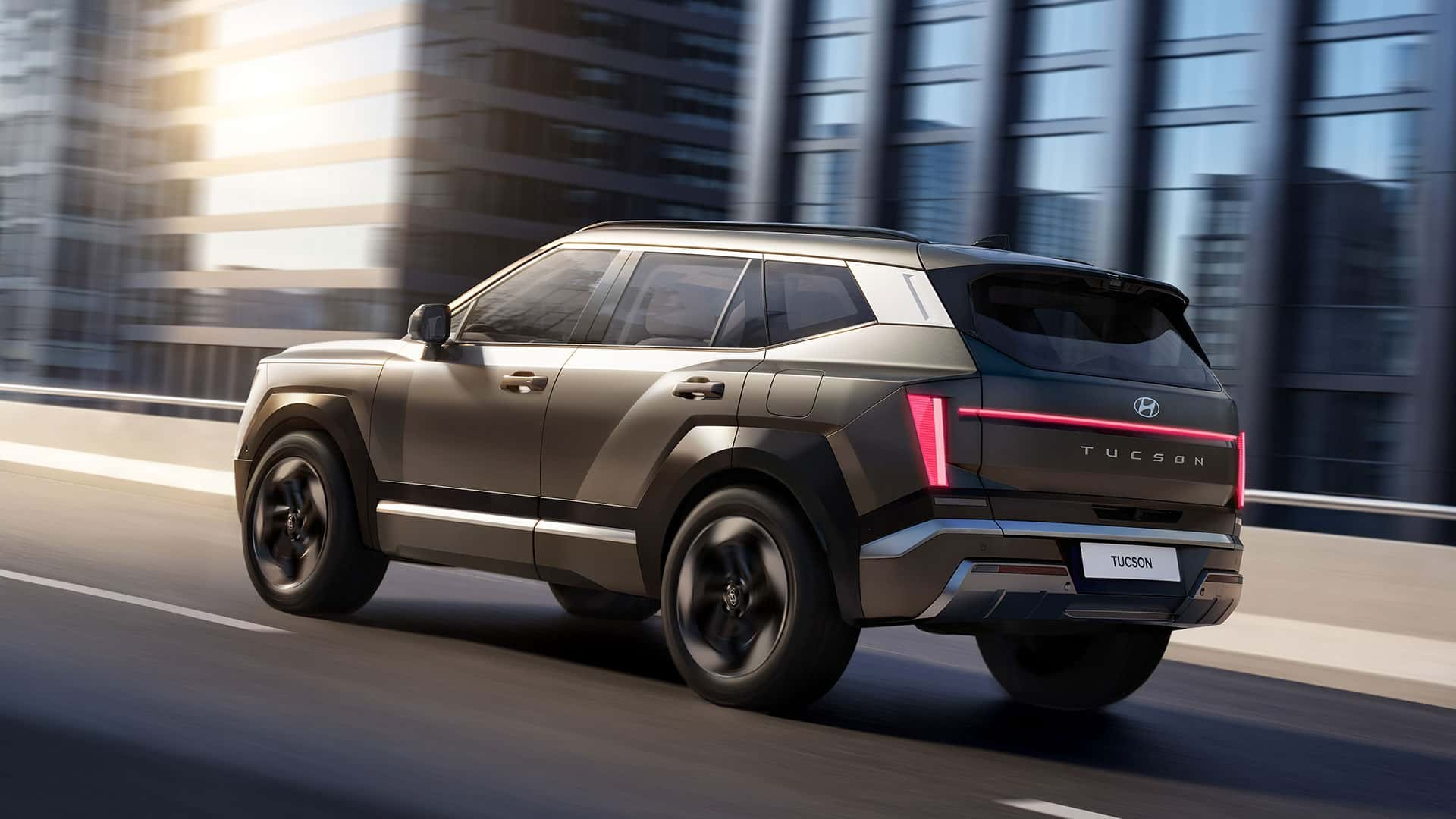
The 2027 Hyundai Tucson Pleos could give Hyundai’s best-selling U.S. compact SUV one of its biggest technology upgrades yet. Hyundai has revealed the redesigned fourth-generation Tucson primarily through its exterior and interior design, but the automaker has not released a full technical specification sheet. One of the most intriguing details is the possibility that the new SUV will use Hyundai’s new Pleos infotainment system.
That possibility matters because the Tucson is not an experimental nameplate for Hyundai. It is one of the company’s most important global vehicles and its sales leader in the United States by a significant margin. Hyundai moved 234,000 Tucson units last year, according to the information provided, putting it 86,000 units ahead of the Elantra.
For a vehicle with that kind of market importance, Hyundai has taken a surprisingly dramatic approach to the redesign. The new Tucson abandons much of the softer styling of the current model for a boxier, more architectural appearance, while the cabin moves in a noticeably more premium direction.
And sitting at the center of that redesigned interior is a large touchscreen that is expected to run Hyundai’s new Pleos software. Hyundai has not confirmed the screen size or the exact system configuration, so buyers will have to wait for additional information. But the design reveal already provides an unusually clear picture of where the next Tucson is heading.
What Is the 2027 Hyundai Tucson Pleos System?
At this stage, it is important to separate what Hyundai has confirmed from what remains speculation. The automaker’s reveal was primarily visual, and Hyundai has not released complete technical specifications for the new Tucson.
However, the redesigned cabin clearly shows a large central display positioned horizontally across the dashboard, accompanied by a slim digital instrument display in front of the driver. The available information indicates that the central screen will likely run Hyundai’s new Pleos infotainment system.
That makes the 2027 Hyundai Tucson Pleos combination particularly interesting. Instead of simply increasing screen size and removing physical controls, Hyundai appears to be pursuing a more integrated technology-focused cabin while retaining conventional controls underneath the main display.
The distinction is important. Modern vehicle interiors increasingly rely on large screens, but screen size alone does not determine whether an infotainment system is genuinely useful. The layout of the interface, the relationship between the driver display and central touchscreen, and the availability of physical controls can have an equally significant impact on everyday usability.
What Hyundai Has Confirmed
- The Tucson is entering its fourth generation.
- The exterior and interior have been completely redesigned.
- The new model is larger in almost every major dimension.
- The cabin features a large central touchscreen.
- A slim digital instrument display remains directly in front of the driver.
- Hyundai’s new Pleos infotainment system is expected to be used in the redesigned cabin.
- Hyundai has retained a row of physical controls underneath the main display.
- Complete technical specifications have not yet been released.
That last point is critical. Hyundai has not confirmed every detail surrounding the new infotainment setup, so claims about exact screen size, processor specifications, software features or connectivity capabilities should be treated as unconfirmed until Hyundai provides additional information.
Why Pleos Could Be Important for the New Tucson
Hyundai’s decision to introduce its new software direction in a vehicle as important as the Tucson would make strategic sense. The Tucson competes in one of the industry’s most crowded segments, alongside vehicles such as the Toyota RAV4 and Honda CR-V.
In that environment, technology has become an increasingly important part of the buying decision. Exterior styling can attract a customer to a showroom, but the interior experience often determines whether the vehicle feels modern once the driver gets behind the wheel.
The 2027 Hyundai Tucson Pleos could therefore become more than a software update. It may represent part of Hyundai’s broader effort to give mainstream vehicles a more sophisticated digital experience.
The redesigned Tucson already appears to be following that strategy visually. Hyundai has given the crossover a much more architectural cabin, premium-looking materials, ambient lighting and a horizontal dashboard layout. The infotainment display becomes the technological centerpiece rather than an isolated screen attached to an otherwise conventional dashboard.
A Bigger Screen Without Abandoning Buttons
One of the more notable details is what Hyundai has not removed.
Despite the presence of a large touchscreen, the redesigned Tucson retains a row of physical controls underneath the display. That could be an important advantage for drivers who prefer conventional controls for frequently used functions.
The approach also creates a useful division of labor. The touchscreen can handle navigation, media and other digital functions, while physical controls can remain available for functions where tactile feedback is helpful.
For buyers considering the 2027 Hyundai Tucson Pleos, this may ultimately be just as significant as the size of the screen itself.
2027 Tucson Technology: What We Know So Far
The new Tucson’s technology story extends beyond the infotainment system. Hyundai has redesigned the entire dashboard around a modern horizontal layout, with a slim instrument display positioned within the driver’s direct line of sight.
This arrangement closely follows the design direction Hyundai is also taking with its redesigned eighth-generation Elantra. The new Tucson therefore appears to be part of a larger design and technology strategy rather than an isolated experiment.
The cabin shown by Hyundai features soft-looking materials, light-colored upholstery, ambient lighting, perforated upholstery and wood trim. Together, those elements are intended to give the compact crossover an upscale character.
That is a significant shift for a vehicle competing in the mainstream compact SUV market.
The Driver Still Gets a Dedicated Display
Another interesting detail is the continued presence of a digital instrument cluster.
As automakers increasingly consolidate vehicle information into central displays, some manufacturers have experimented with simplifying the driver’s instrument area. Hyundai has taken a different approach with the new Tucson, retaining a dedicated slim display directly in front of the driver.
That should make basic driving information easier to access without forcing the driver to look toward the center of the dashboard.
It also gives the cabin a layered digital appearance: a dedicated driver display for essential information and a larger central screen for infotainment and other functions.
The New Tucson Touchscreen Could Be Larger Than the Elantra’s
Hyundai has not officially announced the exact size of the new Tucson’s central touchscreen. However, the available information suggests that it could potentially use a display similar to the 17-inch unit found in the Grandeur rather than the 14.6-inch setup associated with the redesigned Elantra.
That remains an expectation rather than a confirmed specification.
If Hyundai does use the larger display, it would give the 2027 Hyundai Tucson Pleos an especially prominent technology centerpiece. The screen would also fit naturally into the vehicle’s broader design philosophy, which emphasizes horizontal lines and a clean, architectural dashboard.
But there is an important distinction between having a large display and making good use of one. A huge touchscreen can look impressive in photographs while becoming frustrating if essential functions require too many menu layers.
That is why the retention of physical controls could be one of the smartest decisions Hyundai has made with the new cabin.
2027 Hyundai Tucson Pleos vs. the Current Tucson
The technology changes make more sense when viewed alongside the physical transformation of the vehicle.
The outgoing Tucson is already considered a stylish compact crossover, but Hyundai has taken the fourth-generation model in a dramatically different direction. The new vehicle uses a much boxier shape with pronounced horizontal elements, angular lighting and heavily sculpted bodywork.
The result is closer to the design language established by Hyundai’s latest Santa Fe and Palisade, but with a more architectural interpretation intended for an urban-oriented crossover.
The technology follows the same philosophy. Instead of merely refreshing the existing dashboard, Hyundai has redesigned the cabin around a large central screen, a slim driver display and a more premium arrangement of materials and lighting.
| Feature | 2026 Tucson | 2027 Tucson |
|---|---|---|
| Generation | Current generation | Fourth generation |
| Central infotainment | Current system | Large touchscreen expected to use Pleos |
| Driver display | Existing configuration | Slim digital display integrated into redesigned dashboard |
| Physical controls | Present | Physical controls retained below main display |
| Interior design | Current-generation layout | Completely redesigned, more premium appearance |
The 2027 Tucson Is Bigger, Too
The new infotainment system is only one part of the fourth-generation Tucson’s transformation. Hyundai has also increased the vehicle’s dimensions in almost every direction.
The wheelbase grows from 108.5 inches to 109.6 inches, an increase of 1.1 inches. Overall length increases from 182.7 inches to 185 inches, adding 2.3 inches to the vehicle’s footprint.
Width increases from 73.4 inches to 75 inches, while height rises to 66.3 inches. The result is a noticeably larger vehicle that should provide additional interior space.
2027 Hyundai Tucson Dimensions
| Dimension | 2027 Tucson | 2026 Tucson | Change |
|---|---|---|---|
| Wheelbase | 109.6 inches | 108.5 inches | +1.1 inches |
| Length | 185 inches | 182.7 inches | +2.3 inches |
| Width | 75 inches | 73.4 inches | +1.6 inches |
| Height | 66.3 inches | 65.6 inches (FWD) | +1.3 inches |
| Second-row headroom | 40.6 inches | 39.5 inches | +1.1 inches |
The rear doors also open to 83 degrees, compared with 73 degrees on the outgoing model. That 10-degree increase should make entering and exiting the rear seats easier, while the additional second-row headroom provides another tangible benefit of the larger body.
These changes are relevant to the technology story because the new Tucson is not simply a software refresh wrapped in familiar sheet metal. Hyundai is rebuilding the vehicle around a substantially different package.
2027 Hyundai Tucson Powertrain: What to Expect
Hyundai has not released complete powertrain specifications for the redesigned Tucson. However, the available information suggests that the automaker may be reluctant to make dramatic mechanical changes to a vehicle that is already performing strongly in the market.
The current gas, hybrid and plug-in hybrid powertrains are expected to carry over, potentially with changes designed to improve power and efficiency.
That would mean a standard 2.5-liter inline-four, a hybrid configuration pairing a turbocharged 1.6-liter four-cylinder with an electric motor, and a plug-in hybrid using the same 1.6-liter turbocharged engine with a more powerful electric motor and a larger battery.
The new Tucson is also expected to remain based on a front-wheel-drive platform while offering all-wheel drive.
None of those details should be considered final until Hyundai releases its complete specifications.
Could the Tucson Get Extended-Range EV Technology?
There is another unanswered technology question surrounding the new Tucson.
Hyundai CEO José Muñoz has said the automaker will launch its first extended-range electric vehicles next year. However, there is currently no confirmation that the redesigned Tucson will be among the first Hyundai models to receive that technology.
For now, the Tucson’s electrification strategy appears more straightforward: retain the existing hybrid and plug-in hybrid options while Hyundai evaluates where its next-generation electric technology fits into the lineup.
That cautious approach would also make sense given the Tucson’s importance to Hyundai’s sales performance.
2027 Tucson Interior: A More Premium Direction
If the exterior is the most obvious change, the interior may be the more important transformation for everyday owners.
Hyundai has moved away from a conventional compact crossover dashboard and toward a cleaner, wider design. The horizontal arrangement makes the cabin appear broader, while the large touchscreen becomes a central visual element.
The materials shown in Hyundai’s reveal reinforce that impression. Light-colored upholstery, ambient lighting, wood trim and perforated surfaces create a more upscale environment than buyers might expect from a mainstream compact SUV.
This is where the 2027 Hyundai Tucson Pleos story becomes particularly compelling. Hyundai isn’t simply adding a new infotainment system to the existing vehicle. The software appears to be part of a larger cabin redesign that combines digital technology with conventional controls and premium visual elements.
A Cabin Designed Around Horizontal Lines
The horizontal dashboard theme is consistent with the exterior design language. Hyundai has emphasized horizontal elements at both ends of the vehicle, including its slim lighting signatures.
Inside, that philosophy translates into a wide dashboard with the central screen and driver display integrated into the overall structure.
The result should make the cabin feel less like a collection of individual screens and more like one unified design.
What the Pleos Infotainment System Could Mean for Buyers
For consumers researching Tucson Pleos infotainment, the most important takeaway is that Hyundai has not yet revealed enough information to judge the system’s complete functionality.
What can be evaluated now is the hardware and interface philosophy shown in the design reveal.
- A large central display: The touchscreen is positioned as the centerpiece of the dashboard.
- A dedicated driver display: Essential information remains directly in front of the driver.
- Physical controls: Hyundai has retained conventional controls below the main screen.
- Premium presentation: Ambient lighting and higher-end materials complement the digital technology.
- A unified design: The infotainment system is integrated into a horizontal dashboard rather than appearing as a separate tablet-style addition.
That combination could make the new Tucson particularly appealing to buyers who want modern technology without an entirely touchscreen-dependent cabin.
When Will the 2027 Hyundai Tucson Go on Sale?
Hyundai is expected to begin selling the redesigned Tucson late this year or early next year, with the vehicle expected to go on sale in Korea later this year and other markets likely following in 2027.
That timing means additional information should emerge before the vehicle reaches U.S. dealerships. Hyundai has yet to provide complete technical specifications, including final infotainment details, exact touchscreen size and full powertrain information.
For shoppers, that makes the current reveal more of a preview than a complete buying guide.
Should You Wait for the 2027 Hyundai Tucson?
For buyers who are considering a compact SUV now, the answer depends on priorities.
The current Tucson remains an established model, while the 2027 redesign promises a completely different appearance, a larger body, a redesigned interior and potentially Hyundai’s newest infotainment technology.
Waiting could make particular sense for shoppers who prioritize cabin design and technology. The combination of the new touchscreen, expected Pleos software and larger dimensions represents a substantial change from the current model.
On the other hand, buyers who prefer confirmed specifications may want to wait until Hyundai publishes the full details. The company has intentionally kept much of the mechanical and technical information under wraps.
Reasons to Watch the 2027 Tucson
- Completely redesigned fourth-generation model.
- Much more distinctive boxy exterior.
- Larger dimensions and increased second-row headroom.
- New premium-oriented interior.
- Large central touchscreen.
- Expected Hyundai Pleos infotainment system.
- Dedicated digital driver display.
- Physical controls retained beneath the main screen.
- Gas, hybrid and plug-in hybrid configurations are expected to continue.
- Tucson XRT is planned to return.
2027 Hyundai Tucson Pleos: What Remains Unconfirmed?
Despite the amount of information revealed through the design presentation, several important questions remain unanswered.
Hyundai has not provided the final powertrain specifications, exact infotainment screen size or a complete description of the Pleos system’s functionality. The company also has not confirmed whether the new Tucson will receive a sportier N Line or N variant.
At least one sportier version has been rumored, while the previous Tucson N Line was discontinued in the United States for 2026. Hyundai has confirmed that a new Tucson XRT is planned.
There is also no confirmation that the Tucson will be one of Hyundai’s first vehicles to receive its upcoming extended-range EV technology.
Those unanswered questions are likely to become clearer as the launch approaches.
The Bottom Line
The 2027 Hyundai Tucson Pleos is shaping up to be much more than a routine model-year update. Hyundai has completely redesigned its compact crossover, increasing its dimensions while giving it a radically different visual identity.
The interior follows the same philosophy. A large central touchscreen, slim digital driver display, ambient lighting and premium-looking materials create a cabin that appears to target a higher class of vehicle. Most importantly for buyers interested in Hyundai’s next generation of in-car technology, the central display is expected to use the company’s new Pleos infotainment system.
Hyundai is still keeping the technical details secret, so it would be premature to judge the final software experience or declare the Tucson a segment leader based solely on the design reveal.
But the direction is clear.
The fourth-generation Tucson combines a bigger body, a bolder exterior, a more sophisticated interior and a potentially significant technology upgrade. If Hyundai delivers on the promise of the new Pleos system while maintaining the practical controls shown in the reveal, the 2027 Tucson could have one of the more compelling technology-and-design combinations in the mainstream compact SUV segment.
Frequently Asked Questions About the 2027 Hyundai Tucson Pleos
What is the 2027 Hyundai Tucson Pleos system?
The 2027 Hyundai Tucson Pleos is expected to use Hyundai’s new Pleos infotainment system through its large central touchscreen. Hyundai has not yet released complete technical specifications for the system, so its final features and capabilities remain unconfirmed.
Will the 2027 Hyundai Tucson have a large touchscreen?
Yes. Hyundai’s design reveal shows the redesigned Tucson with a large central touchscreen. The exact screen size has not been officially confirmed, although the available information suggests it could potentially use a display similar to the 17-inch unit found in the Grandeur.
Will the new Tucson have physical buttons?
Yes. The redesigned cabin shown by Hyundai retains a row of physical controls underneath the large central display, despite the vehicle’s increased reliance on digital technology.
What is Hyundai Pleos?
Hyundai Pleos is the automaker’s new infotainment and software direction referenced in the redesigned Tucson. The new model’s central touchscreen is expected to run the system, although Hyundai has not yet released all of its technical details.
Will the 2027 Tucson be bigger?
Yes. The new Tucson is longer, wider and taller than the 2026 model. Its wheelbase increases to 109.6 inches, overall length reaches 185 inches, width increases to 75 inches and height reaches 66.3 inches.
How much more rear-seat headroom does the new Tucson have?
The redesigned Tucson has 40.6 inches of second-row headroom, compared with 39.5 inches in the 2026 model, an increase of 1.1 inches.
Will the 2027 Tucson have hybrid and plug-in hybrid models?
The available information indicates that the current Tucson’s gas, hybrid and plug-in hybrid powertrains are expected to carry over, potentially with improvements to power and efficiency. Hyundai has not yet released complete specifications.
Will the Tucson have all-wheel drive?
The new Tucson is expected to continue using a front-wheel-drive platform while offering all-wheel drive. Final specifications have not yet been announced.
Will the Tucson XRT return?
Yes. Hyundai has shown that a more rugged Tucson XRT is planned for the new generation.
Will there be a 2027 Tucson N Line or N model?
Hyundai has not confirmed a new N Line or N version. At least one sportier variant has been rumored, but the automaker has not provided official confirmation.
When will the 2027 Hyundai Tucson arrive?
The redesigned Tucson is expected to go on sale in Korea later this year, with other markets likely following in 2027. Hyundai has also indicated a late-this-year or early-next-year arrival timeframe.