Mitsubishi is stepping up its electrification strategy as part of its Momentum 2030 turnaround plan, with the 2027 Eclipse Sportback EV joining updated hybrid versions of the Outlander. After a difficult 2025 and a weak start to 2026, the automaker is targeting a sharp increase in full-year sales through a broader range of new products and segments.
Mitsubishi Expands Its Electrified Lineup
Mitsubishi, the smallest of the Japanese automotive brands from the U.S. perspective, saw sales fall nearly 14% in 2025 following the discontinuation of the Mirage and years of limited product offerings and marginal brand awareness.
Sales have moved into the black in recent months after a weak launch to 2026. The automaker is now relying on a product offensive at the center of its Momentum 2030 turnaround plan, including new models and product segments such as a midsize pickup scheduled to arrive next year.
Electrification is also a key part of the strategy. Mitsubishi introduced the i-MiEV battery-electric vehicle in Japan in 2006, followed by the U.S. version in 2011. With its marginal 62-mile range, the i-MiEV never became a significant seller, and Mitsubishi pulled it from the market in 2017.
The automaker is now returning to the segment with the new Eclipse Sportback EV. Mitsubishi also launched its first plug-in hybrid, the Outlander PHEV, in 2013, with the model eventually reaching the U.S. in 2018.
2027 Mitsubishi Eclipse Sportback EV
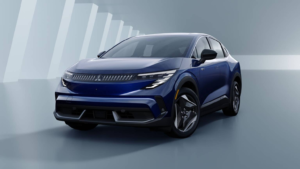
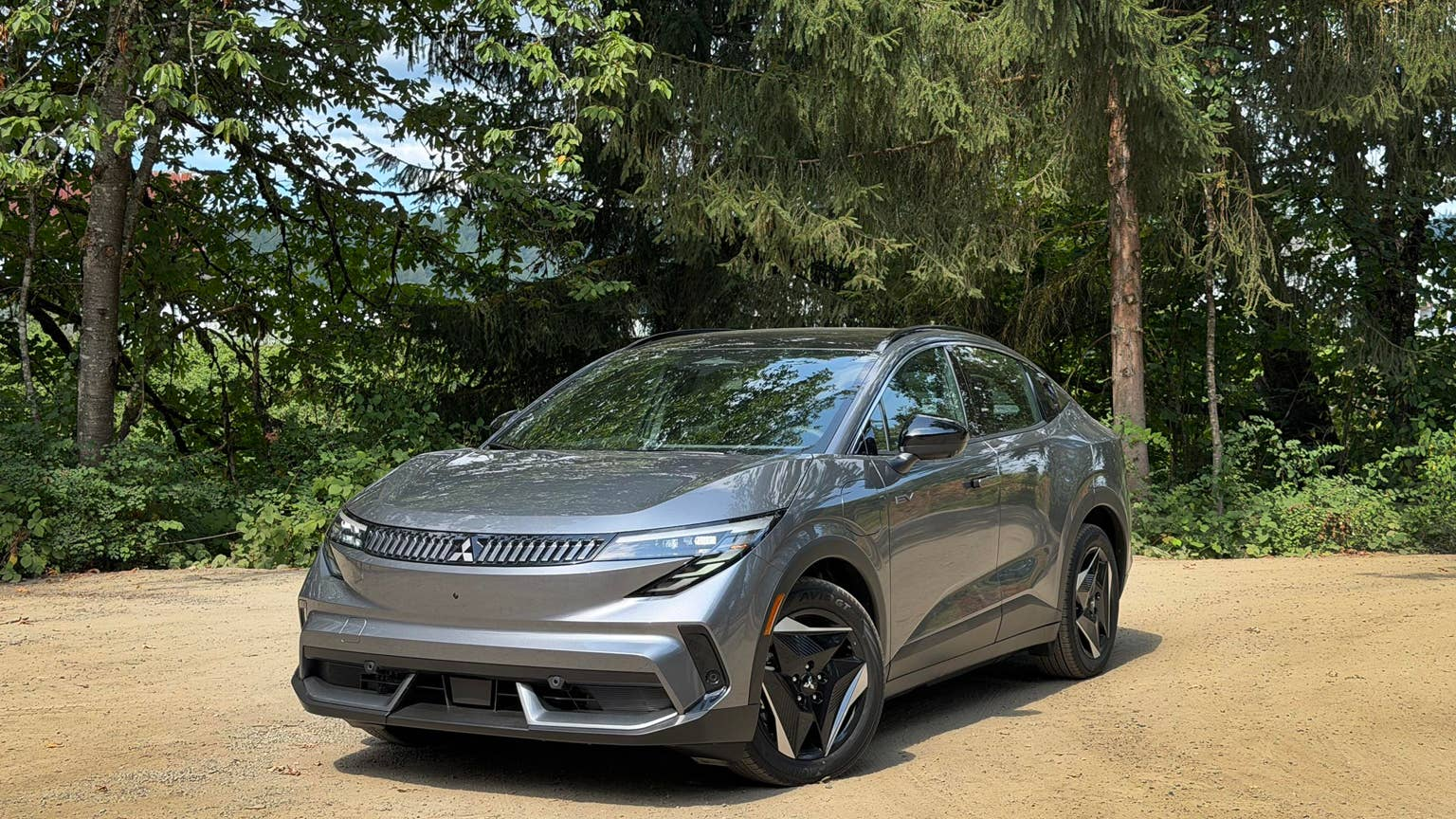
The 2027 Mitsubishi Eclipse Sportback EV is a new addition to the lineup and should not be confused with the older Eclipse Cross. The Sportback comes from Mitsubishi’s alliance with Nissan and is based on the familiar Leaf EV.
Mitsubishi has made several design changes intended to give the Sportback a more “athletic” and “dynamic” appearance. The revisions include the headlights and taillights, bumpers and grille, along with unique interior details.
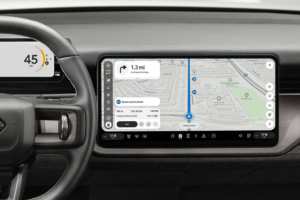
The cabin features dual 14.3-inch gauge and infotainment displays. Mitsubishi will offer the Sportback in a single trim with minimal options, reflecting the expectation that U.S. sales of the EV will be modest.
Among the standard features is the Google Automotive infotainment system, including a navigation voice assistant and access to apps through the Google store. Instead of a conventional moonroof, electrochromic glass can switch from transparent to opaque at the touch of a button and provides more headroom than a manual or power shade.
A fully flat floor creates substantial legroom, including for the middle rear passenger, although fitting three adults in the back is best reserved for situations when necessary. Maximum cargo capacity is factory-rated at 56 cubic feet.
Eclipse Sportback EV Range and Charging
The Eclipse Sportback EV and Nissan Leaf share a single electric motor that drives the front axle. The motor produces 214 hp and 261 lb-ft of torque and draws power from a 75-kWh lithium-ion battery.
The Sportback has an EPA-rated range of 282 miles. Using a DC quick charger, charging from 10% to 80% can take as little as 35 minutes. With a 240-volt Level 2 charger, charging from 20% to 80% can take as little as 6.5 hours.
One distinctive feature is the presence of two charging ports, positioned on opposite sides of the front fenders. One is a NACS port that provides access to the Tesla Supercharger network, while the other uses a J1772 plug for Level 1 and Level 2 charging.
Driving the Eclipse Sportback EV
The Eclipse Sportback EV and Leaf are essentially identical from a driving perspective. They are reasonably quick away from the line but do not deliver the acceleration of some battery-powered competitors from Hyundai and Kia.
Neither automaker provides acceleration figures, but a rough test suggests 0-60 mph times of around 7 seconds. The ride is reasonably smooth, while handling is acceptable given the vehicle’s total mass and large battery pack.
Noise cancellation was another strong point during the drive. One drawback is the absence of a true 1-Pedal mode capable of slowing the Eclipse Sportback to a complete stop through brake-pedal modulation.
The e-Pedal system instead uses regenerative braking to slow the crossover. At around 5 mph, however, that effect largely fades and requires brake pressure. Once stopped, the vehicle begins creeping forward if the driver lifts off the brake, similar to a vehicle with an internal combustion engine.
2026 Mitsubishi Outlander Hybrid Options
Mitsubishi offers two hybrid choices for buyers seeking additional mileage and performance from the Outlander SUV: a mild hybrid and a plug-in hybrid.
The mild-hybrid system replaces the conventional starter and alternator with a BSG, or belt starter generator. The 48-volt system enables a smooth Stop/Start function during situations such as waiting at a light, ATM or fast-food line while also providing additional power.
Paired with a 1.5-liter turbo-four gas engine, the mild hybrid produces 174 hp and 206 lb-ft of torque through a CVT gearbox. That represents a 25 lb-ft increase for the 2026 model year.
The mild-hybrid Outlander can be ordered with either front-wheel drive or Mitsubishi’s Super-All Wheel Control system.
Outlander PHEV Gets More Battery Range
The upgraded Outlander HEV is scheduled to arrive in late 2026 with a larger battery pack powering twin electric motors. Battery capacity increases from 20 to 22.7 kWh, while range rises from 38 miles per charge to 45 miles.
The electric drivetrain works with a 2.4-liter internal combustion engine operating in the efficient Atkinson cycle. Combined output reaches 297 hp and 332 lb-ft.
Mitsubishi claims an estimated 420 miles of driving on a full tank and charge. For a large percentage of drivers, the pouch-type battery cells provide enough energy for typical day-to-day chores or commutes.
Outlander Mild Hybrid vs. Plug-In Hybrid
The two Outlander hybrid systems deliver noticeably different experiences on the road. The BSG system provides a modest boost at launch in the mild hybrid, an important benefit when moving more than 4,000 pounds with a 1.5-liter gas engine.
Most of that additional boost arrives during the initial launch, with 0-60 mph acceleration estimated at about 8 seconds. The mild hybrid is also less smooth and quieter than the plug-in version, while its light, relatively numb steering adds to its straightforward driving character.
The mild hybrid is positioned as the choice for buyers on a moderately tight budget or those who view driving primarily as transportation from one point to another with minimal involvement.
The Outlander PHEV offers a different character. Some owners will focus on reducing fuel consumption by operating in all-electric mode as often as possible, switching drive settings to maximize range and using light throttle inputs.
Other drivers can take advantage of the instant torque from the electric motors while the internal combustion engine revs up. Based on the drive, 0-60 mph acceleration appears to be in the mid-6-second range, substantially increasing the Outlander’s fun-to-drive factor.
The PHEV comes exclusively with all-wheel drive, which is a plus for drivers in wet and snowy conditions. Despite its more aggressive acceleration, the plug-in Outlander was also found to be quieter and more confidence-inspiring than the mild-hybrid alternative.
2027 Mitsubishi Eclipse Sportback EV Pricing and Availability
Final pricing for the 2027 Mitsubishi Eclipse Sportback EV has not yet been announced. Based on a comparably equipped Nissan Leaf, the Sportback is expected to cost somewhere between $33,000 and $36,000.
The Mitsubishi includes a longer warranty than the Nissan Leaf, covering five years or 60,000 miles bumper-to-bumper and 10 years or 100,000 miles on the powertrain and battery. It also includes two years of free maintenance.
For the 2026 Mitsubishi Outlander PHEV, pricing is expected to range from $45,000 to $56,000 depending on trim and options. The mild-hybrid version is expected to run from around $30,000 to $32,000.
A $1,745 destination fee applies to all of these figures. The Eclipse Sportback EV, updated Outlander PHEV and mild-hybrid Outlander represent Mitsubishi’s latest push to expand its electrified offerings as the automaker works toward its Momentum 2030 turnaround plan.