Range remains one of the biggest questions for anyone shopping for an electric SUV. But in 2026, the conversation has changed. The best electric SUVs are no longer simply trying to break the 300-mile barrier; the leaders are pushing toward 400 and even 450 miles on a single charge.
For shoppers searching for the EV Crossover SUV Best Range 2026, the choices now extend from efficient luxury crossovers to large three-row models with enormous battery packs. The Lucid Gravity can deliver up to 450 miles, while the Rivian R1S reaches 410 miles in Max Pack form. At the other end of the spectrum, models such as the Hyundai Ioniq 9 offer a more attainable combination of range, space and fast charging.
There is an important catch, however: maximum range is not the whole story. Battery size, efficiency, charging speed, vehicle size, price and real-world driving conditions can dramatically change the ownership experience.
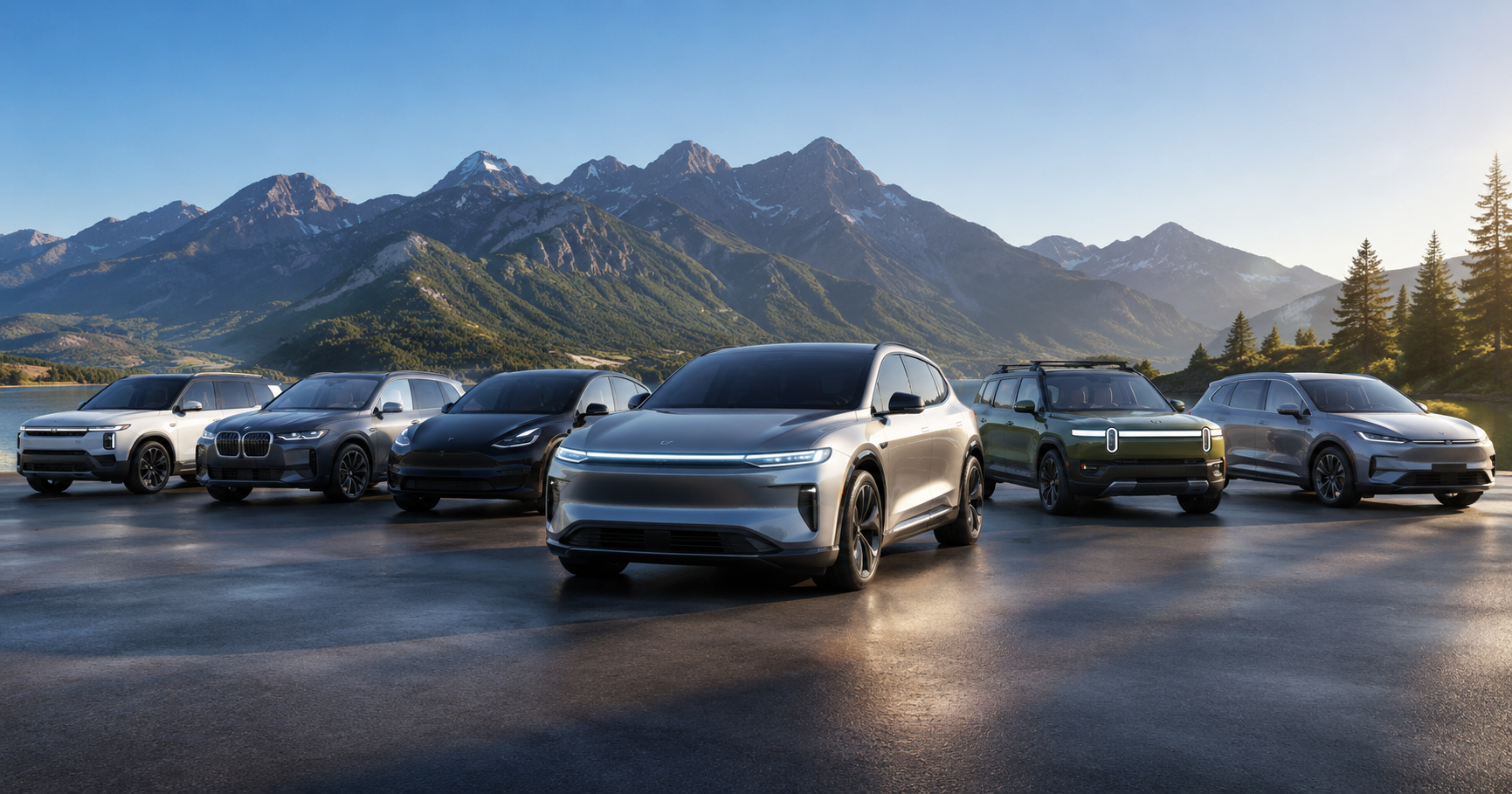
Here are the seven long-range electric SUVs that stand out in 2026, based on the research and U.S. automotive sources provided for this article.
The 7 Best Long-Range Electric SUVs for 2026
- Cadillac Escalade IQ / IQL — approximately 460–465 miles
- Lucid Gravity Grand Touring — up to 450 miles
- Rivian R1S Max Pack — up to 410 miles
- Mercedes-Benz EQS SUV — up to 390 miles
- BMW iX xDrive60 — up to 364–380 miles
- Tesla Model X — up to 352 miles
- Polestar 3 — up to 342 miles
These figures vary by trim, battery configuration and wheel choice, so buyers should always verify the exact configuration before making a purchase decision.
1. Cadillac Escalade IQ / IQL: The Range Leader on Paper
Maximum range: approximately 460–465 miles
Starting price in the supplied research: $130,300+
If maximum driving range is the only objective, the Cadillac Escalade IQ sits at the top of the 2026 discussion. The Escalade IQ is listed at roughly 465 miles, while the longer IQL version is cited at about 460 miles.
That makes the large Cadillac particularly interesting for buyers who want a full-size luxury electric SUV without accepting the charging stops associated with many other large EVs.
There is, however, an important efficiency lesson behind that impressive number. The Escalade IQ reportedly uses a massive 215-kWh battery to achieve roughly the same range that the Lucid Gravity reaches with a 123-kWh pack.
In other words, the Cadillac demonstrates one way to achieve exceptional range: carry a very large battery.
Why the Escalade IQ stands out
- Approximately 460–465 miles of claimed range.
- Full-size luxury SUV proportions.
- Extremely large battery capacity.
- Available in IQ and IQL configurations.
- Ideal for shoppers prioritizing maximum range and large-SUV capability.
For consumers simply asking, “What EV SUV has the longest range?” the Escalade IQ deserves to be near the top of the answer based on the supplied research.
2. Lucid Gravity: The Efficiency Champion
Maximum range: 450 miles
Price cited in the research: $81,550
The Lucid Gravity may be the most interesting vehicle in the entire long-range EV SUV market because its advantage isn’t just range. It is efficiency.
The Grand Touring version is rated at up to 450 miles while using a 123-kWh battery. The research calculates approximately 3.7 miles per kWh, making the Gravity exceptionally efficient for a large electric SUV.
That distinction matters. A vehicle that reaches 450 miles with a relatively smaller battery can potentially offer advantages in weight, energy consumption and charging strategy compared with a much larger vehicle carrying an enormous battery.
Road & Track highlighted the contrast between the two range leaders, noting that the Escalade IQ requires a 215-kWh battery for its claimed range while the Gravity reaches a comparable figure with 123 kWh. WardsAuto likewise highlighted the Gravity’s 450-mile capability and approximately 3.7 miles-per-kWh efficiency.
Why the Lucid Gravity is such a strong choice
- Up to 450 miles of range.
- 123-kWh battery.
- Approximately 3.7 miles per kWh.
- Three-row seating.
- Up to 828 horsepower according to the supplied research.
- 400-kW fast-charging capability.
Car and Driver gives the Gravity a 10/10 and ranks it highly across several luxury SUV categories. That makes it more than a range champion; it is positioned as a broadly capable luxury electric SUV.
The real-world range question
There is a reason buyers should not treat a 450-mile EPA estimate as a guarantee of 450 miles on every trip.
Edmunds tested a Gravity and recorded 400 miles, below its 450-mile EPA estimate. That difference illustrates why EPA ratings should be treated as a standardized comparison tool rather than a promise of exactly how far every driver will travel.
Speed, temperature, wheel size, terrain and driving style can all influence actual energy consumption.
3. Rivian R1S Max Pack: Long Range Meets Off-Road Ability
Maximum range: 410 miles
Price cited in the research: $78,885
The Rivian R1S takes a different approach to the long-range SUV formula. Rather than focusing primarily on luxury-road-trip efficiency, the R1S combines substantial range with three-row practicality and serious off-road capability.
The Max Pack version is listed at up to 410 miles, putting it comfortably above the 400-mile threshold.
For families who regularly travel long distances but don’t want a traditional luxury crossover, that combination could be particularly compelling.
Rivian R1S strengths
- Up to 410 miles of range.
- Three-row seating.
- Strong off-road capability.
- Quick acceleration.
- Distinctive interior and exterior design.
The trade-offs include a relatively high price compared with some competitors and the lack of Apple CarPlay and Android Auto cited in the research.
4. Mercedes-Benz EQS SUV: A Luxury Long-Distance Cruiser
Maximum range: approximately 390 miles
Price cited in the research: $89,950
The Mercedes-Benz EQS SUV remains an important contender for buyers who value luxury and long-distance comfort.
Its approximately 390-mile figure places it below the 400-mile threshold, but that is still considerably more range than many electric SUVs offer.
The EQS SUV makes the most sense for someone who views an electric SUV as a premium highway cruiser rather than simply a transportation appliance. Its position in the rankings also demonstrates how quickly the upper end of the EV SUV market has moved toward 400 miles.
The research uses a Carfax range figure for the EQS SUV, so shoppers should check the exact model year, trim and configuration when comparing it with the other vehicles on this list.
5. BMW iX xDrive60: Premium Performance With Strong Range
Maximum range: approximately 364–380 miles
Price cited in the research: $76,325
The BMW iX occupies an interesting position in the long-range electric SUV market. Its maximum range is below the leaders, but it still offers a strong combination of efficiency, performance and premium interior quality.
The supplied research cites a range of approximately 364 to 380 miles depending on the source and configuration.
For buyers who don’t necessarily need 400-plus miles, the iX can represent a more balanced choice. Its appeal comes from what happens between charging stops: lively acceleration, smooth handling and a luxury-focused cabin.
BMW iX advantages and disadvantages
Advantages:
- Lively acceleration.
- Smooth handling.
- High-quality cabin.
- Strong technology package.
- More than 350 miles of potential range.
Disadvantages:
- No front trunk.
- Can become expensive with options.
The iX therefore makes sense for drivers who want a premium electric SUV without making absolute maximum range their only buying criterion.
6. Tesla Model X: Still a Major Long-Range Player
Maximum range: 352 miles
Price cited in the research: $91,380
The Tesla Model X no longer dominates the long-range SUV conversation the way it once did, but a claimed 352-mile range keeps it firmly among the notable choices in 2026.
The Model X continues to appeal to buyers looking for quick acceleration and a technology-heavy ownership experience.
Its distinctive falcon-wing doors remain one of its most recognizable features, although they are also part of the vehicle’s polarizing character.
Where the Model X fits
The Model X is not the most efficient SUV on this list, nor does it offer the longest range. But 352 miles is still enough to make it a serious option for many long-distance EV drivers.
The supplied research also identifies its relatively high price and lack of Apple CarPlay as potential disadvantages.
7. Polestar 3: A Stylish Long-Range Alternative
Maximum range: 342 miles
Price cited in the research: $68,900
The Polestar 3 rounds out this seven-SUV ranking with a maximum range of 342 miles.
That number is well below the 450-mile mark achieved by the Lucid Gravity, but it remains competitive in the broader electric SUV market.
More importantly, the Polestar 3 gives shoppers another option between mainstream electric SUVs and larger, significantly more expensive luxury models.
Its $68,900 figure in the supplied research makes it one of the more accessible vehicles among the seven finalists, although buyers should compare exact trims and equipment rather than relying exclusively on base pricing.
How the Seven Long-Range EV SUVs Compare
| Rank | Model | Maximum Range | Price Cited |
|---|---|---|---|
| 1 | Cadillac Escalade IQ / IQL | ~460–465 miles | $130,300+ |
| 2 | Lucid Gravity Grand Touring | 450 miles | $81,550 |
| 3 | Rivian R1S Max Pack | 410 miles | $78,885 |
| 4 | Mercedes-Benz EQS SUV | 390 miles | $89,950 |
| 5 | BMW iX xDrive60 | 364–380 miles | $76,325 |
| 6 | Tesla Model X | 352 miles | $91,380 |
| 7 | Polestar 3 | 342 miles | $68,900 |
The comparison shows why range alone can be misleading. The Escalade IQ has the highest quoted range, but the Gravity reaches almost the same distance with a dramatically smaller battery. Meanwhile, the Rivian adds off-road capability, and the lower-ranked BMW, Tesla and Polestar can still provide more than 340 miles in their strongest configurations.
What About More Affordable Long-Range Electric SUVs?
Not every shopper needs a $70,000-plus luxury EV. Several vehicles outside the seven finalists still offer more than 300 miles of range.
The research identifies the Hyundai Ioniq 9 at up to 335 miles, with a cited price of $60,555. It describes the Ioniq 9 as a strong value choice in the three-row category.
Other notable 300-plus-mile models include the Tesla Model Y, Chevrolet Blazer EV, Audi Q6 e-tron, Cadillac Lyriq, Chevrolet Equinox EV, Kia EV6, Hyundai Ioniq 5 and Toyota bZ, depending on configuration and source.
Hyundai Ioniq 9: The Value Play
The Ioniq 9 deserves special attention for shoppers who want three-row practicality without stepping into the pricing territory of the Escalade IQ.
Its cited 335-mile range is not class-leading, but it is substantial enough for many drivers. The research also highlights its fast 800V charging architecture and genuine three-row space.
That makes the Ioniq 9 an example of an important point: the best EV SUV for an individual buyer isn’t necessarily the one with the highest EPA number.
Why Battery Efficiency Matters as Much as Range
One of the biggest lessons from the 2026 electric SUV market is that range and battery size should be evaluated together.
Imagine two SUVs that can both travel approximately 450 miles. One requires a 215-kWh battery while the other uses 123 kWh. Their headline range is similar, but their energy efficiency is dramatically different.
That’s essentially the distinction between the Cadillac Escalade IQ and Lucid Gravity highlighted by the research.
For consumers, efficiency can matter because it affects how much energy the vehicle consumes during a trip and provides another way to judge engineering efficiency beyond the EPA range number.
How Much EV Range Do You Really Need?
It is easy to assume that more range is always better. But the ideal range depends on how you drive.
A driver who travels 30 to 50 miles per day and charges at home may rarely benefit from a 450-mile SUV. Someone who regularly travels hundreds of miles between charging opportunities may value every additional mile.
Consider three hypothetical buyers:
The Daily Commuter
A driver with a short daily commute and reliable home charging may be perfectly comfortable with a 300-to-350-mile electric SUV. The vehicle can spend most nights plugged in, reducing the importance of maximum range.
The Road-Tripping Family
A family regularly traveling several hundred miles may benefit considerably from a 400-plus-mile EV. A larger range buffer can reduce the number of charging stops and make long trips easier to plan.
The Rural Driver
Someone who lives far from dependable public charging infrastructure may place even greater value on range. In this situation, the ability to start a journey with a large battery buffer can provide meaningful flexibility.
EPA Range vs. Real-World Range
One of the most important things to understand when shopping for a long-range EV SUV is that laboratory-tested ratings don’t guarantee identical real-world results.
The research cites a June 2026 BEV Database study covering 1,678 EVs. Across the vehicles studied, real-world range averaged 19.5% below official figures. In the United States, however, the gap relative to EPA ratings was reported at approximately 10.5%, compared with 24.6% below WLTP figures in Europe.
That makes the EPA number extremely useful for comparing vehicles, but it should not be interpreted as a guaranteed trip distance.
Highway speeds can reduce range. Cold weather can hurt efficiency. Heavy loads, aggressive acceleration, hills, towing and larger wheels can also change consumption.
August 2026: The EV Range Race Is Accelerating
The long-range SUV market is not standing still.
Several August 2026 developments show how rapidly manufacturers are pushing electric range beyond today’s U.S. leaders.
BMW reported an internal China road test in which a long-wheelbase iX3 traveled approximately 1,030 kilometers, or about 640 miles, on a single charge. The result exceeded its 919-km CLTC rating, with 5% battery remaining.
BYD also confirmed a Denza N8 with a claimed 1,003-km, or 623-mile, CLTC range using Blade Battery 2.0. Meanwhile, Hyundai has confirmed an extended-range Santa Fe EREV targeting more than 600 miles of combined range, while Genesis is planning an EREV SUV for early 2027 with a target above 640 miles.
These developments are significant, but American shoppers need to pay close attention to the testing standard.
Why CLTC Numbers Shouldn’t Be Compared Directly With EPA
Many of the eye-catching August range records use China’s CLTC testing cycle rather than the U.S. EPA procedure.
Those figures can be considerably higher than comparable EPA estimates. A 600-mile CLTC vehicle should therefore not automatically be interpreted as a 600-mile EPA vehicle in the United States.
For American consumers, EPA figures remain the more appropriate benchmark when comparing vehicles intended for the U.S. market.
Charging Speed Is the Other Half of the Range Equation
A vehicle with enormous range can still be inconvenient if it takes too long to recharge.
That’s why charging capability deserves almost as much attention as battery capacity when choosing a long-range EV SUV.
The Lucid Gravity, for example, is cited with 400-kW charging capability. The Hyundai Ioniq 9 is highlighted for its 800V charging system.
For long-distance drivers, fast charging can compensate for having somewhat less maximum range. A vehicle that charges quickly during a planned stop may be more convenient than a vehicle that travels farther but requires a longer charging session.
Is Range Anxiety Still a Problem in 2026?
Range anxiety has not disappeared, but its meaning is changing.
As more EVs cross the 300-mile threshold and some reach 400 or 450 miles, simply running out of energy is becoming less of a concern for many drivers.
The research suggests that charging reliability, charger location and charging cost are increasingly important concerns. In other words, the industry is gradually moving from “Will my EV make it?” toward “Will I find a working charger when I need one?”
Which Long-Range EV SUV Is Best for You?
The answer depends on what matters most.
- Best maximum range: Cadillac Escalade IQ/IQL.
- Best efficiency: Lucid Gravity.
- Best range plus off-road capability: Rivian R1S.
- Best luxury long-distance cruiser: Mercedes-Benz EQS SUV.
- Best premium balance: BMW iX.
- Best technology-focused alternative: Tesla Model X.
- Best lower-priced entry among the seven: Polestar 3.
- Best value-oriented three-row alternative: Hyundai Ioniq 9.
For a buyer whose only goal is to minimize charging stops, the Cadillac’s approximately 460–465-mile figure is difficult to ignore. But the Lucid Gravity arguably presents the more technically impressive solution because it combines 450 miles with much greater battery efficiency.
The Rivian R1S is the better answer for someone who wants long range without giving up adventure-oriented capability.
And for shoppers who don’t need 400-plus miles, the BMW iX, Tesla Model X, Polestar 3 and Hyundai Ioniq 9 demonstrate that there are several ways to get strong EV range without necessarily buying the most expensive model on the market.
Bottom Line: The Best EV Crossover SUV Range in 2026
The 2026 EV SUV market has reached a point where 300 miles is no longer an extraordinary target. The leading vehicles now approach or exceed 400 miles, while the Lucid Gravity and Cadillac Escalade IQ push the conversation toward 450 miles and beyond.
But the biggest lesson isn’t simply that EVs can travel farther. It is that manufacturers are taking different approaches to solving the range problem.
Cadillac uses a huge battery to achieve exceptional distance. Lucid emphasizes efficiency. Rivian combines range with rugged capability. BMW and Mercedes focus on premium comfort, while Tesla and Polestar offer alternative approaches to the luxury EV crossover.
That means the right choice isn’t necessarily the vehicle with the biggest number in the specification sheet. The best long-range electric SUV is the one whose range, charging speed, efficiency, price and practicality match the way you actually drive.
Frequently Asked Questions
What EV SUV has the longest range in 2026?
Based on the supplied research, the Cadillac Escalade IQ is listed at approximately 465 miles, with the Escalade IQL at about 460 miles. The Lucid Gravity follows closely with a 450-mile maximum range.
Which electric SUV has the best range for the price?
The answer depends on how price and range are weighted. The Lucid Gravity is particularly notable because its 450-mile range is paired with a cited price of $81,550, while the Hyundai Ioniq 9 offers 335 miles at a cited $60,555 and is identified in the research as a strong three-row value.
Is the Lucid Gravity the longest-range electric SUV?
The supplied sources place the Lucid Gravity at 450 miles, while the Cadillac Escalade IQ is cited at approximately 465 miles. However, the Gravity stands out for efficiency because it reportedly achieves its range using a 123-kWh battery.
How much real-world range can an EV SUV deliver?
Real-world range varies significantly with conditions. The supplied research cites a BEV Database study finding U.S. real-world range approximately 10.5% below EPA figures on average. Individual results can vary based on speed, weather, wheel size, terrain and driving behavior.
Why is my EV’s range lower than its EPA rating?
EPA testing uses standardized conditions, while real-world driving involves variables such as highway speeds, temperature, elevation changes, cargo, towing and driving style. Consequently, an EV’s actual range can be higher or lower than what the dashboard or EPA rating suggests.
Is the federal EV tax credit available in 2026?
No. According to the supplied research, the $7,500 new-EV credit and $4,000 used-EV credit ended for vehicles acquired after September 30, 2025. Buyers may still encounter state, utility or manufacturer incentives, depending on location and eligibility.
Are 600-mile electric SUVs available in the United States?
The research cites several 600-plus-mile announcements or test results, but some use China’s CLTC testing cycle rather than the U.S. EPA procedure. Therefore, those figures should not be treated as equivalent to 600-mile EPA ratings for U.S.-market vehicles.
Does a bigger EV battery always mean better range?
No. Battery size is only one part of the equation. Vehicle weight, aerodynamics, drivetrain efficiency and energy consumption all affect range. The Lucid Gravity is a useful example: the research says it achieves up to 450 miles from a 123-kWh battery, illustrating how efficiency can be just as important as battery capacity.
Is 300 miles of EV range enough?
For many drivers, yes. A 300-mile-plus EV can provide a substantial buffer for daily driving and road trips, particularly when home charging is available. Drivers who regularly travel very long distances or have limited access to charging may benefit from a 400-mile-plus model.