Mate Rimac, the CEO of Bugatti and his own hypercar company, believes electric vehicles will dominate the mainstream market while combustion engines remain in the upper reaches of the automotive world for a very long time.
Rimac Sees Two Different Automotive Markets
Speaking with CNBC, Rimac drew a clear distinction between how ordinary cars and high-end performance vehicles are likely to evolve.
“For normal cars, normal people, the vast majority [of future cars] will be electric,” Rimac said. But he does not expect that shift to extend all the way into the upper segment.
“The upper segment, like sports cars and upwards, are going to stay combustion for a very long time, exactly like watches,” he told CNBC.
Rimac compared the automotive market with the luxury watch industry. Only a small portion of the world’s watches are produced in Switzerland, yet nearly all of the industry’s profit sits there. In his view, a smartwatch may outperform a mechanical Patek Philippe in measurable functions, but “no one will pay $200,000 for it.”
Rimac believes hypercar customers could make a similar distinction, with function becoming less important beyond a certain price point and the emotional experience becoming more significant.
A Nevera and V16 Share a Croatian Production Line
Rimac’s position is particularly notable because his factory in Croatia currently builds the Nevera, described as arguably the most powerful production electric car on the planet.
That same production line also builds an enormous 8.3-liter V16, which is, by some measures, the biggest combustion engine currently in production anywhere.
“It’s kind of ironic that I’m now making the world’s biggest combustion engine,” Rimac admitted.
That engine powers the Tourbillon, Bugatti’s new flagship. The naturally aspirated V16 works with electric motors to produce combined output of somewhere around 1,800 horsepower, making the Tourbillon a hybrid rather than a pure EV.
“You have the crazy situation now at our facility in Croatia,” Rimac said. “On the same production line, you have the world’s most powerful electric car being built right next to the world’s biggest combustion engine. Life is strange sometimes.”
Why Rimac Still Sees a Place for Combustion
Rimac’s argument is tied to how accessible high performance has become through electric power. A mainstream EV selling for a fraction of the price of a hypercar can now outperform performance cars that were once considered flagship models, making outright acceleration less effective as a way to distinguish an expensive car from an ordinary one.
For Rimac, the difference is increasingly about craftsmanship and the experience surrounding the machine. He sees value in a vehicle that feels built rather than simply assembled, with its performance accompanied by mechanical drama rather than only a battery specification.
The BMW E30 That Started Rimac’s EV Career
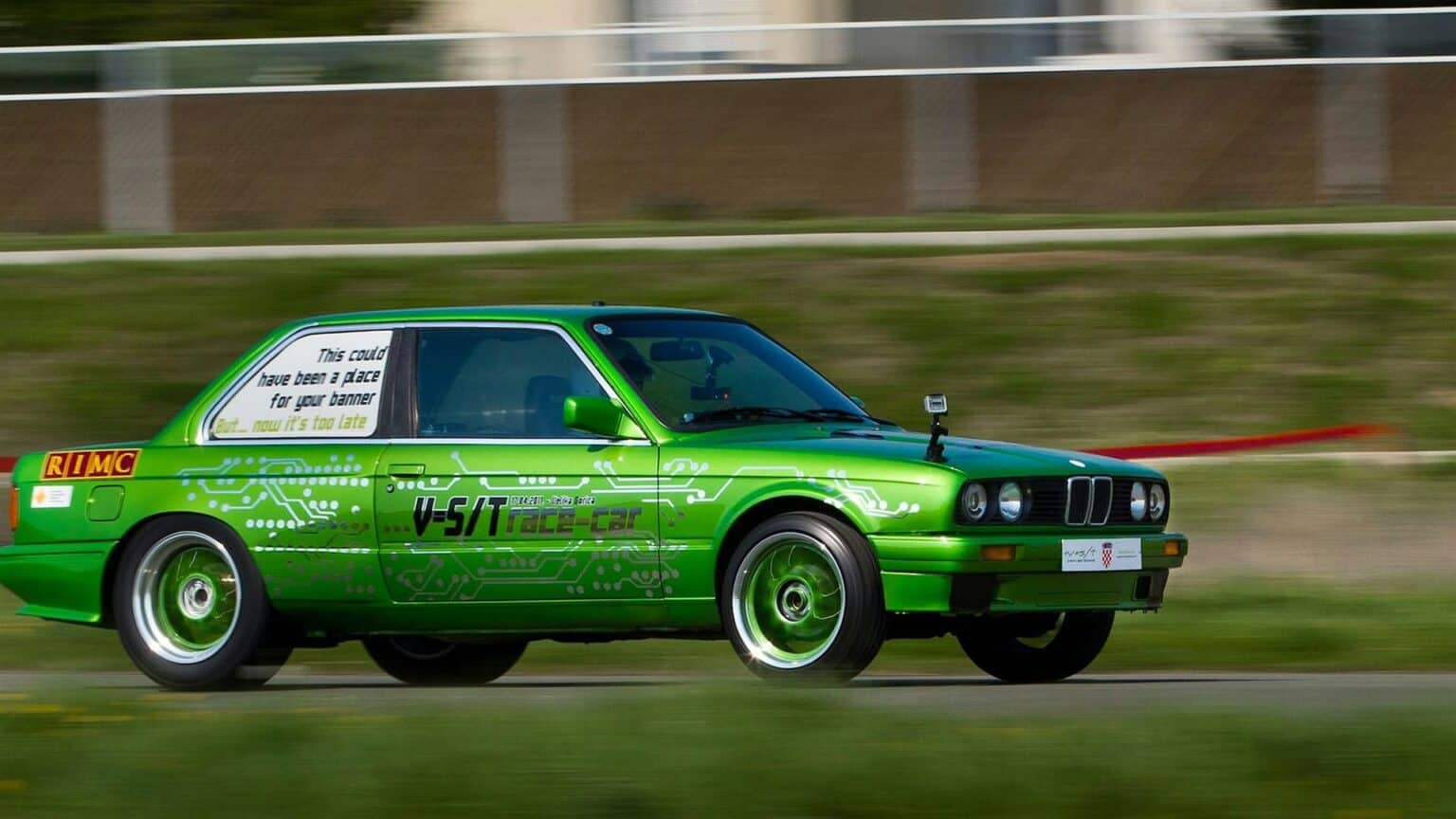
Rimac’s position is striking given that his career in electric vehicles began with a BMW. As a teenager racing a BMW 325i, he blew the engine. Rather than rebuilding it, he removed the gas powertrain and installed an electric drivetrain.
The project, based on a lesser E30 after its engine failed, introduced him to EV engineering. The car, nicknamed the “green monster,” went on to set world records for electric acceleration before Rimac had turned 21. The project also directly led to the founding of what became Rimac Automobili.
Rimac’s Personal Garage Still Favors German Cars
Despite building his career around electric technology, Rimac’s personal garage remains heavily German and heavily gas-powered.
He calls his BMW E30 M3 his “true love,” and the car is a rare Sport Evolution, one of only 600 ever built, with the 2.5-liter S14 engine.
His collection has also included a pair of M3 CSLs, a Z4 M and an E39 M5. He has also been linked to an M3 E90 and an F90 M5 Competition.
Rimac has discussed eventually building a V10-swapped restomod based on the same E30, although he has said the project will probably have to wait for retirement.
Rimac’s Combustion Argument Is Narrow
Rimac’s comments are not presented as a rejection of electric technology. His companies continue to push electric technology in areas including robotaxi development, high-voltage systems supplied to other automakers and battery technology for daily-driver EVs.
His argument for combustion engines is specifically focused on the hypercar tier. At the very top of the market, where a car also functions as a status object, Rimac believes buyers want the noise, complexity and sense of occasion associated with a large combustion engine.
BMW’s Flexible Drivetrain Strategy
The approach also aligns with the flexibility of BMW’s product lineup, which offers multiple drivetrain options. Its CLAR platform allows BMW to build gasoline, diesel, hybrid and electric cars on a single architecture.
At the same time, the NCAR (Neue Klasse) goes EV first for customers committed to electric vehicles. That gives BMW flexibility as the market changes and consumer preferences evolve.
For now, Rimac is making a clear distinction between the two ends of the market: batteries for the vast majority of future cars, while combustion engines remain, in his view, part of the experience at the highest end of the automotive world.