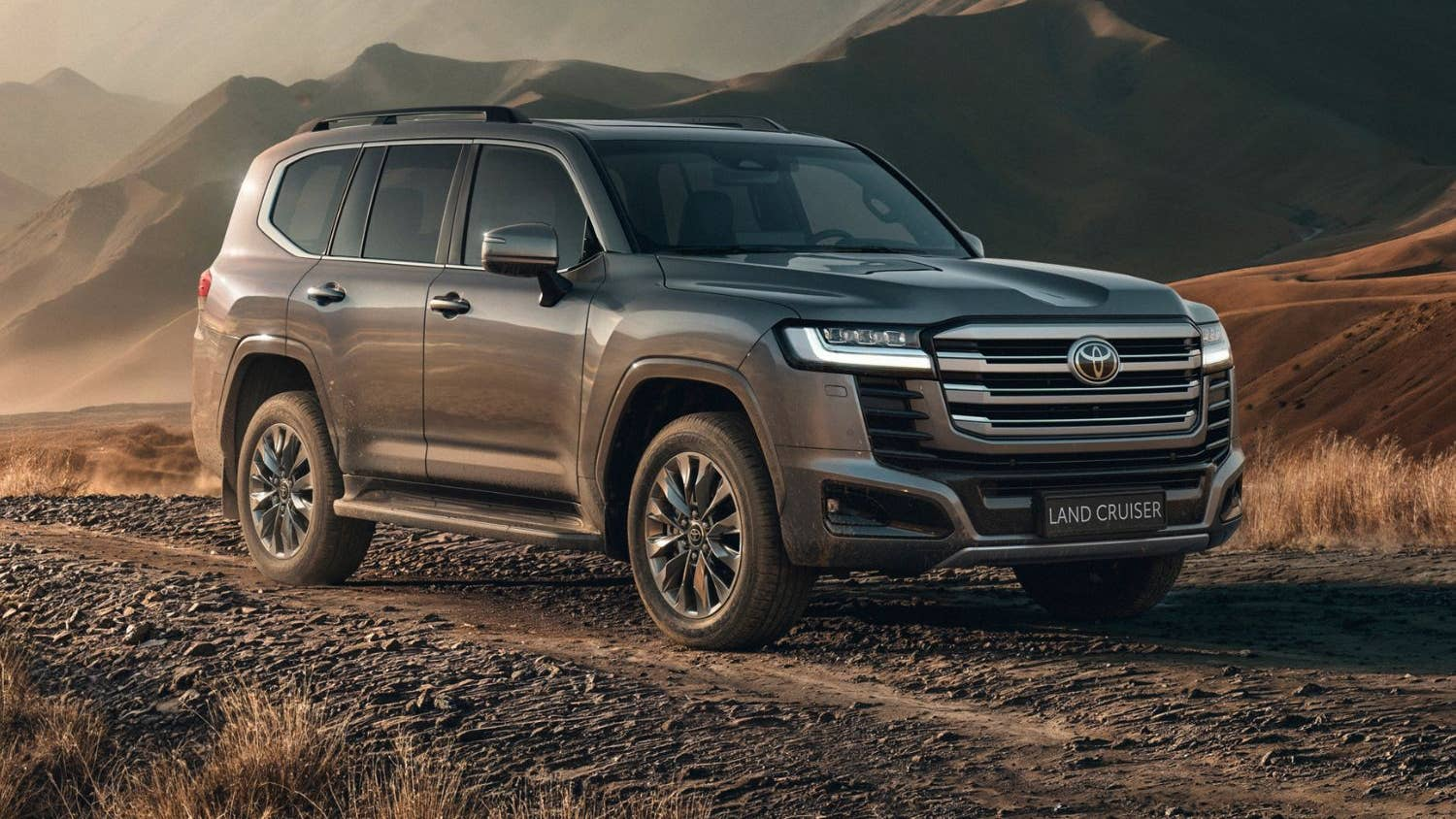
The Toyota Land Cruiser 300 Hybrid delivers more power and slightly better fuel economy than the standard model, but its smaller fuel tank creates a major range disadvantage. While the hybrid can be quicker and more efficient in town driving, the numbers show that it is not the long-distance range champion in the Land Cruiser lineup.
Why the Land Cruiser 300 Is Missing in North America
The Toyota Land Cruiser sold in the U.S. and Canada is not a direct successor to the previous models. Instead, it is the Prado, known in most markets as the Land Cruiser 250.
North America did not get the “proper” 300 Series model, mainly because many buyers chose its more expensive sibling, the Lexus LX, or opted for the larger but less expensive Sequoia.
Meanwhile, the Land Cruiser 300 Series continues to thrive, particularly in Asia and Oceania, where it remains a highly aspirational SUV. The model has also gained a hybrid version, marking a first for the full-size Land Cruiser line.
The Land Cruiser 300 Hybrid’s Power Advantage
The Land Cruiser 300 Hybrid would have been an appealing choice for buyers looking for a more subtle alternative to the Lexus LX 700h. The hybrid was first introduced in the Middle East in late 2025 before being rolled out to additional countries.
Like the LX 700h, the Land Cruiser 300 Hybrid pairs a 3.4-liter twin-turbo V6 with a single motor connected to a 1.87 kWh battery. The setup produces 457 hp and 583 lb-ft of torque.
That is a significant increase over the standard 3.4-liter V6, which is the same engine used in the LX 600 and produces 409 hp and 479 lb-ft of torque. The additional power is welcome, and the hybrid is also slightly quicker than the non-hybrid Land Cruiser.
Fuel Economy Comes With a Compromise
The hybrid’s fuel-economy advantage is modest. There are no official ratings for the Land Cruiser 300 Hybrid because it is not sold in the U.S., but EPA figures for the Lexus suggest that the electrified twin-turbo V6 provides roughly a 2 MPG advantage over the non-hybrid model.
That small improvement comes with an important trade-off: a smaller fuel tank. The standard Land Cruiser has a 21.1-gallon tank, while the hybrid is equipped with a 17.9-gallon tank.
As a result, the non-hybrid Land Cruiser can travel slightly farther between fill-ups despite consuming more fuel. Some markets offer a 25.8-gallon tank for the hybrid, but the gas/diesel version can also be ordered with a 29-gallon tank.
The Diesel Land Cruiser Wins on Range
The Land Cruiser 300 Hybrid makes the most sense for drivers who spend considerable time in traffic and want a little more performance from the twin-turbo V6. But for genuine long-range driving, the diesel model has the clear advantage.
Toyota Australia claims combined fuel consumption of 8.9 liters per 100 km for the diesel model, which works out to roughly 26.3 MPG. With a 29-gallon fuel tank, that translates to more than 760 miles of range.
By comparison, the EPA estimates that the LX 700h with its 17.9-gallon tank can travel as far as 358 miles. Even if the Land Cruiser Hybrid used the larger 25.8-gallon tank, its estimated range would be about 516 miles between fill-ups, based on Toyota Australia’s claimed fuel economy of 10 liters per 100 km, or 23.5 MPG.
The diesel’s range advantage is substantial, although diesel fuel is not exactly cheap these days.
The Land Cruiser 300 Hybrid’s Biggest Weakness
The takeaway is straightforward: buyers seeking a full-size SUV while hoping to save a couple of MPGs are unlikely to find the answer in the Land Cruiser 300 Hybrid.
The hybrid offers slightly better fuel economy and quicker performance, but its smaller standard fuel tank limits its range between fill-ups. For buyers willing to accept higher fuel bills, the hybrid can still provide a satisfying ownership experience. For those who are not, looking elsewhere may be the better choice.