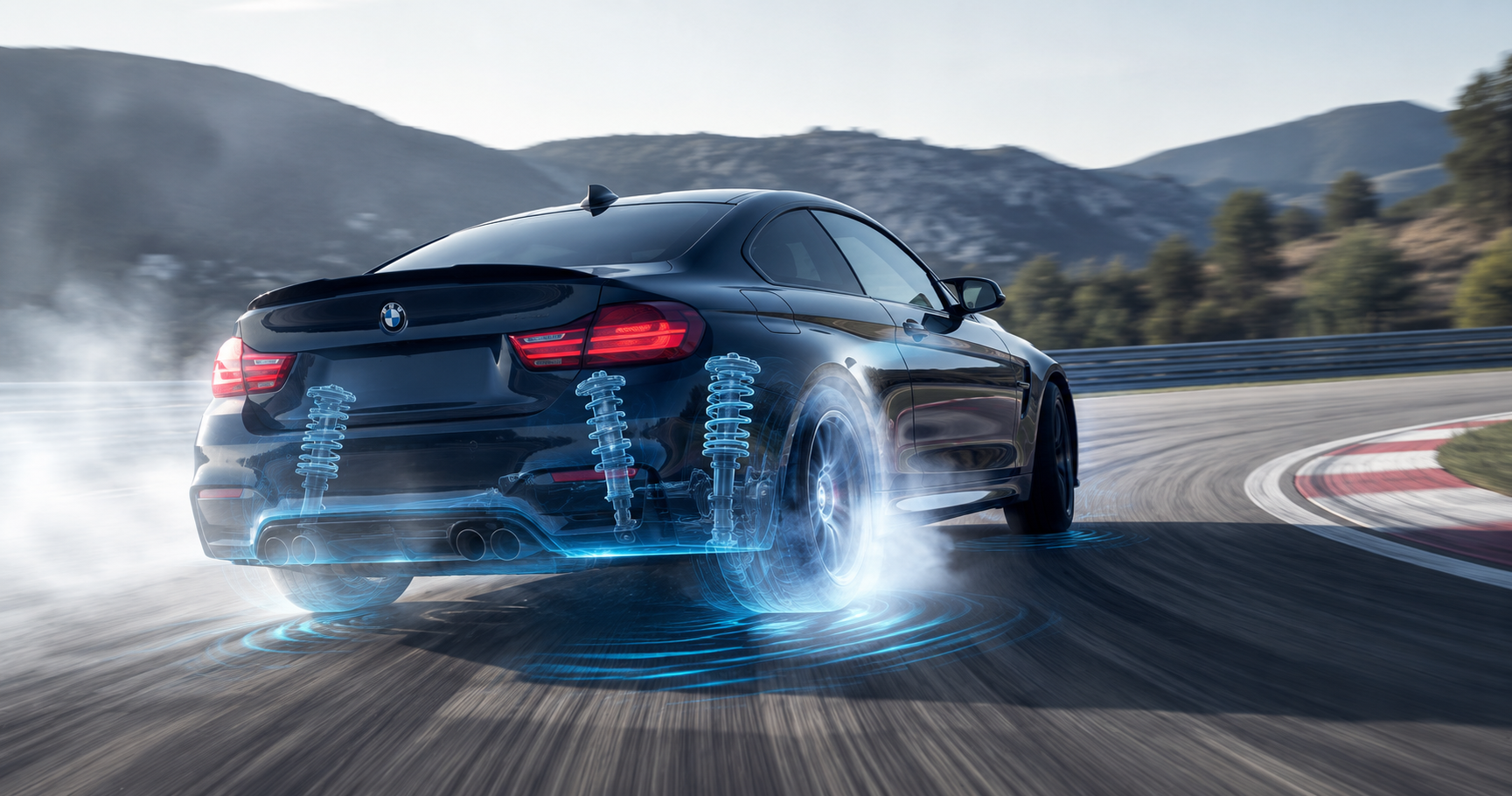
A newly discovered BMW patent outlines an unusual approach to one of drifting’s most difficult moments: getting the car sideways in the first place. The proposed system could use the vehicle’s suspension to briefly shift the rear axle and reduce tire grip, potentially making drift initiation easier.
BMW Patent Focuses on Starting the Drift
In patent terminology, a drift is a driving maneuver in which the rear tires have a greater slip angle than the front tires. In practical terms, it involves spinning the rear tires while maintaining control of the vehicle as its rear end slides outward.
Starting a drift can be the most difficult part. Drivers typically use techniques such as the handbrake, a flick, a clutch kick, or other methods to break rear-end traction, but successfully initiating and controlling the maneuver requires practice.
BMW’s proposed solution begins with determining whether the driver intends to start a drift. According to the patent, that could be accomplished through sensors, calculations, or direct input from the driver.
The patent then states that “an unsprung mass of the vehicle is shifted impulsively in at least approximately the upward direction of the vehicle, so that the load on the rear axle is temporarily reduced.”
It further explains: “An impulse-like displacement refers to a displacement or acceleration of the unsprung mass that occurs suddenly and abruptly, such that the unsprung mass is displaced or accelerated upwards in the vehicle’s vertical direction within a very short time.”
Suspension Could Briefly Bounce the Rear Wheels
In simpler terms, the BMW patent proposes using a brief rear-axle hop to help initiate a drift. The system could use the suspension to temporarily lift or bounce the rear wheels, similar to unwanted axle hop that can occur during burnouts or other low-traction situations.
Reducing the load on the rear wheels, or briefly lifting them, would reduce grip and make wheelspin easier. BMW says this approach could allow a driver to start a drift with very little torque, which could theoretically make the maneuver easier to control.
System Would Monitor Steering and Vehicle Speed
The proposed feature would not operate under all conditions. According to the article, the system would only engage during a hard corner or when the vehicle has a high level of steering angle.
It would also monitor vehicle speed to help ensure that initiating a drift would not throw the vehicle off course. BMW suggests the system could store steering-angle settings to determine when drifting is and is not permitted.
Adaptive Suspension and Active Roll Control Could Power the Feature
The rear axle movement could be created using the vehicle’s adaptive suspension system or active roll control. The concept could also work on the front axle, potentially allowing a driver to attempt a drift while reversing.
Combined with BMW’s Drift Analyzer, the proposed technology could create a vehicle designed to make sideways driving easier. However, while such a feature may have a place on a closed course, attempting similar maneuvers on public roads presents significant safety concerns and could draw the attention of law enforcement and the NHTSA.