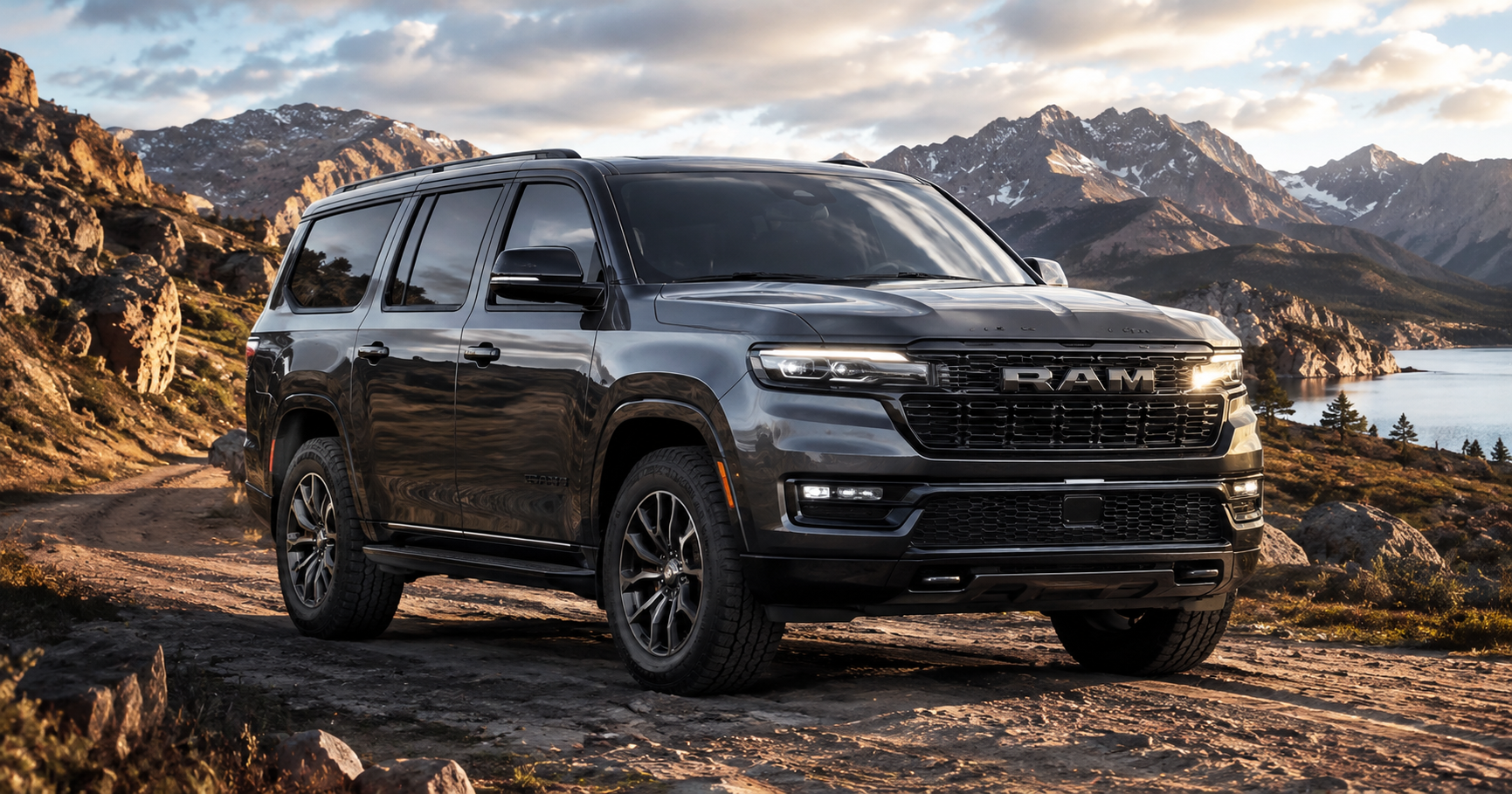
The Ramcharger is Ram’s bid for a direct competitor to the Chevrolet Tahoe and Suburban, as well as the Ford Expedition and Expedition Max. The full-size SUV repurposes the Ramcharger name and essentially brings a Ram version of the body-on-frame-derived Jeep Grand Wagoneer into the brand’s lineup.
What the Ramcharger Is
The Ramcharger name originally belonged to a short-wheelbase competitor to the Chevy K5 Blazer with a removable roof. More recently, the name was expected to be used for the extended-range version of the electric Ram 1500, but that vehicle has since been renamed REV.
In its latest application, the Ramcharger is essentially a repatriated version of the Ram body-on-frame-derived Jeep Grand Wagoneer. That makes it, in effect, a Ram truck masquerading as a Jeep before being re-costumed as a Ram.
The SUV will be built at the same plant in Warren, Michigan, that produces Ram 1500s and Jeep Grand Wagoneers.
Why the Ramcharger Matters
The Ramcharger represents Stellantis’ effort to rationalize its offerings in the lucrative full-size SUV market after the Wagoneer/Grand Wagoneer lineup failed to pull customers away from the established Chevy/GMC/Cadillac and Ford/Lincoln ranges of full-size SUVs.
Ramcharger can use established Ram trim names to cover different parts of the market. Express and Big Horn can signal entry-level Chevy and Ford pricing, while Laramie, Limited and Tungsten can cover territory occupied by GMC and Denali models.
Ramcharger Tungsten can also overlap with Jeep Grand Wagoneer trim levels, with both vehicles seeking buyers of the Lincoln Navigator and Cadillac Escalade.
The overlap between the brands could become particularly relevant in areas such as off-roading and high performance. The introduction of an SUV under the Ram brand also raises questions about Stellantis’ future midsize SUV strategy.
Ramcharger Platform and Powertrain
The DT platform architecture officially began with the fifth-generation Ram pickup, which transformed full-size truck ride quality with its standard coil-sprung live-axle rear suspension setup.
Adapting the architecture for Jeep duty brought additional frame revisions to accommodate an independent rear suspension. The platform therefore requires little further development for Ramcharger duty.
The architecture has already supported powertrains ranging from the Pentastar V-6 to various Hurricane I-6 and Hemi V-8 configurations, including the TRX’s supercharged Hellcat powerplant.
A version of that powerplant will almost assuredly power the top SRT model as Stellantis’ answer to the Cadillac Escalade V, probably at a price considerably below $170,895.
Off-Road Capability Will Be a Key Question
How the Ramcharger’s four-wheel-drive setup ultimately plays out will be worth watching. Raptors and Rebels are highly capable, but much of that capability comes from the articulation provided by a live rear axle, which these SUVs do not have.
From a philosophical standpoint, Jeep arguably should get the model with the greatest off-road capability. However, Jeep has so far wisely avoided giving any Wagoneer or Grand Wagoneer a “Trail Rated” designation, as there is no getting one over the Rubicon.
A Ramcharger Rebel or RHO equipped with Quadra-Lift air suspension, an electronic limited-slip differential, a low-range transfer case, Selec-Terrain modes and skidplates should be able to target the Chevy Tahoe Z71 and Ford Expedition Tremor.
What Could Happen in the Midsize SUV Market
The midsize SUV segment will also be important to watch. The 2029 Durango is expected to remain a unibody Dodge built alongside Grand Cherokees, positioning it against the Chevy Traverse, Toyota Highlander and similar vehicles.
Meanwhile, a new SUV based on the 2029 Dakota could become a compelling Ram midsize SUV designed more specifically around towing and hauling.
The Ramcharger therefore gives Stellantis another approach to the full-size SUV market while creating distinct opportunities for Ram and Jeep across overlapping trim levels, capabilities and customer segments.