
Finding the Most Reliable SUV for Seniors is about much more than choosing the vehicle with the lowest number of reported problems. For older drivers, reliability matters, but so do visibility, easy entry and exit, comfortable seating, intuitive controls, safety technology and a size that is manageable in everyday driving.
That is why the best choice for one senior driver may not be the best choice for another. Someone who drives long distances may place fuel economy at the top of the list, while another driver may care more about a high seating position, easy access or a simple cabin layout.
For 2026, the Subaru Forester stands out as a particularly well-rounded option. It combines excellent outward visibility, standard all-wheel drive, senior-friendly access and strong safety credentials. But it is not the only SUV worth considering. The Toyota RAV4 Hybrid, Honda CR-V, Toyota Corolla Cross, Subaru Crosstrek, Lexus NX and Hyundai Tucson each bring a different combination of strengths.
Below, we compare all seven and explain what makes each one suitable for older drivers, where each model has limitations, and which features shoppers should examine before signing a purchase agreement.
What Makes an SUV Reliable and Senior-Friendly?
Reliability is often treated as a single number, but automotive reliability studies do not all measure the same thing. Consumer Reports places significant emphasis on predicted reliability and owner-survey data, while J.D. Power’s Vehicle Dependability Study measures problems reported by owners during the previous three years of ownership.
Those differences matter when comparing new or redesigned vehicles. A newly introduced powertrain may have an attractive specification sheet but relatively little long-term ownership data. Conversely, an established powertrain may have years of real-world history behind it.
For older drivers, reliability should therefore be considered alongside practical usability. A vehicle that is mechanically dependable but difficult to enter, hard to park or confusing to operate may not be the right choice.
Key factors seniors should evaluate
- Reliability history: Look at both brand-level and model-level evidence.
- Visibility: Large windows and a good view around the vehicle can reduce driving stress.
- Entry and exit: Seat height and door opening dimensions can be especially important for drivers with limited mobility.
- Safety technology: Automatic emergency braking, blind-spot monitoring and rear cross-traffic alert are valuable features.
- Controls: Physical buttons and intuitive controls can be easier to operate than complicated touchscreen menus.
- Ride quality: A comfortable suspension can make daily driving substantially more pleasant.
- Vehicle size: More space is useful, but an oversized SUV can be difficult to maneuver or park.
- Ownership costs: Fuel, tires, insurance, maintenance and warranty coverage all affect long-term value.
How Reliable Are SUVs in 2026?
The 2026 reliability landscape is complicated by the increasing amount of technology inside modern vehicles. J.D. Power’s 2026 U.S. Vehicle Dependability Study reported the highest overall problem rate since its current study redesign, with software and infotainment-related issues contributing to the broader trend.
Consumer Reports’ 2026 automotive brand report placed Toyota first in its predicted-reliability ranking, with Subaru close behind. Lexus and Honda also remained among the leading brands in the report.
Meanwhile, J.D. Power’s 2026 study placed Lexus at the top of the premium segment with 151 problems per 100 vehicles. Toyota also received the highest number of model-level awards in the study.
These results demonstrate why shoppers should not rely on a single reliability ranking. A vehicle can have a strong brand reputation while still having a particular model, generation or powertrain that deserves additional scrutiny.
7 Most Reliable SUVs for Seniors in 2026
1. Subaru Forester — Best Overall for Seniors
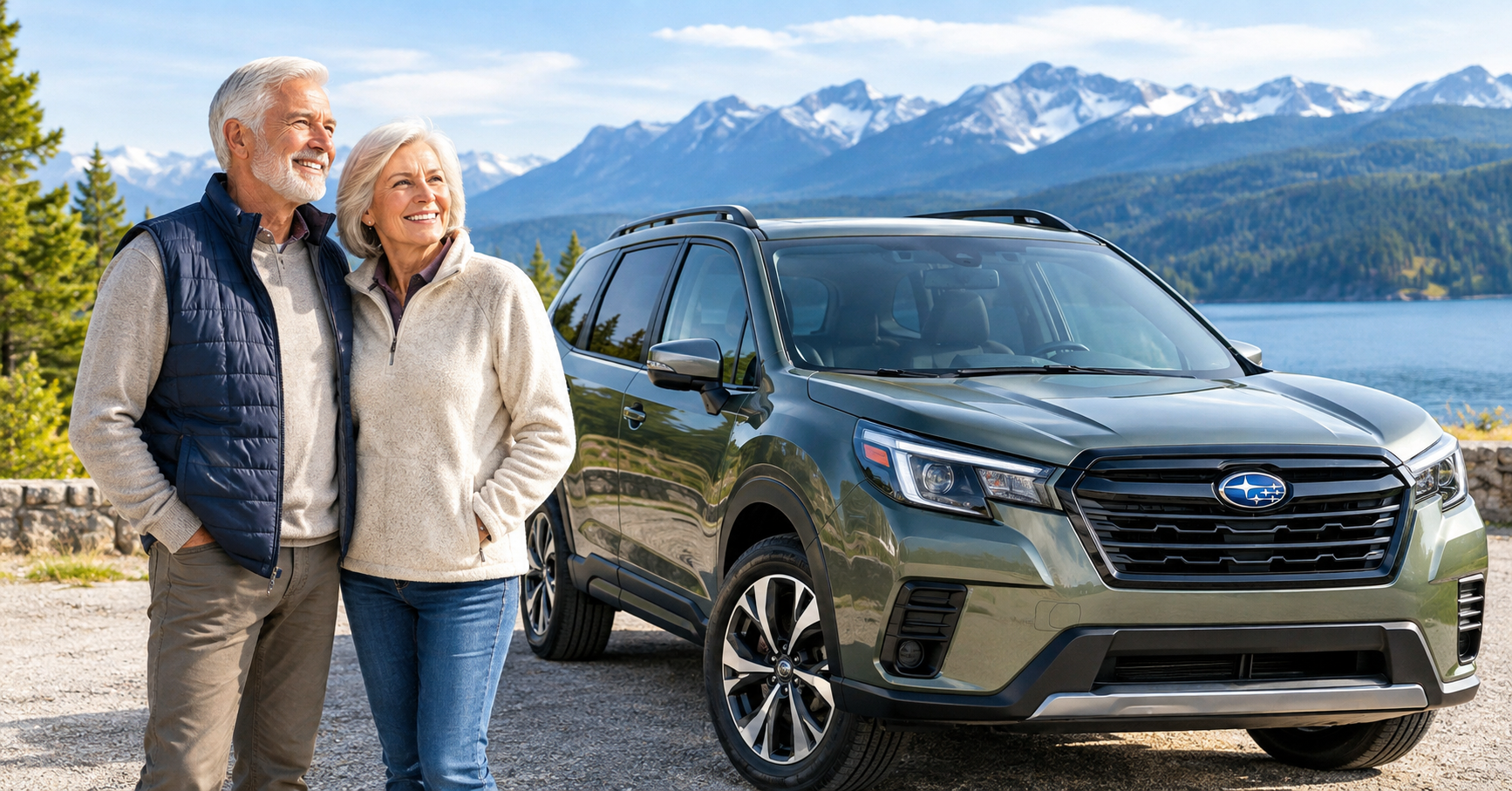
The Subaru Forester is one of the strongest all-around choices for older drivers because its design naturally addresses several common senior-driving concerns. Its upright seating position, large windows and strong outward visibility make it easy to understand where the vehicle is positioned on the road.
Consumer Reports’ senior-driver coverage specifically highlighted the Forester’s visibility as one of its standout characteristics. That is important because visibility can be just as useful in everyday driving as sophisticated electronic safety technology.
The 2026 Forester also carries an IIHS Top Safety Pick+ designation, giving it strong current crash-avoidance and crashworthiness credentials.
2026 Forester highlights
- Gasoline and hybrid powertrains.
- Standard all-wheel drive.
- Hybrid fuel economy of approximately 35 mpg combined.
- Hybrid starting MSRP announced at $34,730.
- Excellent outward visibility.
- Easy step-in height.
- IIHS Top Safety Pick+ recognition.
Pros
- Excellent visibility.
- Easy entry and exit.
- Standard AWD.
- Strong safety credentials.
- Practical interior and comfortable ride.
Cons
- Base gasoline engine is not particularly powerful.
- Higher trims can become expensive.
- The new hybrid has limited long-term ownership history.
- Some drivers may prefer a conventional automatic transmission.
Best for: Seniors who want one vehicle that balances visibility, safety, comfort, all-weather capability and practicality.
2. Toyota RAV4 Hybrid — Best for Fuel Economy
The 2026 Toyota RAV4 is particularly interesting because Toyota redesigned the model and moved the U.S. lineup to hybrid-only powertrains. Toyota has extensive experience with conventional hybrid systems, which makes the RAV4 Hybrid an important choice for buyers who prioritize fuel efficiency.
Toyota estimates fuel economy as high as 44 mpg combined for certain configurations. The company also announced a starting MSRP of $31,900 for the front-wheel-drive hybrid before dealer processing and handling fees.
The major caveat is that the 2026 redesign means long-term reliability data for this generation is not yet available. Buyers should distinguish Toyota’s established hybrid experience from the reliability history of this specific new generation.
Pros
- Excellent potential fuel economy.
- Long Toyota hybrid experience.
- Available AWD.
- Strong resale reputation.
- Broad service network.
Cons
- New generation has limited long-term reliability data.
- Upper trims can become expensive.
- Touchscreen-heavy controls may not suit every senior driver.
- Exact fuel economy depends on configuration.
Best for: Drivers who cover significant mileage and want a fuel-efficient SUV from a manufacturer with extensive conventional-hybrid experience.
3. Honda CR-V — Best for Space and Comfort
The Honda CR-V remains a practical choice for older adults who want a spacious cabin without moving into a larger SUV. Its roomy rear seating area, useful cargo capacity and comfortable ride make it well suited to everyday family and retirement driving.
The CR-V is also available with gasoline and hybrid powertrains, allowing shoppers to choose between a simpler conventional configuration and improved fuel efficiency.
One consideration is safety-test differentiation. In the cited 2026 IIHS whiplash-prevention evaluation, the CR-V received an “Acceptable” rating, while the Forester and RAV4 received “Good” ratings.
Pros
- Spacious cabin.
- Comfortable ride.
- Useful cargo area.
- Available hybrid powertrain.
- Practical everyday layout.
Cons
- Safety equipment varies by trim.
- Upper trims can become expensive.
- Hybrid systems add complexity compared with a conventional gasoline model.
- Its cited whiplash-prevention result was “Acceptable” rather than “Good.”
Best for: Seniors who frequently carry passengers, groceries or mobility equipment and want a comfortable compact SUV.
4. Toyota Corolla Cross — Best Value-Oriented Toyota
The Toyota Corolla Cross takes a different approach from the RAV4. It is smaller, which can be an advantage for older drivers who frequently navigate crowded parking lots or narrow streets.
Its elevated seating position provides a more SUV-like driving experience than a traditional sedan while maintaining a relatively compact footprint. Consumer Reports-related 2026 reporting cited a predicted-reliability score of 79 for the Corolla Cross.
The trade-off is interior space. Drivers who regularly transport several adults may find the Corolla Cross less accommodating than the Forester, CR-V or RAV4.
Pros
- Compact exterior dimensions.
- Higher seating position.
- Toyota reliability reputation.
- Available hybrid version.
- Generally more affordable than luxury alternatives.
Cons
- Less rear-seat room.
- Smaller cargo area than larger competitors.
- Modest acceleration.
- Interior refinement is below luxury SUVs.
Best for: Seniors who prioritize maneuverability, compact dimensions and Toyota ownership value.
5. Subaru Crosstrek — Best Small SUV for Visibility and AWD
The Subaru Crosstrek is particularly attractive for seniors who want something smaller than a Forester without giving up standard all-wheel drive or elevated ground clearance.
Consumer Reports’ senior-driver guidance highlighted the Crosstrek’s ground clearance as useful for drivers who may have difficulty bending or stepping down into a low vehicle.
J.D. Power’s 2026 dependability results also identified the Crosstrek as the leading small SUV in its category, according to published coverage of the model-level results.
Pros
- Compact and easy to park.
- Standard AWD.
- Good ground clearance.
- Strong visibility.
- Practical cargo area.
Cons
- Less rear-seat room than larger compact SUVs.
- Performance is adequate rather than sporty.
- Some drivers may find the entry height less suitable for limited mobility.
- Cabin refinement is not at luxury-SUV levels.
Best for: Seniors who want a smaller vehicle that remains capable in rain, snow and rougher road conditions.
6. Lexus NX — Best Luxury Option
For buyers who want a quieter and more upscale environment, the Lexus NX brings many of the advantages associated with a premium SUV without moving into a large vehicle.
Lexus led the premium brands in J.D. Power’s 2026 Vehicle Dependability Study with 151 problems per 100 vehicles. That gives the NX a strong brand-level dependability case, although individual trim and powertrain differences still matter.
The NX is offered with gasoline, hybrid and plug-in-hybrid powertrains. For a senior buyer primarily concerned with simplicity and fuel economy, the conventional hybrid may be easier to justify than the more complex plug-in configuration.
Pros
- Quiet cabin.
- Comfortable seats.
- Premium interior.
- Strong Lexus dependability results.
- Available hybrid.
Cons
- Higher purchase price.
- Potentially higher maintenance costs.
- Rear-seat and cargo space are not class-leading.
- Some infotainment functions may require familiarization.
Best for: Seniors who place a premium on quietness, comfort, materials and premium dealership service.
7. Hyundai Tucson — Best Feature-Rich Alternative
The Hyundai Tucson deserves consideration for buyers who want a generous list of technology and safety features without moving into a luxury SUV.
The 2026 Tucson appears among the IIHS Top Safety Pick+ winners in the cited award list. It also offers a spacious cabin, comfortable ride and hybrid availability.
Its principal consideration is long-term dependability history. Hyundai has made significant progress in product quality, but buyers seeking the longest-established reliability record may give more weight to Toyota, Honda, Subaru or Lexus.
Pros
- Strong safety-equipment availability.
- Spacious interior.
- Comfortable ride.
- Available hybrid powertrain.
- Competitive warranty coverage.
Cons
- Less long-term dependability history than some Japanese competitors.
- Some controls may feel complicated.
- Resale value may trail Toyota and Honda.
- Exact safety equipment can vary by configuration.
Best for: Seniors who want a spacious, comfortable SUV with substantial technology and warranty coverage.
2026 Senior-Friendly SUV Comparison
| SUV | Best For | Key Strength | Main Concern |
|---|---|---|---|
| Subaru Forester | Overall senior usability | Visibility, access and AWD | New hybrid has limited long-term data |
| Toyota RAV4 Hybrid | Fuel economy | Hybrid efficiency and Toyota experience | 2026 redesign lacks long-term reliability history |
| Honda CR-V | Space and comfort | Roomy cabin and comfortable ride | Safety results vary by test and equipment |
| Toyota Corolla Cross | Value and maneuverability | Compact size and elevated seating | Less passenger and cargo space |
| Subaru Crosstrek | Small SUV and AWD | Visibility, clearance and AWD | Smaller interior |
| Lexus NX | Luxury | Quiet cabin and premium comfort | Higher purchase and ownership costs |
| Hyundai Tucson | Features and warranty | Technology, space and comfort | Less established long-term reliability history |
Why Visibility Matters So Much for Older Drivers
Visibility is one of the easiest characteristics to overlook when comparing vehicles on paper. Yet it can affect nearly every part of daily driving.
A driver needs to judge the position of the vehicle in a lane, see pedestrians and cyclists, monitor nearby cars and maneuver through parking lots. A high seating position alone does not guarantee excellent visibility; window design, windshield dimensions, roof pillars and seat positioning all contribute.
This is one reason the Forester and Crosstrek deserve particular attention. Their upright design and relatively generous glass areas can make the vehicle feel easier to understand from the driver’s seat.
Before buying any SUV, sit in the driver’s seat and check whether you can comfortably see the vehicle’s corners. Do not rely solely on cameras and sensors to compensate for poor natural visibility.
What Safety Features Should Seniors Look For?
Modern driver-assistance technology can provide another layer of protection, but shoppers should understand what the systems actually do rather than assuming every safety package works identically.
Automatic Emergency Braking
Automatic emergency braking can warn the driver about an impending collision and, depending on the system and circumstances, apply the brakes. Consumer Reports’ senior-driver guidance specifically emphasizes this technology.
Blind-Spot Monitoring
Blind-spot monitoring can help identify vehicles traveling alongside the SUV where they may be difficult to see in the mirrors.
Rear Cross-Traffic Alert
This feature can be particularly useful when backing out of parking spaces where another vehicle or pedestrian may approach from the side.
Parking Sensors and Cameras
Parking sensors, rear cameras and available surround-view systems can make larger vehicles easier to position. However, they should supplement—not replace—careful observation.
Is a Hybrid SUV a Good Choice for Seniors?
A conventional hybrid can be an attractive option for older drivers who want to reduce fuel consumption without adopting a charging routine. The system combines a gasoline engine with electric assistance and does not require the driver to plug the vehicle in.
Toyota has particularly extensive experience with conventional hybrid technology, which helps explain the appeal of the RAV4 Hybrid and Lexus hybrid models.
However, the newest hybrid system in a vehicle should not automatically be considered as proven as an older system simply because the manufacturer has a strong hybrid history. The 2026 Forester Hybrid, for example, has less long-term ownership data than Subaru’s established gasoline models.
J.D. Power’s 2026 dependability study also reported more problems among plug-in hybrids and battery-electric vehicles than among conventional hybrids and gasoline vehicles. That finding describes reported problems across the study population; it does not mean every EV or plug-in hybrid is unreliable.
Should Seniors Choose AWD?
All-wheel drive can be useful in snow, heavy rain, steep driveways and unpaved roads. Subaru’s Forester and Crosstrek make AWD standard, while the RAV4 and other competitors offer it depending on configuration.
But AWD is not automatically necessary for every older driver. In regions with mild weather and well-maintained roads, front-wheel drive may provide adequate traction while reducing cost and weight.
Tires also matter. AWD cannot compensate for worn or inappropriate tires, excessive speed or poor road conditions.
Are Bigger SUVs Safer for Seniors?
IIHS notes that larger and heavier vehicles generally provide greater occupant protection in collisions. That does not mean that every senior driver should purchase the largest SUV available.
A large vehicle can be more difficult to park, harder to maneuver through narrow spaces and potentially more difficult to enter or exit. For many older drivers, a compact or midsize SUV represents a more practical compromise between occupant protection, visibility, maneuverability and comfort.
Senior SUV Buying Checklist
The best way to determine whether an SUV actually works for an older driver is to spend time inside and behind the wheel before buying it.
- Get into the driver’s seat several times rather than testing it only once.
- Check the steering-wheel reach and seat adjustment range.
- Make sure the door opens wide enough for comfortable entry and exit.
- Check visibility over the hood and around the vehicle.
- Test the infotainment and climate controls without salesperson assistance.
- Confirm which safety features are standard on the exact trim.
- Load a walker, cane, wheelchair or typical grocery bags into the cargo area.
- Drive over rough pavement as well as smooth roads.
- Spend time maneuvering through a parking lot.
- Check insurance, tire, maintenance and warranty costs.
- Verify IIHS and NHTSA results for the exact model year and configuration.
- Do not assume that the most expensive trim is automatically the easiest or safest to operate.
Which SUV Makes the Most Sense for Different Senior Drivers?
If Visibility Is Your Top Concern
The Subaru Forester deserves close attention because visibility is one of the characteristics Consumer Reports specifically highlighted for older drivers.
If Fuel Economy Is the Priority
The Toyota RAV4 Hybrid is a natural candidate, particularly for drivers who cover many miles each year. Its 2026 redesign means shoppers should still distinguish its promising specifications from long-term reliability data that has not yet accumulated.
If You Frequently Carry Passengers
The Honda CR-V provides a roomy cabin and useful cargo space without becoming a large three-row SUV.
If Parking Is a Major Concern
The Toyota Corolla Cross and Subaru Crosstrek offer smaller footprints than the larger compact SUVs, making them worth considering for drivers who spend considerable time in crowded parking areas.
If Comfort and Luxury Matter Most
The Lexus NX provides a quieter and more premium environment, although its purchase and ownership costs are higher.
If Technology and Warranty Coverage Are Priorities
The Hyundai Tucson combines a spacious cabin with extensive available features and a strong warranty proposition.
Final Takeaway: What Is the Most Reliable SUV for Seniors in 2026?
The Most Reliable SUV for Seniors should not be selected solely by looking at a reliability ranking. For an older driver, the practical ownership experience matters just as much: Can you get in and out comfortably? Can you see clearly around the vehicle? Are the controls understandable? Does it provide the safety technology you actually need? Is the vehicle small enough to maneuver confidently?
The 2026 Subaru Forester brings these considerations together particularly well. Its visibility, upright seating position, standard AWD, practical dimensions and strong safety credentials make it a compelling all-around choice for many older drivers.
The Toyota RAV4 Hybrid offers a different proposition, emphasizing fuel economy and Toyota’s extensive conventional-hybrid experience. The Honda CR-V is especially practical for passengers and cargo, while the Corolla Cross and Crosstrek make sense for drivers who prefer a smaller footprint.
At the premium end, the Lexus NX combines comfort with strong Lexus dependability results. The Hyundai Tucson is another alternative for buyers who place significant value on equipment, space and warranty coverage.
Ultimately, there is no single SUV that is perfect for every senior driver. The strongest 2026 choices are better understood as vehicles that currently combine reliability evidence, safety performance, usability and senior-friendly design. Long-term ownership data should continue to be monitored, particularly for newly redesigned models and new hybrid systems.
Frequently Asked Questions
What is the most reliable SUV for seniors in 2026?
The Subaru Forester is a particularly strong all-around choice because it combines good visibility, easy access, standard AWD, practical dimensions and strong safety credentials. The Toyota RAV4 Hybrid is another important option for buyers who prioritize fuel economy and Toyota’s hybrid experience.
Is the Subaru Forester more reliable than the Toyota RAV4?
There is no single answer because Consumer Reports and J.D. Power use different methodologies. Toyota ranked first among brands in Consumer Reports’ 2026 predicted-reliability report, while J.D. Power’s 2026 study produced different brand and model-level results. The redesigned 2026 RAV4 also does not yet have a long-term reliability history for this generation.
Is a hybrid SUV a good choice for an older driver?
A conventional hybrid can be a practical choice, especially for drivers who want lower fuel consumption without plugging in. However, buyers seeking the longest possible track record should consider how established the specific hybrid system is.
Should seniors choose AWD?
AWD can be useful in snow, heavy rain, steep driveways and poor road conditions, but it is not essential for every driver. In mild climates, front-wheel drive may provide sufficient traction at a lower cost.
Are bigger SUVs safer for seniors?
IIHS notes that larger and heavier vehicles generally provide greater occupant protection in a crash. However, larger SUVs can also be harder to park and maneuver, so vehicle size should be balanced against the driver’s physical abilities and driving environment.
Which SUV has the best visibility for seniors?
The Subaru Forester is one of the strongest choices. Consumer Reports’ senior-driver coverage specifically highlighted the Forester’s visibility as a standout characteristic.
Is the Lexus NX worth the extra money?
The Lexus NX can make sense for buyers who value a quiet cabin, premium materials, comfortable seating and Lexus dealership service. Mainstream alternatives such as the Forester, RAV4 and CR-V generally have lower purchase costs.
Should seniors buy a plug-in hybrid or EV?
It depends on charging access and personal preferences. A plug-in hybrid or EV can work well when home charging is convenient, but buyers who prioritize simplicity should also consider a conventional hybrid or established gasoline powertrain. J.D. Power’s 2026 study reported higher problem rates for plug-in hybrids and EVs than conventional hybrids and gasoline vehicles in the study population.