
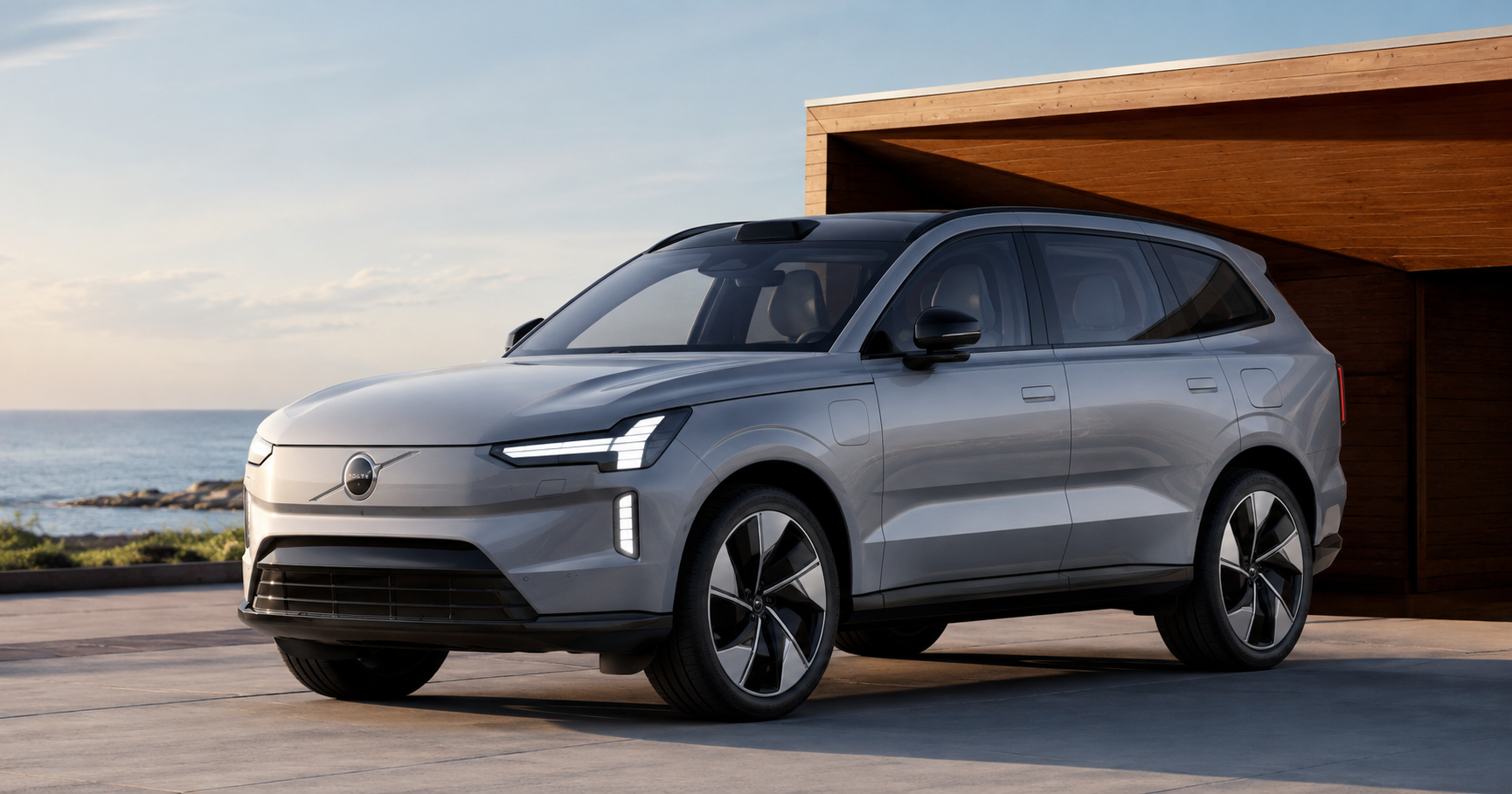
The Volvo EX60 is entering the U.S. electric SUV market with better news than expected. Before production models reached dealerships, Volvo estimated the launch version would travel up to 322 miles on a full charge. Now, the official Environmental Protection Agency (EPA) certification has increased that figure to 330 miles, giving the premium electric SUV a stronger position against growing competition.
Although an eight-mile improvement may seem modest at first glance, official EPA certification often plays a major role in buyer confidence. Many consumers rely on EPA numbers rather than manufacturer estimates when comparing electric vehicles, making this revised rating more significant than the raw mileage increase suggests.
The updated certification also confirms that the Volvo EX60 becomes Volvo’s longest-range electric vehicle currently available in the United States. Combined with its new 800-volt architecture, ultra-fast charging capability, and built-in Tesla-compatible charging port, the EX60 arrives with several important advantages that extend beyond range alone.
This article explores everything buyers need to know about the EPA certification, explains why wheel size matters, compares the EX60 with rivals like BMW’s newest electric SUV, and examines what this means for Volvo’s growing EV lineup.
Official EPA Rating Gives Volvo Better-Than-Expected News
When Volvo first revealed the all-electric EX60, the company projected that its launch trim—the EX60 P10 AWD—would deliver approximately 322 miles per charge. That estimate already placed the SUV among competitive premium electric crossovers.
Following EPA testing, however, the official number increased to 330 miles for vehicles equipped with either 20-inch or 21-inch wheels.
That represents:
- 330 miles official EPA range
- 322 miles original Volvo estimate
- 8 additional certified miles
- Roughly a 2.5% improvement
While eight miles will not dramatically change daily driving habits, it improves consumer perception because EPA-certified figures are considered the benchmark for real-world comparisons in the American market.
Why EPA Ratings Matter More Than Manufacturer Estimates
Every automaker publishes estimated driving ranges before EPA certification becomes available. These early figures are based on internal testing methods and engineering simulations.
The EPA conducts standardized testing procedures that allow shoppers to compare different vehicles using the same methodology.
For consumers, EPA numbers typically carry greater credibility because they:
- Use standardized testing protocols.
- Allow fair comparisons across brands.
- Influence purchase decisions.
- Help determine eligibility for various fleet and business calculations.
Receiving an EPA number that exceeds the manufacturer’s estimate is relatively uncommon and reflects positively on the vehicle’s overall efficiency.
How Wheel Size Changes the Volvo EX60 Driving Range
One of the most interesting findings from the EPA certification involves wheel size.
Many shoppers focus exclusively on styling when selecting wheels, but larger wheels generally increase weight and rolling resistance while reducing aerodynamic efficiency.
EX60 P10 AWD EPA Ratings
- 20-inch wheels: 330 miles
- 21-inch wheels: 330 miles
- 22-inch wheels: 312 miles
Choosing the largest wheels reduces certified range by approximately 18 miles.
Rear-Wheel Drive EX60 P6 Ratings
- 307 miles with smaller wheels
- 295 miles with 22-inch wheels
This pattern is common across nearly every electric vehicle currently on sale. Larger wheels improve appearance and handling characteristics but often reduce efficiency.
Why Larger Wheels Reduce Electric Vehicle Efficiency
Many buyers wonder why something as simple as wheel diameter can influence battery range.
Several engineering factors contribute:
1. Increased Rotational Mass
Larger wheels weigh more, requiring additional energy every time the vehicle accelerates.
2. Higher Rolling Resistance
Performance-oriented tires usually create more friction with the road surface.
3. Aerodynamic Changes
Bigger wheels often create additional turbulence around the wheel wells.
4. Wider Tires
Wider tires provide more grip but increase energy consumption during everyday driving.
For drivers who prioritize maximum range, smaller wheel packages typically remain the smarter choice.
The Volvo EX60 Is Now Volvo’s Longest-Range EV in America
The new certification gives the Volvo EX60 another important distinction.
With an EPA-certified maximum of 330 miles, it officially becomes the longest-range battery-electric Volvo currently sold in the United States.
That milestone reflects Volvo’s broader transition toward electrification, with newer dedicated EV platforms delivering meaningful gains in efficiency over previous models.
Rather than simply adapting gasoline platforms, Volvo engineered the EX60 from the ground up as a purpose-built electric SUV.
The New SPA3 Platform Brings Major Technical Improvements
Underneath the EX60 sits Volvo’s latest SPA3 architecture.
Unlike earlier platforms designed to accommodate multiple powertrains, SPA3 was developed specifically for electric vehicles.
Advantages include:
- Improved battery packaging
- Lower center of gravity
- Better crash protection
- Higher structural rigidity
- Improved software integration
- Future-ready electrical architecture
Purpose-built EV platforms generally allow manufacturers to maximize interior space while improving efficiency.
800-Volt Architecture Changes the Charging Experience
Perhaps even more important than total driving range is charging speed.
The EX60 introduces an 800-volt electrical system, placing it among a growing group of premium EVs capable of dramatically faster charging than older 400-volt systems.
According to Volvo, the SUV can recover up to:
- 165 miles of range in approximately 10 minutes
That figure assumes connection to a compatible high-output DC fast charger capable of delivering the necessary power.
Faster charging reduces downtime during road trips and makes long-distance travel significantly more convenient.
Built-In NACS Port Expands Charging Options
Another major highlight is the inclusion of a built-in North American Charging Standard (NACS) charging port.
The EX60 becomes the first Volvo sold in the United States with native compatibility for Tesla’s Supercharger network.
That means owners can access thousands of fast chargers without carrying an external adapter.
For many buyers, charging convenience can influence purchasing decisions just as much as total driving range.
Real-World Driving Expectations
EPA ratings provide a standardized benchmark, but real-world results vary depending on several conditions.
Drivers may experience different range based on:
- Outside temperature
- Highway versus city driving
- Driving style
- Climate control usage
- Vehicle load
- Tire pressure
- Terrain
Under favorable conditions, many owners may approach the EPA estimate. Conversely, cold weather, sustained highway speeds, or towing can noticeably reduce available range.
How the Volvo EX60 Compares With the BMW iX3
One of the EX60’s newest competitors is the 2027 BMW iX3 50 xDrive.
While Volvo’s updated EPA certification represents an improvement, BMW currently holds an advantage in maximum certified range.
| Model | Maximum EPA Range |
|---|---|
| 2027 Volvo EX60 P10 AWD | 330 miles |
| 2027 BMW iX3 50 xDrive | 434 miles |
BMW’s most efficient configuration exceeds Volvo’s launch model by approximately 104 miles.
However, range represents only one aspect of vehicle ownership. Buyers often consider:
- Charging infrastructure
- Safety technology
- Interior comfort
- Software experience
- Reliability expectations
- Brand loyalty
Volvo has traditionally built its reputation around safety, Scandinavian design, and practical everyday usability rather than chasing maximum performance specifications.
Volvo’s Future 400-Mile EX60 Variant
The launch model is only the beginning.
Volvo has already confirmed plans for a higher-performance EX60 P12 AWD variant with a claimed driving range of approximately 400 miles.
Official EPA certification has not yet been released, so buyers should wait for verified figures before making direct comparisons.
If certified close to Volvo’s projected number, that version would significantly narrow the gap with class-leading competitors while giving shoppers another compelling option within the EX60 lineup.
Who Should Consider the Volvo EX60?
The EX60 appears well suited for several categories of buyers.
Daily Commuters
Most American commuters drive far less than 50 miles per day, making the EX60’s range more than sufficient for several days between charges.
Families
The midsize SUV format provides practical passenger and cargo space while maintaining premium comfort.
Road Trip Travelers
Fast charging and native Tesla Supercharger compatibility reduce travel anxiety during longer journeys.
Technology Enthusiasts
The SPA3 platform and 800-volt architecture position the EX60 among Volvo’s most advanced production vehicles.
What the EPA Rating Means for Volvo’s EV Strategy
The updated certification demonstrates steady progress in Volvo’s transition toward fully electric vehicles.
Rather than relying solely on ambitious marketing claims, official EPA testing validates that the launch version performs slightly better than originally expected.
That positive result may strengthen consumer confidence as competition intensifies across the premium electric SUV segment.
Combined with modern charging technology, thoughtful engineering, and Volvo’s longstanding emphasis on safety, the EX60 arrives as one of the company’s most important EV launches to date.
Final Thoughts
The official EPA certification may increase the Volvo EX60‘s driving range by only eight miles, but the symbolic importance is much larger than the numerical gain.
Exceeding Volvo’s original estimate reinforces confidence in the vehicle’s efficiency while confirming the EX60 as the longest-range electric Volvo currently available in America.
Although competitors like BMW currently offer greater maximum range, the EX60 counters with a balanced package that includes an advanced 800-volt platform, ultra-fast charging capability, native Tesla Supercharger compatibility, premium Scandinavian design, and Volvo’s well-established safety reputation.
As additional EX60 variants arrive—including the anticipated 400-mile P12 AWD—the model could become an even stronger contender in one of the fastest-growing segments of the electric vehicle market.
Frequently Asked Questions
What is the official EPA range of the 2027 Volvo EX60?
The launch-model Volvo EX60 P10 AWD is officially rated at up to 330 miles on a full battery when equipped with 20-inch or 21-inch wheels.
Did the EPA rating exceed Volvo’s estimate?
Yes. Volvo originally estimated 322 miles, while EPA certification increased the official rating to 330 miles.
Does wheel size affect the Volvo EX60 range?
Yes. Models equipped with 22-inch wheels receive lower EPA ratings than versions fitted with 20-inch or 21-inch wheels.
Can the Volvo EX60 use Tesla Superchargers?
Yes. The EX60 includes a built-in NACS charging port, allowing direct access to Tesla’s Supercharger network without an adapter.
How fast can the Volvo EX60 charge?
Volvo says the EX60 can add up to 165 miles of driving range in approximately 10 minutes using a compatible DC fast charger.
Will there be a longer-range version?
Yes. Volvo has previewed an EX60 P12 AWD variant with a claimed driving range of 400 miles, although official EPA certification has not yet been announced.