
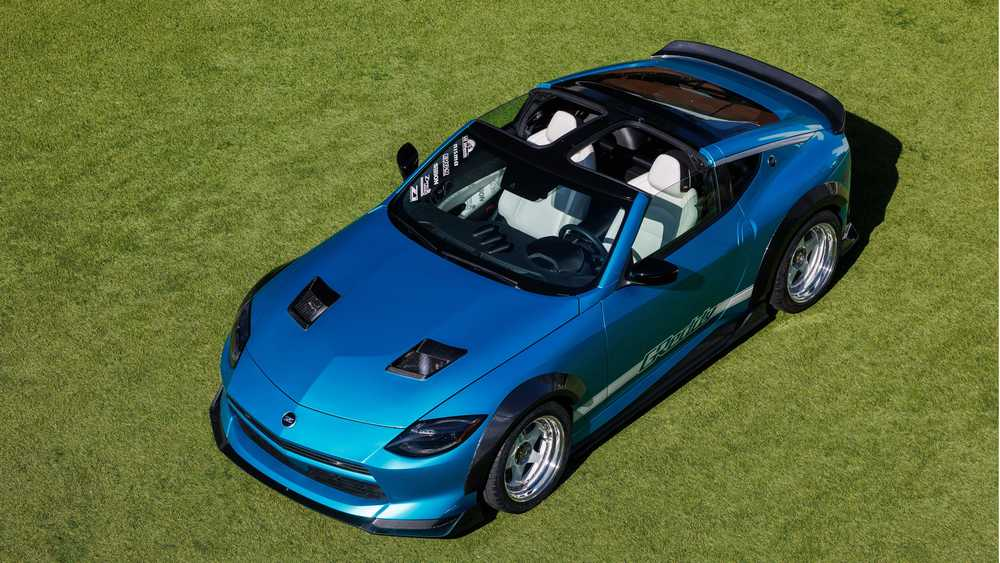
The Nissan Z Kaze Concept brings a dose of 1990s JDM tuning culture to the modern era, combining the latest 2027 Z with a T-top roof, restored Nismo wheels, carbon-fiber bodywork and GReddy performance upgrades.
Nissan Z Kaze Concept Brings Back T-Top Nostalgia
Tuning culture, particularly within the JDM scene, was a major part of the 1990s before 2001’s The Fast And The Furious helped push it into the mainstream. As SUVs became more dominant and conventional cars grew increasingly powerful, especially with the rise of electrification, the idea of modifying your own car became less popular.
Nissan, however, has not forgotten that era. The automaker unveiled the Z Kaze Concept at the annual ZCON gathering for Nissan Z enthusiasts, hosted by the Z Car Club Association and currently underway in Phoenix, Arizona.
Based on the latest 2027 Z, the concept draws inspiration from some of Nissan’s most iconic sports cars of the past. Its most prominent retro feature is a T-top roof, an option first introduced on the 280ZX in the early 1980s before becoming almost a standard feature on the two generations of 300ZX that followed.
With the roof panels removed, occupants can experience air rushing through the cabin. The name Kaze is the Japanese word for “wind.”
Restored Nismo Wheels and Carbon-Fiber Bodywork
The retro design continues with 18-inch Nismo LMGT2 wheels. The forged, multi-piece wheels have long been out of production, so Nissan’s designers sourced an original set and had them restored specifically for the concept.
The wheels measure 10 inches wide at the front and 11 inches at the rear, helping give the Z Kaze Concept its stance. A carbon-fiber body kit further contributes to the car’s appearance.
Inside, the changes are more subtle. Nissan had to reinforce the roof structure and modify the interior trim around the removable panels to accommodate the T-top design.
Carbon-fiber accents reinforce the performance theme, while Bose headrest speakers provide a modern touch and allow occupants to enjoy music with the roof panels removed.
GReddy Performance Upgrades Under the Hood
The giant “GReddy” graphic along the sides of the Z Kaze Concept will be familiar to anyone with knowledge of the JDM tuning scene. GReddy is the performance brand of Japanese company Trust, which is primarily recognized for powertrain upgrades, particularly for turbocharged powertrains.
Nissan has not provided detailed output figures for the concept, but it has confirmed several GReddy upgrades, including a Supreme SP exhaust system, an Airinx air filter and a custom air-to-air intercooler.
The upgrades are intended to help increase output from the Z’s twin-turbocharged 3.0-liter V6 beyond its stock 400 horsepower and 350 pound-feet of torque.
To complement the additional performance, Nissan fitted the concept with suspension upgrades from its own Nismo catalog.
The Z Kaze Concept Uses an Automatic Transmission
One notable detail is the choice of an automatic-equipped Z as the donor vehicle. That contrasts with the concept’s performance-focused theme, although its seven-speed automatic transmission is described as no slushbox.
The concept therefore does not feature the three-pedal manual setup that would further connect it to the traditional tuning-car experience.
The Final T-Top Cars in America
The Z Kaze Concept’s T-top roof also recalls a feature that has disappeared from production cars. The final two production models to carry removable roof panels were the 2002 Chevrolet Camaro and Pontiac Firebird.
Chevrolet first gave the Camaro a T-top in 1978, providing a bridge between its coupe and convertible variants. The Firebird received removable roof panels in 1976, when the brand released a black and gold special edition to celebrate its 50th anniversary.
Today, the final T-top versions of both models offer enthusiasts an opportunity to drive an American sports car with V8 power while experiencing open-air driving without a traditional convertible top.
They are fairly affordable, although T-top models may cost more because of their rarity. Their LS1 V8 engines are relatively reliable and provide plenty of power.
Why T-Tops Disappeared
Despite their appeal, T-tops came with several drawbacks that ultimately contributed to their demise. They could leak as much as a cloth convertible roof and could rattle while driving at highway speeds.
More serious concerns involved reduced structural support, which could result in worse handling and worse crash safety.
Those drawbacks ultimately outweighed the appeal of the removable roof panels, with a solid roof providing a way to address the safety, handling and other concerns associated with T-top designs.