
Finding the right suv elderly mid size for drivers is about much more than choosing a vehicle with a high seating position. For older drivers, the best midsize SUV should make everyday driving easier from the moment the door opens. Seat height, door opening, visibility, controls, safety technology, parking assistance, seat comfort and fuel economy can all matter more than horsepower.
What Makes a Midsize SUV Good for Older Drivers?
A senior-friendly SUV does not necessarily need to be the biggest, most expensive or most powerful vehicle available. In fact, excessive size can create its own problems when parking, maneuvering through crowded lots or judging the corners of the vehicle.
The better approach is to find a vehicle that fits the driver physically and makes its important functions easy to understand.
AARP and Consumer Reports have emphasized the importance of vehicle fit for older drivers. A properly adjusted driving position can improve visibility, reduce distraction and help safety systems work as intended.
That makes the test drive particularly important. A vehicle that looks ideal on paper may feel completely different once a driver has to climb into the seat, adjust the steering wheel, buckle up, check blind spots and operate the climate controls.
The Ideal Seating Position
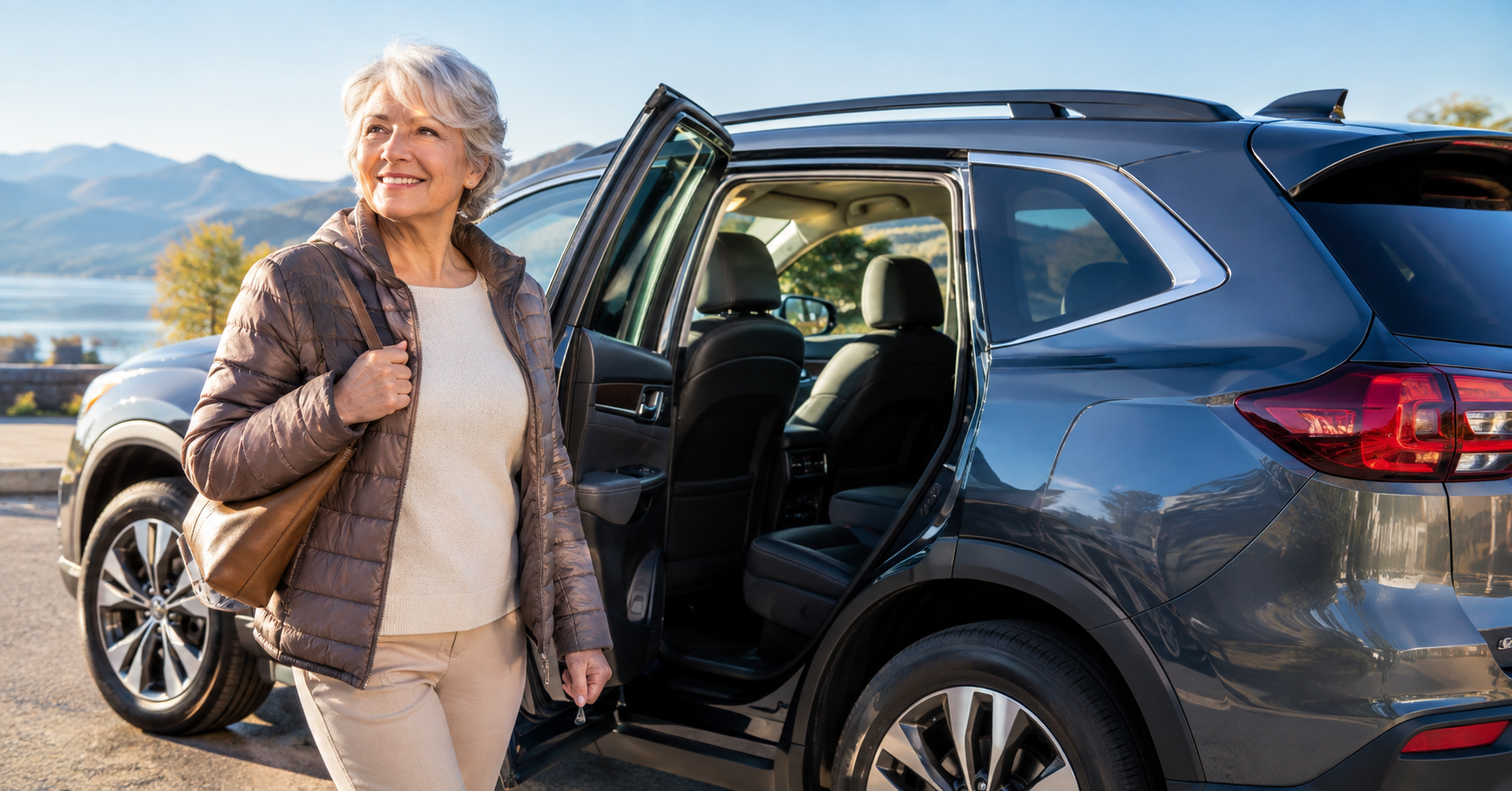
One of the biggest advantages of a midsize SUV is its seating height. Compared with a low sedan, many SUVs place the driver’s seat closer to hip height, reducing the amount of bending required to enter and exit.
However, not every SUV has the same seating position. Buyers should pay attention to the actual step-in height rather than assuming that every SUV will be equally easy to access.
A power driver’s seat with multiple adjustment directions and lumbar support can also be valuable. The ability to raise or lower the seat, move it forward and backward and adjust the backrest allows the driver to create a position that provides both comfort and visibility.
Wide Doors and Easy Entry
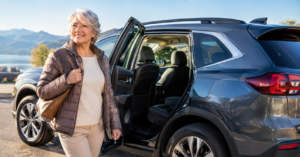
Door design is an often-overlooked part of vehicle accessibility. A wide-opening door can make it easier to sit down without twisting the body awkwardly.
During a test drive, open the driver’s door fully and practice getting in and out several times. Do not judge the vehicle after a single entry. Repeated movement can reveal whether the seat height, door opening and steering wheel position are genuinely comfortable.
Safety Should Come Before Horsepower
For older drivers shopping for a midsize SUV, safety should be evaluated using more than a list of airbags or driver-assistance features.
The Insurance Institute for Highway Safety’s 2026 midsize-SUV list includes a number of Top Safety Pick+ models, including the Honda Passport, Hyundai Ioniq 9, Hyundai Palisade, Hyundai Santa Fe, Kia EV9, Kia Sorento, Mazda CX-70, Mazda CX-70 PHEV, Mazda CX-90, Mazda CX-90 PHEV, Nissan Murano, Nissan Pathfinder, Subaru Ascent and Subaru Outback.
The 2026 IIHS criteria consider performance in several crash and crash-prevention areas, including small-overlap, updated moderate-overlap and side-impact tests. The criteria also address headlights, pedestrian front-crash prevention and vehicle-to-vehicle front-crash prevention.
That matters because a vehicle can have an impressive technology list without necessarily delivering the same level of performance in independent testing.
Safety Features Worth Prioritizing
- Automatic emergency braking with pedestrian detection.
- Blind-spot monitoring.
- Rear cross-traffic warning.
- Adaptive cruise control.
- Lane-departure warning and lane-keeping assistance.
- Parking sensors.
- A clear rearview camera.
- A high-quality 360-degree camera when available.
Buyers should also check whether these features are standard or limited to a more expensive trim. A safety feature that requires moving several levels up the model range can significantly change the vehicle’s price.
Why Vehicle Size Still Matters
IIHS notes that larger and heavier vehicles generally provide greater occupant protection than smaller, lighter vehicles. But size should not be interpreted as a guarantee of safety.
Crash-test performance, vehicle structure, restraint systems, headlights and crash-prevention technology all contribute to the overall safety picture. For older drivers, usability matters too. A vehicle with excellent technology is less helpful if its warnings are confusing or its controls are difficult to operate.
Best 2026 Midsize SUVs for Older Drivers
There is no single SUV that fits every older driver. A retired couple who mostly drives locally has different needs from a grandparent who regularly carries grandchildren or an older driver who frequently travels long distances.
The following models stand out for different priorities.
1. Subaru Outback: Strong Choice for Visibility and Access
The redesigned 2026 Subaru Outback deserves attention because Subaru moved the model toward a more conventional SUV shape while retaining its practical cargo-oriented character.
The 2026 Outback measures 191.7 inches long and 74 inches wide. Subaru lists 25 mpg city, 31 mpg highway and 27 mpg combined for models using the 2.5-liter engine.
Standard all-wheel drive is another major advantage for drivers who regularly encounter rain, snow or loose surfaces.
The Outback’s upright cabin, higher seating position, visibility and comfortable ride make it a compelling choice for drivers who want an SUV that emphasizes everyday usability.
Its biggest drawback may be its dimensions. At nearly 192 inches long, the Outback is not a small vehicle, and its size can become noticeable in tight parking spaces.
The standard engine is also oriented toward adequate everyday performance rather than strong acceleration. For an older driver focused on comfort, visibility and practicality, however, outright performance may not be the priority.
2. Honda Passport: A Two-Row Alternative
The 2026 Honda Passport is particularly relevant to buyers who do not need a third row.
The redesigned Passport comes with standard all-wheel drive and a broad collection of driver-assistance technology. Honda lists collision mitigation braking with pedestrian detection, road-departure mitigation, blind-spot monitoring, a rearview camera, adaptive cruise control with low-speed follow, lane-keeping assistance and parking sensors among its equipment.
The two-row configuration provides a straightforward layout for drivers who want passenger and cargo space without the added length and complexity of a three-row SUV.
Fuel economy is its primary compromise. Honda lists 19 mpg city, 25 mpg highway and 21 mpg combined for most trims.
Like the Outback, the Passport has a relatively substantial exterior footprint. Buyers who frequently use cramped urban parking garages should test its dimensions before making a decision.
3. Toyota Grand Highlander Hybrid: Family-Friendly Efficiency
The Toyota Grand Highlander Hybrid is designed for drivers who need substantially more passenger capacity.
Consumer Reports selected the Grand Highlander as its 2026 Best Midsized SUV, highlighting its adult-friendly third row and the useful cargo space remaining behind it.
Toyota lists seating for up to eight and a manufacturer-estimated 36 mpg combined rating for hybrid models. The hybrid uses a 245-horsepower powertrain.
For an older driver who regularly transports children, grandchildren or other adults, that combination of passenger space and fuel efficiency can be particularly useful.
The trade-off is physical size. The Grand Highlander is not the easiest choice for someone who values compact dimensions and simple parking above everything else.
4. Hyundai Santa Fe: Boxy Design and Accessibility
The 2026 Hyundai Santa Fe takes a different approach to SUV design. Its boxier shape creates a spacious-feeling cabin and broad rear doors.
That design can be advantageous for older passengers because access to the second row is one of the areas where sharply sloping SUV rooflines can become inconvenient.
The Santa Fe is also included on the IIHS 2026 Top Safety Pick+ midsize-SUV list and offers an available hybrid powertrain.
Because equipment and usability can vary by trim, shoppers should examine the exact version they intend to purchase. Seat adjustment, camera systems, wheel sizes and infotainment features should all be evaluated in person.
5. Kia Sorento: Smaller Three-Row Flexibility
The Kia Sorento occupies an interesting position for older drivers who want three rows without moving into one of the largest midsize SUVs.
It offers seating flexibility and an available hybrid powertrain while remaining easier to maneuver than some larger three-row alternatives.
The compromise is the third row itself. It is less spacious than the third row in the Toyota Grand Highlander, making the Sorento more suitable when the additional seats are used occasionally rather than continuously by adults.
The Sorento is also a 2026 IIHS Top Safety Pick+ midsize SUV.
6. Mazda CX-70: Premium Feel With a Different Priority
The Mazda CX-70 is worth considering for older drivers who value driving dynamics and a more premium-feeling cabin.
It earned a 2026 IIHS Top Safety Pick+ designation, and it is available with gasoline and plug-in-hybrid powertrains.
The potential downside is that the CX-70 may not be the most accessible choice for drivers whose primary concern is easy entry and exit. Its seating position and control layout should be tested carefully.
In other words, the CX-70 illustrates an important rule: a vehicle can be excellent overall without being the ideal fit for every older driver.
7. Nissan Murano: Focus on Ride Comfort
The Nissan Murano is another two-row midsize SUV that deserves consideration for drivers who prioritize comfort.
Its comfortable seats and quiet ride can be appealing for long-distance driving, while its two-row layout avoids the added complexity of a third row.
The Murano is included among the IIHS 2026 Top Safety Pick+ midsize SUVs.
However, buyers should compare cargo flexibility, visibility and the exact control layout against competing vehicles before choosing it.
8. Subaru Ascent: AWD and Three-Row Utility
The Subaru Ascent combines three-row practicality with standard all-wheel drive and Subaru’s familiar approach to safety technology.
It is another 2026 IIHS Top Safety Pick+ model and can make sense for drivers who frequently carry passengers.
Its primary disadvantage for some older drivers is size. Someone who usually drives alone or with one passenger may find a two-row SUV easier to park and maneuver.
How to Compare SUVs for Older Drivers
Instead of judging vehicles by horsepower, styling or the size of their infotainment screens, shoppers can use a more practical framework.
- Crash safety: Examine IIHS and NHTSA results and look at crash-prevention performance.
- Entry and exit: Check seat height, door opening and step-in height.
- Visibility: Evaluate the windshield, side windows, mirrors and blind spots.
- Controls: Make sure essential functions are easy to operate without navigating complicated menus.
- Seat comfort: Test lumbar support, cushion length and adjustment range.
- Maneuverability: Consider vehicle length, width, turning space and parking assistance.
- Efficiency: Compare real-world fuel needs and powertrain choices.
- Practicality: Check whether the cargo area accommodates the items the driver actually carries.
This approach puts the emphasis where it belongs: on how the vehicle works for the individual driver.
Visibility Can Matter More Than Vehicle Size
A common mistake is assuming that a larger windshield or taller SUV automatically means better visibility.
Roof pillars, rear-window shapes, hood height and mirror placement can all affect what a driver sees.
Consumer Reports testing cited by AARP has emphasized the importance of visibility for older drivers. Jennifer Stockburger, director of operations at Consumer Reports’ Auto Test Center, described visibility as critical.
During a test drive, drivers should adjust the seat before evaluating visibility. Look forward, over both shoulders and into the mirrors. Then check whether the rear camera provides a clear image and whether parking sensors provide understandable warnings.
A vehicle with excellent seating comfort but difficult blind spots may not be as practical as one with slightly less luxurious seats and substantially better sightlines.
Physical Controls vs. Touchscreens
Modern SUVs increasingly rely on large displays, but bigger screens do not automatically mean better usability.
Consumer Reports testing cited by AARP found that fewer than 30% of respondents age 55 and older preferred touchscreen-heavy dashboards. That finding reinforces the value of physical controls for functions that drivers use frequently.
For an older driver, the most important question is not whether a vehicle has a large screen. It is whether the driver can operate the vehicle without taking unnecessary attention away from the road.
Before buying, test the controls for:
- Temperature.
- Fan speed.
- Audio volume.
- Audio source.
- Windshield defrost.
- Hazard lights.
- Driver-assistance settings.
Physical buttons and knobs can be especially useful when a driver wants to make an adjustment without searching through multiple touchscreen menus.
Hybrid vs. Gas: Which Makes More Sense?
Hybrid SUVs can be an attractive option for older drivers who accumulate substantial annual mileage.
The Toyota Grand Highlander Hybrid, for example, is rated by Toyota at up to 36 mpg combined. Consumer Reports also reported 35 mpg overall for the hybrid in its testing.
A hybrid does not generally require a driver to learn an entirely different driving technique. For everyday operation, it functions much like a conventional automatic vehicle.
Still, buyers should consider more than fuel economy. The purchase price, warranty coverage, local service availability and expected annual mileage should all be part of the calculation.
For someone who drives only a few thousand miles annually, paying significantly more for a hybrid may not produce the same financial benefit as it would for a high-mileage driver.
Do Older Drivers Need All-Wheel Drive?
No. All-wheel drive is useful, but it is not essential for every driver.
AWD can improve traction on snow, rain-soaked roads and loose surfaces. Models such as the Subaru Outback and Honda Passport make AWD standard, which simplifies the decision for buyers who want it.
However, AWD adds weight, complexity and potentially additional cost. It can also reduce fuel economy compared with an otherwise comparable two-wheel-drive vehicle.
Tires remain extremely important. AWD does not eliminate the need for appropriate tires or careful driving in difficult weather.
How to Test-Drive an SUV for an Older Driver
A 10-minute dealership drive is not enough to evaluate a vehicle’s suitability for an older driver.
Bring the items and people that reflect real-world use. That might include eyeglasses, a walking aid, a typical passenger or a walker that needs to fit into the cargo area.
Use This Test-Drive Checklist
- Open the driver’s door fully.
- Enter and exit several times.
- Adjust the driver’s seat and steering wheel.
- Check forward and side visibility.
- Check the mirrors for blind spots.
- Test the rear camera.
- Try the parking sensors.
- Operate the climate controls without assistance.
- Adjust the audio volume and source.
- Test the adaptive cruise control interface.
- Park in a tight space.
- Load the usual cargo into the rear.
- Check whether the seat remains comfortable after extended driving.
The goal is to replicate everyday use rather than simply determine whether the SUV accelerates quickly.
Which Midsize SUV Fits Different Older Drivers?
For visibility, access and all-weather driving: The 2026 Subaru Outback is a strong candidate because of its upright design, standard AWD, comfortable ride and practical cargo area.
For a two-row SUV: The 2026 Honda Passport offers a spacious cabin, standard AWD and a broad set of standard driver-assistance features.
For families: The Toyota Grand Highlander Hybrid provides three-row capacity while retaining useful cargo room and offering strong hybrid fuel economy.
For a boxy, spacious design: The Hyundai Santa Fe deserves attention because its shape emphasizes interior space and rear-seat accessibility.
For a smaller three-row option: The Kia Sorento provides additional seating while remaining more manageable than some larger three-row SUVs.
For driving feel: The Mazda CX-70 is worth considering when handling and interior quality rank highly on the buyer’s list.
For ride comfort: The Nissan Murano is a two-row option with an emphasis on comfortable seats and a quiet driving experience.
For three-row AWD practicality: The Subaru Ascent combines passenger capacity with standard all-wheel drive.
Pros and Cons of Midsize SUVs for Older Drivers
Advantages
- Seat height can make entry and exit easier than in low-slung cars.
- More passenger and cargo room than many compact SUVs.
- Many models provide a commanding driving position.
- Hybrid options can improve fuel economy.
- Three-row models can accommodate family members.
- Advanced driver-assistance systems are increasingly available as standard equipment.
- Cargo areas can accommodate groceries, luggage and mobility equipment.
Disadvantages
- Large dimensions can make parking more difficult.
- Touchscreen-heavy interiors can require a learning period.
- Large wheels may affect ride comfort and tire costs.
- Three-row SUVs can be unnecessarily large for one or two occupants.
- AWD can increase cost and reduce fuel economy.
- Driver-assistance warnings may require familiarization.
- Some desirable comfort and camera features are limited to higher trims.
Why Vehicle Fit Matters More as Drivers Age
The central lesson from research into vehicles for older drivers is that there is no substitute for proper fit.
AARP’s guidance emphasizes that seating position can affect visibility, distraction and the way safety systems function. Josh Dunning, AARP’s vice president and national director of Driver Safety, has stressed that selecting a vehicle that fits the driver and adjusting it to the body can help improve visibility and reduce distraction.
That principle applies regardless of the vehicle’s price.
A luxury SUV with expensive materials and dozens of technological features may not be the best match if the driver struggles to enter it or cannot quickly understand its controls. Conversely, a mainstream midsize SUV may provide an excellent combination of accessibility, safety and practicality without requiring the buyer to pay for unnecessary equipment.
Frequently Asked Questions
What is the best midsize SUV for an elderly driver in 2026?
The right choice depends on the driver’s priorities. The Subaru Outback is a strong all-around candidate for visibility, access, standard AWD and practicality. The Honda Passport is a compelling two-row option, while the Toyota Grand Highlander Hybrid is suited to drivers who regularly need three rows and strong fuel economy.
Is a midsize SUV easier to get into than a sedan?
Often, yes. Many midsize SUVs place the seat closer to hip height, which can reduce the amount of bending required to enter the vehicle. However, seat height varies, so drivers should physically test entry and exit before buying.
Which SUV is easiest for seniors to get in and out of?
There is no universal answer because driver height, mobility and vehicle-seat design differ. Look for a seat near hip height, wide-opening doors, a manageable step-in height and sufficient steering-wheel clearance.
Do seniors need a three-row SUV?
Only if they regularly carry several passengers. A two-row SUV can be easier to park and maneuver and may be more practical for a driver who usually travels alone or with one passenger.
Are hybrid SUVs suitable for older drivers?
Yes. Hybrid SUVs generally drive like conventional automatic vehicles and do not require special driving techniques. Their lower fuel consumption can be useful for high-mileage drivers, although purchase price and service availability should also be considered.
What safety features matter most for older drivers?
Important features include automatic emergency braking with pedestrian detection, blind-spot monitoring, rear cross-traffic warning, adaptive cruise control, lane-departure warning, parking sensors and a clear rearview or 360-degree camera.
Is all-wheel drive necessary for older drivers?
No. AWD can improve traction in difficult conditions, but it is not essential for every driver. Proper tires and cautious driving remain important, and AWD can add cost and affect fuel economy.
Is a larger SUV safer?
IIHS says larger and heavier vehicles generally provide greater occupant protection than smaller, lighter vehicles. However, size alone does not determine safety. Crash-test performance, restraint systems, vehicle design and crash-prevention technology also matter.
Are touchscreens bad for older drivers?
Not necessarily, but complicated menus can increase distraction. A more senior-friendly vehicle should make essential functions such as climate control, audio volume and hazard lights easy to operate.
What should an older driver bring to a test drive?
Bring eyeglasses, walking aids, a typical passenger and any walker or mobility equipment that normally travels