
The Volkswagen ID. Tiguan brings major changes to the automaker’s electric SUV lineup, addressing several of the most criticized features of the ID.4. With sharper exterior styling, physical buttons and switches, upgraded interior options and familiar electric powertrain configurations, the new model represents a significant redesign. Volkswagen has confirmed that the ID. Tiguan will reach the U.S., but it has not announced an American launch date or price.
Volkswagen ID. Tiguan Replaces the ID.4’s Rounded Styling
Volkswagen’s first generation of electric vehicles introduced styling that differed from its combustion-powered models, relying heavily on rounded shapes and curved bodywork. The ID.4 was among the more bulbous designs, while the smaller ID.3 had a more wedge-shaped profile and the ID. Buzz adopted a boxy, breadbox-like appearance.
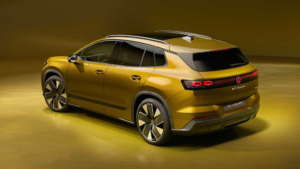
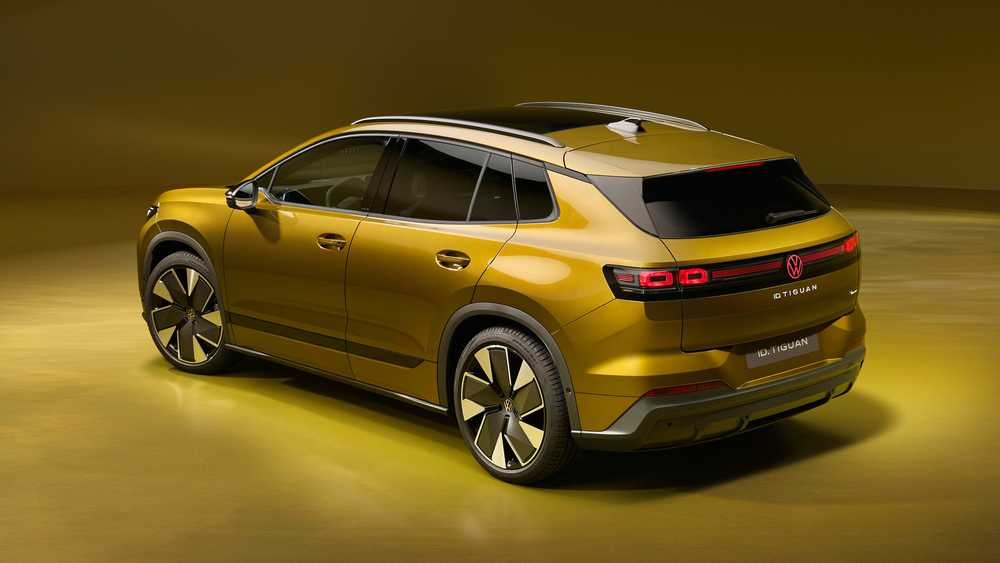
The ID. Tiguan moves toward the sharper lines and more restrained styling seen on other Volkswagen models. Although its curved roofline retains some resemblance to the ID.4, the rest of the exterior features a taller, squared-off headlight area that flows into a wide faux grille and light bar.
Creases extend from the lower bumper through the grille and into the hood, while the fenders appear more tightly shaped around the wheels. At the rear, the taillights combine a boxier design with pronounced depth, echoing styling elements found on other recent Volkswagen vehicles, including the combustion-powered Tiguan.
The new model also drops the cheap-looking black plastic cladding associated with the ID.4 and uses conventional pull-style door handles.
Volkswagen will offer two main styling versions. The standard model is shown in Olive Bronze, while the sportier R-Line appears in Glacier White. The R-Line is distinguished by different wheels and bumper covers, including larger, more prominent faux lower-grille and diffuser sections.
Real Buttons Return to the Volkswagen ID. Tiguan Interior
The interior represents one of the biggest changes from the ID.4. Volkswagen has removed the haptic touch buttons and panels, bringing back physical controls throughout the cabin, including actual buttons on the steering wheel.
Below the infotainment display, a row of knurled toggle switches controls the climate system’s temperature, fan speed and vent selection. The center console also features a physical volume knob that can be pressed in either direction to seek radio stations or skip tracks.
The driver’s door now has separate switches for all four windows, eliminating the need to press an additional button to switch between controls for the front and rear windows.
The dashboard has also adopted a more conventional, upright layout. Rather than using separate screen pods rising from a low dashboard, the ID. Tiguan integrates its displays into a more traditional design.
Three Screens and Vintage Volkswagen Display Themes
The ID. Tiguan will offer a 15-inch infotainment screen, an increase of 2.1 inches over the previous unit. The driver’s display measures 10 inches diagonally, and buyers can also opt for a separate 10-inch screen for the front passenger.
The driver’s display includes graphics packages inspired by older Volkswagen models. Available designs include the first-, second- and fourth-generation Golf, the first-generation Tiguan, a racing version of the Touareg and an unspecified generation of the Beetle.
For its press photos, Volkswagen selected the fourth-generation Golf theme, featuring cobalt-blue indices and laser-red needles.
Other interior changes include a full-length front center console and additional ambient lighting on certain trims. Illuminated rings surround the cupholders, while lighting appears in dashboard gaps, door pulls and dotted patterns along the upper door trim.
Premium Features Include Massage Seats and Harman Kardon Audio
Volkswagen will offer several high-end options for the ID. Tiguan, including front seats with heating, ventilation and massage functions. Other available equipment includes two wireless phone chargers in the center console, a 480-watt Harman Kardon sound system and a panoramic sunroof.
The R-Line adds sport seats with more pronounced side bolsters.
Volkswagen ID. Tiguan Powertrain Options and Range
The ID. Tiguan will use the latest version of Volkswagen’s MEB electric-vehicle platform, called MEB+. Three motor configurations are planned for its initial offering, with power outputs and battery sizes similar to options already available for the ID.4 in Europe.
- Base rear-wheel-drive model: A single rear motor producing 188 horsepower, paired with a 58-kWh battery pack. This is currently the base configuration for the ID.4 in Europe.
- More powerful rear-wheel-drive model: A 282-horsepower rear motor paired with a 77-kWh battery. Volkswagen says this configuration will offer up to 373 miles of range on the WLTP cycle.
- Dual-motor model: A two-motor setup producing 295 horsepower, using the same larger 77-kWh battery pack.
The 282-horsepower configuration is similar to the base ID.4 sold in the United States, although American models use an 82-kWh battery pack and offer up to 291 miles of range.
Two configurations currently available in other ID.4 versions are absent from the announced ID. Tiguan lineup: the 82-kWh battery used in the U.S. and a higher-output all-wheel-drive powertrain. Volkswagen has used two motors producing a combined 335 horsepower in the European GTX and the all-wheel-drive ID.4 sold in America.
Volkswagen has not confirmed whether these configurations will be added to the ID. Tiguan later, including when the electric SUV reaches the U.S. market.
When Will the Volkswagen ID. Tiguan Arrive in the U.S.?
Volkswagen has confirmed that the ID. Tiguan is coming to the United States, but the company has not provided a target launch date. The model is scheduled to enter various markets over the course of next year, with availability in Europe beginning at the start of 2027.
U.S. versions could arrive considerably later. The source article suggests they may not reach the market until 2028, potentially alongside the return of the ID. Buzz, but Volkswagen has not confirmed that timing.
Volkswagen ID. Tiguan Price
Volkswagen has announced a starting price of €42,695 for the ID. Tiguan, equivalent to $47,935 at current exchange rates. That price is likely associated with the base powertrain, as it is within a few hundred euros of the current base ID.4 in Germany.
The U.S. price remains unknown. For comparison, the 2026 Volkswagen ID.4 has a starting manufacturer’s suggested retail price of $45,095 in the United States, with a 282-horsepower rear motor and an 82-kWh battery pack.
With revised styling, a substantially redesigned cabin and three announced powertrain options, the ID. Tiguan marks a major change from the ID.4. Volkswagen has confirmed its U.S. arrival, but American buyers will have to wait for official pricing and launch details.