
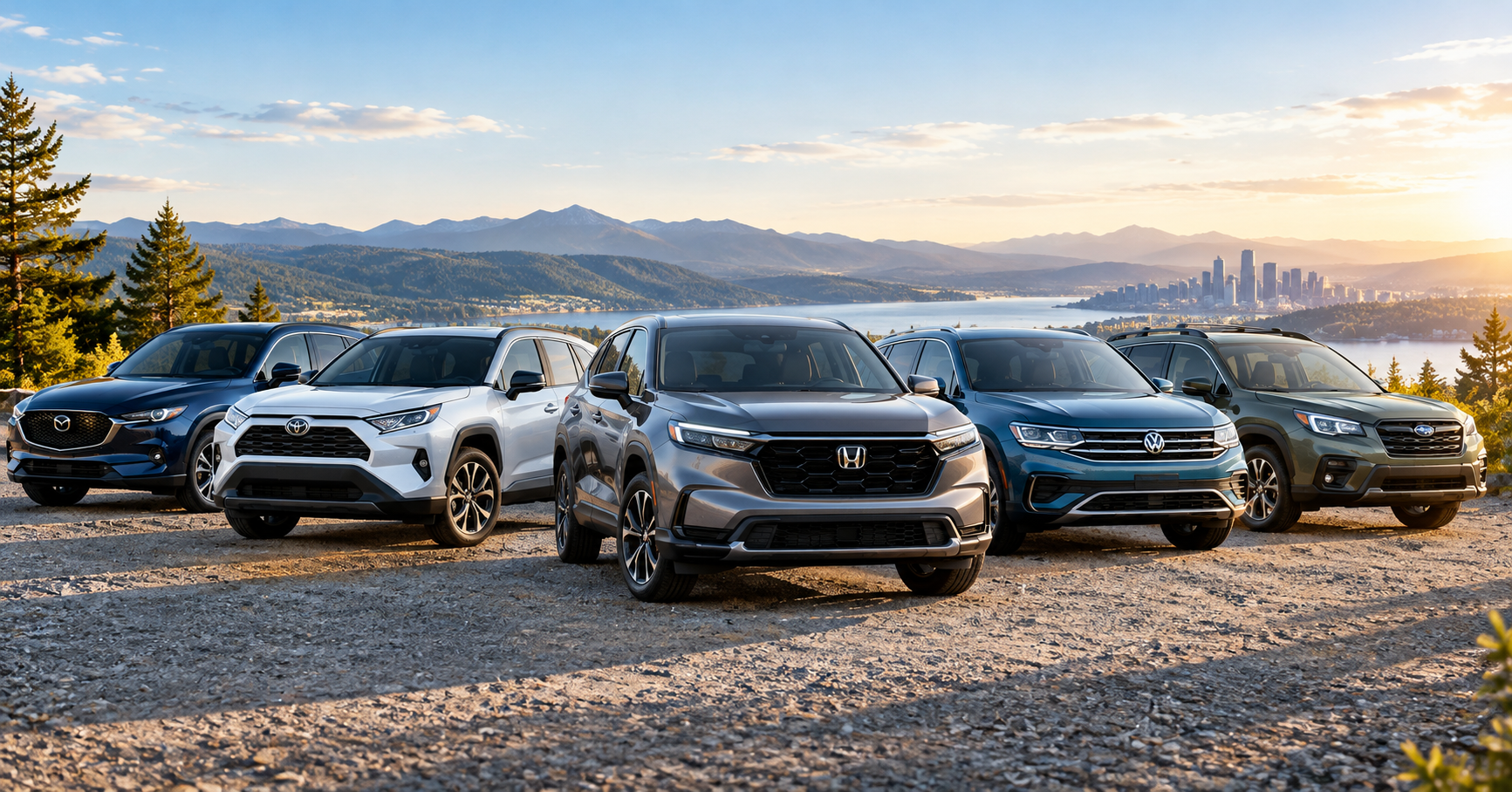
The compact SUV market has reached an important turning point. Buyers can choose from fuel-efficient hybrids, comfortable family vehicles, premium-feeling interiors, and adventure-ready crossovers without moving into a larger, more expensive vehicle.
Choosing the right SUV involves more than comparing starting prices or fuel economy figures. A vehicle that works perfectly for a family commuting through suburban traffic might not be the best match for someone who regularly drives through snow, takes long road trips, or prioritizes an upscale cabin.
This guide examines 10 compelling compact SUVs for the 2026 model year, highlighting what each does well, where it makes compromises, and which buyers should consider it. Whether fuel savings, family comfort, technology, or weekend adventures matter most, understanding these differences can help you make a more confident purchase.
Best Compact SUVs 2026: Quick Comparison
These 10 models cover the major priorities American compact SUV shoppers face, from everyday family transportation to hybrid efficiency and light off-road capability. Prices and fuel economy figures reflect the supplied research and should be confirmed against the specific trim, drivetrain, and current manufacturer information before purchase.
| Compact SUV | Best For | Starting Price | Reported Combined MPG |
|---|---|---|---|
| Honda CR-V | Overall practicality | $32,470 | 29–30 |
| Toyota RAV4 | Hybrid efficiency | $33,495 | 38–43; up to 47 reported by KBB |
| Mazda CX-50 | Driving enjoyment | $31,395 | 25 |
| Volkswagen Tiguan | Cabin quality and comfort | $32,280 | 25–29 |
| Hyundai Tucson | Technology and cargo value | $31,350 | 26–28 |
| Kia Sportage | Features for the money | $30,285 | 24–28 |
| Ford Bronco Sport | Light off-road driving | $33,840 | 24–27 |
| Jeep Cherokee | Hybrid power and efficiency | $36,995 | 37 |
| Subaru Forester | All-weather practicality | $31,445 | 29 |
| Nissan Rogue | Daily commuting comfort | $30,635 | 31 |
Note: Prices and fuel economy figures are based on the supplied research and have not been independently verified. The RAV4 figures vary between sources and configurations. Check official EPA ratings and current MSRP for the exact vehicle you intend to buy.
How We Evaluated the Best Compact SUVs for 2026
A useful compact SUV comparison should consider how vehicles perform in everyday ownership, not simply how many features appear on a specification sheet.
The supplied research draws on rankings and comparisons from Car and Driver, Kelley Blue Book, and Cars.com. Their evaluations consider factors such as ride comfort, handling, acceleration, fuel efficiency, cargo capacity, passenger space, interior quality, and overall value.
Car and Driver’s compact SUV rankings use instrumented testing and a broad set of performance and usability measures. Kelley Blue Book offers expert assessments and buyer-oriented comparisons, while Cars.com provides comparative testing that includes practical considerations such as passenger accommodation, cargo measurements, and child-seat usability.
These sources do not always agree on a single winner because they may evaluate different trims, use different scoring systems, or prioritize different characteristics. That disagreement is useful for buyers: the highest-ranked vehicle is not automatically the right choice for every household.
This guide considers six major factors:
- Everyday usability: Comfort and practicality for commuting, errands, and family transportation.
- Efficiency: Fuel economy, particularly in hybrid versions.
- Interior and cargo space: Room for passengers, groceries, luggage, and child seats.
- Driving experience: Comfort, responsive handling, or rugged capability.
- Value: Whether the equipment and performance justify the price.
- Ownership priorities: All-wheel drive, fuel savings, warranty coverage, and resale considerations.
1. Honda CR-V: Best Overall Compact SUV
Starting price: $32,470 | Reported combined fuel economy: 29–30 mpg
The 2026 Honda CR-V is a strong starting point for shoppers who want one vehicle to handle commuting, family transportation, shopping trips, and long-distance travel. Rather than concentrating on one standout feature, it combines several characteristics that matter during everyday ownership.
Car and Driver awards the CR-V a 10-out-of-10 rating in its compact SUV rankings, while Kelley Blue Book places it first on its list and gives it a 4.8-out-of-5 rating. Both publications highlight its practicality, comfort, and easy driving manners.
Why the Honda CR-V stands out
The CR-V’s appeal comes from its well-rounded character. Its spacious cabin helps accommodate passengers, while its comfortable ride makes it suitable for drivers who spend considerable time behind the wheel.
Families can benefit from its flexible interior and useful cargo area. These characteristics matter when the SUV must transition between school runs, weekly shopping, luggage, and everyday errands.
Hybrid availability adds another option for drivers who want to reduce fuel consumption. The conventional model’s reported combined economy of 29–30 mpg is respectable, although buyers should compare the hybrid’s purchase price and official fuel economy before deciding which version makes financial sense.
Where the CR-V makes compromises
The CR-V’s technology presentation can feel less modern than that of some newer competitors. Buyers who prioritize the latest infotainment experience or a particularly upscale cabin should compare it directly with the Volkswagen Tiguan and Mazda CX-50.
Its starting price compared with some alternatives also makes it worth examining the standard equipment included in each trim.
Best for: Families, commuters, and buyers who want a practical compact SUV with balanced everyday usability.
Consider something else if: You prioritize the lowest possible starting price, a more distinctive driving experience, or the highest available hybrid fuel economy.
2. Toyota RAV4: Best Compact SUV for Hybrid Efficiency
Starting price: $33,495 | Reported combined fuel economy: 38–43 mpg, with KBB reporting up to 47 mpg
The redesigned 2026 Toyota RAV4 changes the conversation for buyers comparing gasoline and hybrid compact SUVs. Hybrid power is standard across the redesigned lineup, making electrified driving the default rather than an upgrade reserved for selected versions.
Kelley Blue Book names the 2026 RAV4 its Best Compact SUV and reports combined fuel economy of up to 47 mpg. Car and Driver lists a range of 38–43 mpg combined in the supplied research. Because these figures differ, shoppers should check the official EPA rating for the specific trim and drivetrain they are considering.
Why the redesigned RAV4 matters
Fuel economy can become a meaningful ownership expense for drivers who cover substantial annual mileage. A commuter traveling long distances every weekday may benefit more from a highly efficient hybrid than someone who drives only occasionally.
The RAV4’s standard hybrid configuration simplifies that decision. Buyers do not have to choose between a conventional gasoline model and a hybrid just to enter the lineup, although trim selection, equipment, and pricing still matter.
The 2026 redesign also brings updated exterior and interior styling, an updated Toyota Audio Multimedia system, and hybrid and plug-in hybrid variants.
For shoppers who need everyday versatility alongside lower fuel consumption, that combination makes the RAV4 an important model to test-drive.
What buyers should consider
Efficiency does not guarantee a premium interior. Cars.com notes that the base LE’s cabin feels less upscale than some competitors.
Buyers should also distinguish between a conventional hybrid and a plug-in hybrid. A conventional hybrid does not require external charging, while a plug-in hybrid can use externally charged energy when appropriately equipped and charged. The two configurations may have different prices, electric-driving capabilities, and fuel-economy measurements.
Availability is another consideration during a redesign year. The supplied sales research reports that RAV4 sales were down year over year through September 2026, with inventory constraints during the model changeover cited as a factor. Buyers should confirm local inventory and delivery timing rather than assuming every configuration is immediately available.
Best for: High-mileage commuters, fuel-conscious households, and buyers who want hybrid power without giving up compact SUV practicality.
Consider something else if: Your priorities are a particularly luxurious base interior or a lower initial purchase price above all else.
3. Mazda CX-50: Best Compact SUV for Driving Enjoyment
Starting price: $31,395 | Reported combined fuel economy: 25 mpg
The Mazda CX-50 appeals to drivers who want their compact SUV to feel engaging rather than purely functional. Its design and driving character give it a different personality from more conventional family crossovers.
Car and Driver gives the CX-50 a 9.5-out-of-10 rating in its compact SUV rankings, while Kelley Blue Book awards it 4.5 out of 5. KBB highlights its adventurous styling, premium character, and responsive driving manners.
A more engaging everyday drive
For some buyers, steering response, body control, and an attractive cabin matter nearly as much as cargo capacity. The CX-50 targets those drivers with a more driver-focused experience.
Its styling also makes it a natural candidate for shoppers who like the appearance of an adventure-oriented SUV but do not necessarily need a dedicated off-road vehicle.
The CX-50 can be particularly appealing to couples or small families who want practical passenger and cargo space without choosing a vehicle that feels generic behind the wheel.
The trade-off: Fuel economy
The reported 25 mpg combined figure places the CX-50 behind the most efficient hybrid choices in this comparison. That difference deserves attention for anyone planning to keep the vehicle for several years and drive substantial annual mileage.
Buyers should also compare the CX-50 with the redesigned 2026 Mazda CX-5. The supplied research identifies the CX-5 as larger following its redesign while retaining Mazda’s driver-focused character. The two models may appeal to overlapping audiences, but the right choice depends on the equipment, dimensions, pricing, and driving experience of the specific versions available.
Best for: Drivers who value styling, responsive handling, and a more distinctive personality.
Consider something else if: Your first priority is maximum fuel economy or the lowest possible operating cost.
4. Volkswagen Tiguan: Best for Interior Quality and Comfort
Starting price: $32,280 | Reported combined fuel economy: 25–29 mpg
The 2026 Volkswagen Tiguan is worth a close look for buyers who want their compact SUV to feel more upscale without moving into a luxury-brand price category.
Cars.com named the Tiguan SEL R-Line Turbo the winner of its eight-SUV 2026 Compact SUV Challenge. Its evaluation highlighted interior quality, passenger space, amenities, and driving performance. Car and Driver gives the Tiguan a 9-out-of-10 rating in its compact SUV rankings.
What makes the Tiguan different?
Interior design and perceived quality can influence how satisfying a vehicle feels throughout years of ownership. The Tiguan’s cabin, passenger accommodation, and equipment help it stand out for buyers who want a comfortable environment for commuting and family trips.
The SEL R-Line Turbo also adds a 268-horsepower turbocharged engine option for 2026, according to the supplied research. That gives shoppers a performance-oriented alternative to compact SUVs that concentrate more heavily on efficiency.
Cars.com’s comparison results are especially relevant for buyers who frequently carry adult passengers or want an interior that feels more refined than the price might suggest.
What is the downside?
The Tiguan does not offer a hybrid powertrain in the supplied research. Buyers focused on minimizing fuel consumption should compare its running costs with the Toyota RAV4 and available hybrid versions of the Honda CR-V, Hyundai Tucson, and Kia Sportage.
It is also important to distinguish the performance-oriented SEL R-Line Turbo from less expensive trims. The engine, equipment, and driving experience may differ significantly across the range.
Best for: Buyers who value cabin quality, passenger comfort, and a refined driving experience.
Consider something else if: Hybrid efficiency is a primary requirement.
5. Hyundai Tucson: Best for Technology and Cargo Value
Starting price: $31,350 | Reported combined fuel economy: 26–28 mpg
The 2026 Hyundai Tucson offers a combination of modern technology, practical interior space, and competitive pricing. It deserves attention from buyers who want a family-friendly vehicle with a generous selection of features.
Cars.com placed the Tucson third in its eight-SUV comparison, while Kelley Blue Book gives it a 4.5-out-of-5 rating in the supplied research.
A practical choice for everyday families
The Tucson’s appeal lies in its balance of comfort, passenger accommodation, cargo flexibility, and equipment. For a household that regularly transports children, groceries, sports equipment, and luggage, those details can matter more than a small advantage in acceleration or handling.
The model’s technology and available hybrid powertrain also give buyers several ways to configure the vehicle around their priorities.
The supplied research lists the Tucson Hybrid at 231 horsepower. Buyers should verify specifications for the exact model and configuration being considered, as powertrain details can vary.
What should you compare before buying?
The Tucson’s conventional versions and hybrid models should not be treated as interchangeable. Purchase price, fuel economy, equipment, and power output can differ depending on the configuration.
Buyers should also test the infotainment system, inspect cargo access, and evaluate the seating position before choosing a trim. A feature-rich vehicle is only good value if its layout and controls work well for the people who will use it every day.
Best for: Families and technology-minded shoppers looking for a versatile compact SUV.
Consider something else if: You prefer a more engaging driving experience or prioritize the Tiguan’s upscale cabin character.
6. Kia Sportage: Best Compact SUV for Features and Value
Starting price: $30,285 | Reported combined fuel economy: 24–28 mpg
The Kia Sportage is an attractive option for shoppers who want substantial equipment without starting at the higher end of the compact SUV price range.
Kelley Blue Book places the Sportage second in its compact SUV rankings, awarding it 4.6 out of 5. Cars.com also identifies it as a value-oriented choice in its comparison research.
Why value-focused buyers should consider it
A vehicle’s starting price is only one part of the value equation. Standard safety equipment, infotainment features, passenger space, warranty coverage, and the cost of moving to a better-equipped trim can all affect the final decision.
The Sportage gives shoppers a useful starting point because its listed entry price is lower than those of several competitors in this guide.
Hybrid availability adds another option for buyers who want to balance equipment with fuel efficiency. The supplied research lists the Sportage Hybrid at 232 horsepower, although shoppers should verify specifications for their preferred model year and trim.
Where the Sportage may fall short
Buyers should not assume that the least expensive version delivers every feature found in promotional images or higher-trim reviews. Compare standard equipment carefully and calculate the price of the configuration you actually want.
Fuel economy also varies by powertrain and trim, so the reported 24–28 mpg range should not be applied to every Sportage variant.
Best for: Buyers seeking useful technology, everyday practicality, and a competitive entry price.
Consider something else if: You want the highest available fuel economy or place driving refinement above equipment and price.
7. Ford Bronco Sport: Best for Light Off-Road Adventures
Starting price: $33,840 | Reported combined fuel economy: 24–27 mpg
The Ford Bronco Sport brings a more rugged personality to the compact SUV class. Its appeal is strongest among drivers who want an everyday vehicle that also suits outdoor recreation and occasional trips onto suitable unpaved routes.
Car and Driver gives the Bronco Sport a 9-out-of-10 rating in its compact SUV rankings. The supplied research also identifies it as Ford’s sole compact SUV entry following the discontinuation of the Escape.
A compact SUV with an outdoor focus
Many buyers like the idea of an adventure-ready vehicle but do not need a larger, specialized off-roader. The Bronco Sport offers an alternative to conventional family crossovers, emphasizing rugged styling and capability-oriented features.
Available all-wheel drive and the vehicle’s adventure-focused character can make it worth considering for camping trips, outdoor equipment, and light trail use. Actual capability depends on the trim, tires, equipment, and terrain.
What compromises should buyers expect?
The Bronco Sport is not necessarily the most efficient or spacious option for every household. The supplied research notes limitations in rear-seat and cargo space compared with some competitors.
Its reported 24–27 mpg combined economy also trails the leading hybrid options. Buyers who primarily drive on paved roads may find that a more conventional crossover offers a better combination of fuel economy and passenger comfort.
Best for: Outdoor enthusiasts who want a compact daily driver with light off-road capability.
Consider something else if: Your main priorities are maximum rear-seat room, cargo capacity, or fuel savings.
8. Jeep Cherokee: Best New Hybrid Alternative
Starting price: $36,995 | Reported combined fuel economy: 37 mpg
The Jeep Cherokee returns for 2026 as an all-new, hybrid-only compact SUV, according to the supplied research. Its combination of electrified power and Jeep’s established SUV identity gives buyers another alternative to the segment’s established hybrid models.
Car and Driver gives the new Cherokee an 8-out-of-10 rating, while Kelley Blue Book awards it 4.5 out of 5 in the research brief.
Why the Cherokee deserves attention
The Cherokee’s reported 37 mpg combined fuel economy makes it relevant to shoppers who want an SUV with hybrid efficiency but prefer Jeep’s styling and brand character.
The supplied research identifies a 1.6-liter turbocharged hybrid system. Car and Driver describes the vehicle as promising, highlighting its competitive fuel economy, upscale interior, and pleasant driving experience.
For buyers who do not want to choose between a conventional gasoline SUV and a hybrid, the Cherokee broadens the range of options worth comparing.
Why a test drive matters
As a newly returned model, the Cherokee deserves a closer look at the exact trim, equipment, warranty terms, and real-world usability before buyers make a decision.
Its starting price is higher than those of several alternatives in this guide. Shoppers should compare the total purchase price with the RAV4, CR-V Hybrid, Tucson Hybrid, and Sportage Hybrid rather than judging it by fuel economy alone.
Drivers interested in rough roads should also verify the capabilities of their chosen configuration instead of assuming every Cherokee trim offers the same off-road equipment.
Best for: Buyers seeking a new hybrid compact SUV with Jeep styling and a reported 37 mpg combined rating.
Consider something else if: You want the lowest purchase price or prefer an established model with a longer history in its current generation.
9. Subaru Forester: Best for All-Weather Practicality
Starting price: $31,445 | Reported combined fuel economy: 29 mpg
The Subaru Forester is a practical candidate for buyers who prioritize year-round usability and all-weather confidence. It is particularly relevant to drivers who regularly encounter rain, snow, or poorly maintained roads.
Kelley Blue Book gives the Forester a 4.4-out-of-5 rating in the supplied research. Its appeal centers on practical packaging and its suitability for buyers who want an SUV-oriented driving position and all-wheel-drive availability.
What makes the Forester useful?
Weather conditions can change what matters most in a vehicle. Drivers in snowy regions may place greater importance on traction, visibility, ground clearance, and predictable handling than on the lowest possible fuel consumption.
The Forester belongs on the shopping list for those buyers. Its practical design also suits households that need everyday transportation with the flexibility to carry outdoor equipment or travel beyond the city.
All-wheel drive can help a vehicle accelerate on slippery surfaces, but it does not eliminate the need for appropriate tires or safe driving. Winter tires, careful speed management, and adequate stopping distance remain important in snow and ice.
What to compare before buying
Shoppers should compare the Forester with all-wheel-drive versions of the Honda CR-V, Toyota RAV4, and Mazda CX-50.
The most suitable choice depends on local weather, cargo requirements, comfort preferences, and the price of the desired trim. Buyers should also confirm the equipment and fuel economy of the exact Forester they intend to purchase.
Best for: Drivers who prioritize all-weather practicality, outdoor activities, and a versatile everyday cabin.
Consider something else if: Your primary goal is the highest possible hybrid fuel economy.
10. Nissan Rogue: Best for Comfortable Daily Commuting
Starting price: $30,635 | Reported combined fuel economy: 31 mpg
The Nissan Rogue remains an important choice in the compact SUV market because of its everyday comfort, competitive pricing, and appeal to commuters.
Kelley Blue Book gives the Rogue a 4.3-out-of-5 rating in the supplied research. The vehicle is a reasonable option for shoppers who want a practical crossover without necessarily prioritizing sporty handling or a premium cabin.
Why commuters should consider the Rogue
A daily commuter needs more than a strong acceleration figure. Seat comfort, ride quality, visibility, cabin noise, and straightforward controls can influence the driving experience every single day.
The Rogue deserves a test drive from buyers who want a comfortable vehicle for routine travel, errands, and family use. Its reported combined fuel economy of 31 mpg also makes it worth comparing with conventional gasoline-powered competitors.
The supplied research notes a 2026.5 update that includes a Rock Creek trim. Shoppers should verify which versions are available locally and whether the updated features justify any price difference.
Where rivals have an advantage
Cars.com found the Rogue’s infotainment experience and on-road refinement behind some newer competitors in its comparison research.
That does not automatically make the Rogue the wrong choice. It means buyers should spend time testing the interface, checking phone connectivity, and driving the vehicle on the roads they use most often.
Best for: Commuters and households seeking a practical compact SUV with a comfortable everyday character.
Consider something else if: You prioritize the latest infotainment experience, the most polished driving dynamics, or leading hybrid efficiency.
Which 2026 Compact SUV Is Right for You?
Once the leading models are compared, the best way to narrow the list is to identify the one or two characteristics that matter most to your household.
Best compact SUV for families
The Honda CR-V, Hyundai Tucson, Kia Sportage, and Volkswagen Tiguan deserve close consideration for family use. Their appeal comes from practical cabins, passenger accommodation, and cargo flexibility.
Parents should bring their actual child seats to the dealership when possible. A vehicle can appear spacious in a showroom but offer a less convenient fit for a particular rear-facing seat, booster, or combination of passengers and luggage.
Best compact SUV for fuel economy
The Toyota RAV4 is a leading candidate because hybrid power is standard in the redesigned 2026 lineup. The Honda CR-V Hybrid, Hyundai Tucson Hybrid, Kia Sportage Hybrid, and Jeep Cherokee also deserve consideration.
Compare official EPA ratings for matching powertrain configurations. Do not compare a hybrid’s advertised figure with a conventional model’s rating without accounting for differences in purchase price and equipment.
Best compact SUV for snow
The Subaru Forester, Toyota RAV4, Honda CR-V, and Mazda CX-50 are worth evaluating for drivers in snowy regions, particularly in all-wheel-drive configurations.
However, the presence of all-wheel drive does not determine winter performance on its own. Tires, ground clearance, visibility, braking, and driver behavior all influence how a vehicle handles challenging conditions.
Best compact SUV for driving enjoyment
The Mazda CX-50 and Volkswagen Tiguan stand out for drivers who place a high value on driving character. The CX-50 emphasizes responsive handling and distinctive styling, while the Tiguan combines interior refinement with an available 268-horsepower turbocharged engine option.
The Ford Bronco Sport is another candidate for drivers who want a more rugged personality and occasional light off-road use.
Best compact SUV for value
The Kia Sportage and Hyundai Tucson offer useful combinations of technology, space, and equipment. The Nissan Rogue and Subaru Forester are also worth comparing, depending on the desired trim and drivetrain.
For an accurate comparison, calculate the out-the-door price rather than relying only on the advertised starting MSRP. Taxes, dealer fees, optional equipment, financing, and insurance can change the real cost of ownership.
Hybrid vs. Gasoline Compact SUVs: Which Makes More Sense?
One of the biggest decisions facing compact SUV shoppers in 2026 is whether to choose a hybrid. More models now offer electrified powertrains, and the redesigned RAV4 makes hybrid power standard across its lineup.
When a hybrid is worth considering
Hybrids are particularly appealing to drivers who cover many miles, frequently travel through stop-and-go traffic, or want to reduce gasoline consumption without depending on external charging.
Models such as the Toyota RAV4, Honda CR-V, Hyundai Tucson, Kia Sportage, and Jeep Cherokee give shoppers several ways to pursue that goal.
Still, fuel savings depend on how much you drive, local gasoline prices, the vehicle’s actual fuel economy, and the difference in purchase price between comparable configurations.
When a conventional gasoline SUV may be enough
Drivers who travel relatively few miles each year may not recover a hybrid’s additional upfront cost through fuel savings alone. The calculation also changes when the conventional model has a lower purchase price or the hybrid requires a more expensive trim.
Some buyers may prefer a conventional SUV because of its engine character, available equipment, or overall value.
How to estimate potential fuel savings
- Estimate how many miles you drive each year.
- Compare the official combined MPG ratings of the specific vehicles.
- Divide annual mileage by each vehicle’s MPG rating to estimate yearly gallons consumed.
- Multiply the difference in gallons by your expected gasoline price.
- Compare annual fuel savings with the additional purchase price of the hybrid.
For example, a driver covering 15,000 miles annually will generally use less gasoline in a vehicle rated at 40 mpg than in one rated at 25 mpg. The exact difference depends on actual driving conditions and the ratings of the vehicles being compared.
This calculation does not account for every ownership expense, including insurance, maintenance, financing, depreciation, and potential differences in resale value. It is a starting point rather than a guarantee of savings.
What to Check Before Buying a Compact SUV in 2026
Even a highly rated vehicle can be a poor match if its seating position, controls, cargo layout, or ownership costs do not fit your needs. Before committing to one of the best compact SUVs 2026 has to offer, use the following checklist.
1. Compare the exact trim levels
Reviews often focus on higher trims with upgraded engines, larger displays, additional driver-assistance equipment, or more premium materials. Confirm which features are standard on the version you can afford.
2. Test the infotainment system
Connect your smartphone, check navigation and audio controls, and see whether common tasks require too many screen taps. An interface that feels intuitive during a test drive may be more satisfying over years of ownership.
3. Evaluate passenger and cargo space
Bring the family if possible. Check rear-seat legroom, door openings, child-seat installation, cargo access, and the amount of room left when passengers and luggage are aboard.
4. Compare safety equipment
Review the standard and optional driver-assistance features on each trim. Confirm which systems are included, how they operate, and whether they match your expectations. Avoid assuming that every version of a model has identical equipment.
5. Calculate the total purchase cost
Request a written price that includes dealer fees and optional equipment. Compare financing terms and insurance estimates, and review the warranty applicable to the exact vehicle.
6. Take a meaningful test drive
Drive on city streets, highways, and uneven pavement when possible. Pay attention to seat comfort, visibility, braking response, cabin noise, and how smoothly the transmission or hybrid system operates.
7. Check local inventory
Redesigns and popular hybrid configurations can affect availability. Confirm delivery timing and avoid making a decision based only on a vehicle shown in an advertisement.
Are Compact SUVs Worth Buying in 2026?
For many American households, compact SUVs offer a useful middle ground between traditional sedans and larger family vehicles.
They typically provide a higher seating position, flexible cargo areas, and available all-wheel drive without requiring buyers to move into a larger three-row SUV. Hybrid options also give fuel-conscious shoppers more choices than they had in earlier model cycles.
There are trade-offs. Compact SUVs can cost more than comparable sedans, and their larger bodies may bring additional fuel consumption. Drivers who rarely carry bulky cargo or passengers may find that a sedan remains the more economical choice.
Buyers should also remember that the compact SUV category includes vehicles with different strengths. The Honda CR-V emphasizes balance, the Toyota RAV4 focuses on standard hybrid power, the Mazda CX-50 targets driving enjoyment, and the Ford Bronco Sport leans toward outdoor capability.
The right choice depends on how the vehicle will be used, not simply which model earns the highest score in a review.
Final Verdict: Which Compact SUV Should You Buy?
The best compact SUVs 2026 shoppers can choose from offer a wide variety of strengths. The Honda CR-V remains a compelling all-around choice, supported by strong evaluations from both Car and Driver and Kelley Blue Book.
The Toyota RAV4 is especially attractive to buyers who prioritize fuel economy and want hybrid power as standard equipment. The Volkswagen Tiguan deserves attention from those who value interior quality and passenger comfort, while the Mazda CX-50 is a natural fit for drivers who want a more engaging experience.
For shoppers focused on equipment and price, the Kia Sportage and Hyundai Tucson offer competitive alternatives. The Subaru Forester is worth a look for all-weather practicality, the Ford Bronco Sport suits light off-road adventures, the Jeep Cherokee adds another hybrid option, and the Nissan Rogue remains relevant for daily commuting.
Before making a final decision, compare at least three vehicles in person, test-drive the exact trims you can afford, and verify current pricing and EPA fuel economy. A small difference in purchase price or fuel consumption can become meaningful over several years, but comfort, usability, and satisfaction matter too.
Ultimately, the smartest purchase is the compact SUV that fits your budget, daily routine, passenger needs, and driving environment—not necessarily the one at the top of every list.
Frequently Asked Questions About the Best Compact SUVs 2026
What is the best compact SUV for 2026?
The Honda CR-V is a strong all-around choice. Car and Driver gives it a 10-out-of-10 rating, while Kelley Blue Book ranks it first with a 4.8-out-of-5 rating. Buyers who prioritize hybrid efficiency should also consider the redesigned Toyota RAV4.
Which 2026 compact SUV gets the best gas mileage?
The Toyota RAV4 is a leading option. Kelley Blue Book reports up to 47 mpg combined, while Car and Driver lists 38–43 mpg combined. Buyers should check the official EPA rating for the exact trim and configuration.
What is the cheapest compact SUV on this list?
The Kia Sportage has the lowest listed starting price among these 10 models at $30,285, based on the supplied research. Actual transaction prices depend on trim, destination charges, dealer fees, incentives, and optional equipment.
Which compact SUV is best for families?
The Honda CR-V, Hyundai Tucson, Kia Sportage, and Volkswagen Tiguan are worth comparing for passenger space, cargo flexibility, and everyday practicality. Families should test their own child seats and evaluate the rear-seat layout before purchasing.
Which compact SUV is best for driving in snow?
The Subaru Forester, Toyota RAV4, Honda CR-V, and Mazda CX-50 are candidates for snowy climates, particularly in all-wheel-drive configurations. Appropriate winter tires, safe driving, and adequate stopping distance remain essential.
Should I buy a hybrid compact SUV in 2026?
A hybrid may make sense if you drive frequently and want to reduce gasoline consumption. Compare the Toyota RAV4, Honda CR-V Hybrid, Hyundai Tucson Hybrid, Kia Sportage Hybrid, and Jeep Cherokee, then calculate whether expected fuel savings justify the purchase price.
Is the Toyota RAV4 better than the Honda CR-V?
The answer depends on your priorities. The RAV4 makes a strong case for fuel-conscious buyers because hybrid power is standard in the redesigned 2026 lineup. The CR-V is highly regarded for its comfort, spacious interior, and overall practicality.
Which compact SUV has the best interior?
The Volkswagen Tiguan stands out in the supplied Cars.com comparison, which recognized its interior quality, amenities, passenger space, and driving performance. The Mazda CX-50 and Honda CR-V are also worth examining for cabin design and everyday comfort.
Are compact SUVs good for long road trips?
Yes. Models such as the Honda CR-V, Toyota RAV4, Volkswagen Tiguan, Hyundai Tucson, and Kia Sportage offer combinations of passenger space, cargo flexibility, and comfort that can suit road trips. Seat comfort, highway noise, fuel economy, and luggage requirements should guide the final choice.
How much should I spend on a 2026 compact SUV?
The supplied starting prices for the 10 vehicles in this guide range from $30,285 for the Kia Sportage to $36,995 for the Jeep Cherokee. Compare the out-the-door price, insurance, financing, fuel, and expected ownership costs rather than focusing on MSRP alone.
FAQ Schema
Add the following JSON-LD to your page through your WordPress SEO plugin or another supported method. The structured data matches the visible FAQ section.