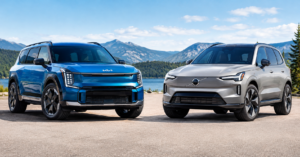

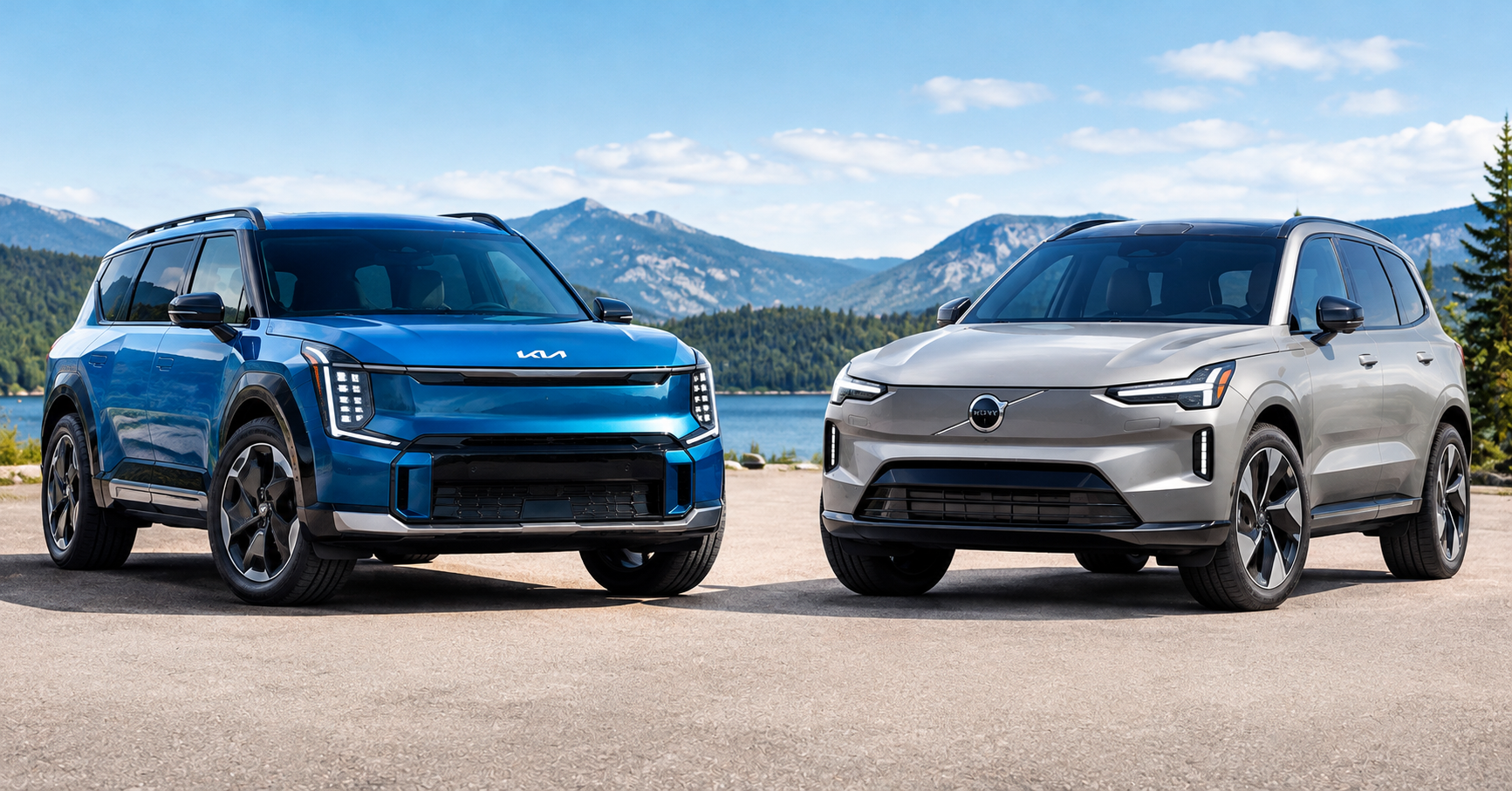
Choosing a three-row electric SUV in 2026 means balancing more than driving range. Families need space, convenient charging, dependable technology and enough room for everyday life, while luxury buyers may be willing to pay more for premium materials, advanced features and a refined driving experience.
The price difference immediately changes the conversation. The 2026 Kia EV9 starts at approximately $56,545, compared with $78,090 for the Volvo EX90. That is a $21,545 gap before taxes, destination charges, incentives and other ownership costs. Meanwhile, their maximum EPA-estimated ranges are remarkably close, with the Kia reaching up to 304 miles and the Volvo reaching up to 305 miles in certain configurations.
So, which SUV deserves your money? For most American families, the EV9 makes the stronger value argument. The EX90, however, can be the better choice for shoppers who prioritize a luxury-focused cabin, Volvo’s safety-oriented approach and a premium ownership experience.
2026 Kia EV9 vs Volvo EX90: Quick Verdict
The Kia EV9 and Volvo EX90 compete for buyers who want the benefits of an electric powertrain without giving up the flexibility of a three-row SUV. Both can accommodate family duties, weekend trips and daily commuting, but the better choice depends on how much you value price versus premium positioning.
- Best overall value: 2026 Kia EV9.
- Best for luxury-focused buyers: 2026 Volvo EX90.
- Best starting price: Kia EV9.
- Longest maximum EPA-estimated range: Volvo EX90, at up to 305 miles, versus up to 304 miles for the EV9.
- Strong safety credentials: Both models have earned the IIHS Top Safety Pick+ award, and both carry five-star overall NHTSA ratings according to the research.
- Best choice for most families: Kia EV9, thanks to its lower price and practical three-row layout.
The important distinction is that the EX90’s higher price does not automatically make it the better SUV. Its value depends on whether the luxury experience, equipment and technology justify spending more. Buyers who simply need a spacious, capable electric family vehicle may find the EV9 delivers what matters without stretching their budget as far.
2026 Kia EV9 vs Volvo EX90: Specifications Compared
Before examining the details, it helps to understand how these SUVs compare on paper. The following figures are based on the supplied research. Battery specifications, output, range and efficiency vary by configuration, so buyers should verify the figures for the exact trim they intend to purchase.
| Specification | 2026 Kia EV9 | 2026 Volvo EX90 |
|---|---|---|
| Starting MSRP | $56,545 | $78,090 |
| Top listed MSRP | $73,545 for GT-Line | $90,740 |
| Vehicle type | Three-row electric SUV | Three-row electric SUV |
| Battery capacity | 76.1 kWh standard; 99.8 kWh long range | 106 kWh usable; 111 kWh gross |
| EPA-estimated range | 230–304 miles | 276–305 miles |
| Powertrain | Rear-wheel drive or dual-motor all-wheel drive, depending on trim | Dual-motor all-wheel drive |
| Reported power | 201–379 hp across listed versions; Boost can raise torque to 516 lb-ft | Dual-motor AWD; output varies by version |
| Reported efficiency | 80–89 MPGe, depending on drivetrain | 97 MPGe city / 86 MPGe highway, as listed in the research |
| Cargo space behind third row | 20.2 cubic feet | Not specified in the supplied comparison figures |
| Maximum listed cargo volume | 81.7 cubic feet with the second row folded | Not specified in the supplied comparison figures |
| IIHS award | Top Safety Pick+ | Top Safety Pick+ |
| NHTSA overall rating | Five stars | Five stars |
Two points stand out. First, the Kia offers a substantially lower entry price while providing a competitive maximum range. Second, the Volvo’s larger battery does not translate into a decisive range advantage across every configuration. Range depends on factors including drivetrain, wheels, equipment and testing configuration.
Price and Value: The Kia EV9 Has a Major Advantage
Price is the clearest difference in the Kia EV9 vs Volvo EX90 comparison. With a starting MSRP of $56,545, the Kia undercuts the Volvo’s $78,090 starting price by $21,545. For buyers comparing family transportation options, that is a substantial amount of money to keep available for other priorities.
What the $21,545 Price Difference Means
The difference is not merely a number on a window sticker. It can influence the entire ownership budget, particularly for families already managing housing costs, insurance, childcare and other expenses.
Depending on individual circumstances, the money saved by choosing the EV9 could help pay for:
- A home-charging installation, including electrical work if required.
- Insurance premiums and routine ownership expenses.
- Public charging during longer journeys.
- A higher EV9 trim with additional equipment.
- Travel, family activities or other household priorities.
These are potential uses for the difference, not guaranteed savings. Actual ownership costs depend on electricity rates, insurance quotes, financing, taxes, incentives, maintenance and local charging availability.
Does the Volvo EX90 Justify Its Premium?
The EX90 is aimed at a different buyer. Its higher price reflects its luxury positioning and focus on a more premium cabin, design and technology experience. For someone moving from a high-end gasoline SUV, those qualities may matter more than securing the lowest possible purchase price.
However, shoppers should evaluate the equipment included with each specific trim rather than assuming that every expensive vehicle automatically offers better value. Compare standard features, optional packages, seat configurations, driver-assistance equipment and warranty coverage before making a decision.
The Kia also has a price advantage near the top of the listed ranges. The EV9 GT-Line reaches approximately $73,545, while the EX90 tops out at $90,740 in the supplied figures. The exact difference between individual trims depends on which versions and options are compared, but the Kia remains the less expensive proposition at the listed entry points.
Verdict: The EV9 wins on upfront affordability. The EX90 makes sense when its luxury-oriented qualities are important enough to justify the additional expense.
Range, Battery and Charging: Which Electric SUV Is Better for Road Trips?
Driving range is one of the most important considerations when buying an electric SUV, especially for families who regularly travel between cities. A larger battery can help, but the number that matters most to drivers is how far the vehicle can travel between charging stops under their typical conditions.
Kia EV9 Range and Battery Options
The 2026 Kia EV9 offers a 76.1-kWh standard battery and a 99.8-kWh long-range battery, according to the supplied research. EPA-estimated range varies from approximately 230 miles in the entry-level Light RWD configuration to as much as 304 miles in the long-range rear-wheel-drive version.
All-wheel-drive versions are listed with ranges of approximately 270–280 miles. That difference illustrates an important electric-vehicle trade-off: additional traction and performance can affect efficiency and distance per charge.
For buyers who spend most of their time commuting, the lower-range version may still be adequate if they can charge at home. Drivers who frequently travel long distances may prefer a long-range configuration to reduce the number of charging stops required.
Volvo EX90 Range and Battery Capacity
The Volvo EX90 has a reported 106-kWh usable battery capacity and 111-kWh gross capacity. Its EPA-estimated range spans approximately 276–305 miles, depending on configuration.
That gives the Volvo a slightly higher maximum range than the Kia’s best listed figure, but the difference is only one mile at the top of the range estimates. In everyday use, that gap is unlikely to be the deciding factor for most shoppers.
Real-world range can differ from EPA estimates because of temperature, highway speed, cabin heating or cooling, terrain, tire choice, passenger load and driving style. Cold weather and sustained high-speed driving can be especially important when planning longer journeys.
Charging Access May Matter More Than One Mile of Range
The EV9’s compatibility with Tesla Superchargers is a practical advantage identified in the supplied research. Access to a broader network of compatible fast chargers can make road trips easier, although drivers should confirm connector compatibility, charging access and any required adapter for their particular vehicle.
Charging performance is not determined by battery capacity alone. The vehicle’s maximum charging rate, battery temperature, charger output and the battery’s state of charge all influence how quickly a stop takes. Charging speed also generally slows as the battery approaches a high state of charge.
For that reason, a useful shopping test is to plan a familiar road trip using each vehicle’s available charging information. Look at the locations of compatible chargers, how many stops the route requires and whether charging stations are convenient for meals or bathroom breaks.
Verdict: The two SUVs are closely matched in maximum EPA-estimated range. The EV9’s Supercharger compatibility is a meaningful practical advantage, while the EX90 remains competitive for drivers who prioritize its premium package.
Interior, Comfort and Family Practicality
Three-row seating is a major reason to consider either of these electric SUVs. Families need more than an attractive cabin: they need room for passengers, easy access to the rear seats and enough cargo capacity for groceries, sports equipment, strollers and luggage.
Kia EV9: A Practical Family-Oriented Layout
The EV9’s interior is designed around the flexibility expected from a modern three-row SUV. Its boxy body shape and family-focused layout support a practical approach to passenger and cargo space.
The supplied figures list 20.2 cubic feet of cargo space behind the third row and a maximum of 81.7 cubic feet with the second row folded. These measurements help explain the Kia’s appeal for families that regularly carry passengers and belongings at the same time.
Imagine a family heading to the airport with six people and several suitcases. Cargo space behind the third row becomes especially important because folding the rear seats is not an option when every seat is occupied. The EV9’s stated 20.2-cubic-foot figure gives shoppers a useful starting point for assessing that scenario.
Buyers should still test the actual luggage they intend to carry. Published cargo figures do not always tell the full story about the shape of the load area, the height of the cargo floor or how easily bulky items fit.
Volvo EX90: A More Premium Cabin Experience
The EX90’s appeal centers more heavily on luxury, design and a refined cabin atmosphere. It is positioned as Volvo’s electric SUV flagship rather than simply an electric alternative to a mainstream family vehicle.
For shoppers who spend hours behind the wheel, interior materials, seat comfort, cabin noise and the overall design can make a meaningful difference. Those qualities are subjective, however, and are best assessed during a test drive rather than inferred from the badge alone.
The supplied comparison does not provide a directly comparable EX90 cargo-volume figure. Buyers should consult Volvo’s specifications for the exact model and seating configuration before deciding which vehicle better suits their storage needs.
Which SUV Is Better for Families?
The EV9 has the stronger value-based family argument because it combines three-row utility with a lower purchase price and specified cargo figures. The EX90 may be more appealing to families who want a luxury-oriented interior and are comfortable paying more for that experience.
Before buying either SUV, try all three rows with the people who will use them most often. Check access to the third row, seat-belt comfort, child-seat installation, visibility, storage compartments and how much luggage remains possible with the seats occupied.
Verdict: The Kia EV9 is the more compelling practical choice on the supplied evidence. The Volvo EX90 is worth considering when cabin ambience and premium positioning take priority.
Safety: Kia EV9 vs Volvo EX90
Safety is a central concern for three-row SUV shoppers, and both vehicles have strong credentials in the supplied research. The 2026 Kia EV9 and 2026 Volvo EX90 have each earned the Insurance Institute for Highway Safety’s Top Safety Pick+ award. Both are also reported to have five-star overall ratings from the National Highway Traffic Safety Administration.
What the IIHS Top Safety Pick+ Award Means
The IIHS evaluates vehicles through crashworthiness tests and other safety assessments. Its Top Safety Pick+ designation is a high-level recognition, but the award applies to specific qualifying vehicles and model-year configurations. Shoppers should check the institute’s current listing to confirm that the exact vehicle they are considering is covered.
The supplied research states that the EX90 received Good ratings in the small-overlap front, updated moderate-overlap front and updated side crash tests. These results are relevant to shoppers assessing how a vehicle performs in demanding crash evaluations.
Neither the award nor a five-star government rating means that a vehicle is immune to crashes or injuries. Safety outcomes depend on many factors, including collision circumstances, seat-belt use, child restraints, vehicle condition and driver behavior.
Should Buyers Pay More for Volvo Safety?
Volvo’s reputation for emphasizing safety may be attractive to buyers who want a luxury vehicle with a safety-focused identity. However, the available results do not support the conclusion that the EX90 is categorically safer than the EV9 in every situation.
Both models have strong independent safety recognition in the supplied information. The more useful comparison is to review the latest crash-test results, standard driver-assistance features, available safety systems and the equipment included on each trim.
It is also worth testing the driver-assistance features in normal driving conditions. Clear displays, understandable alerts, comfortable visibility and controls that are easy to operate can contribute to a more confident driving experience.
Verdict: This category is a close contest. Both SUVs offer strong reported safety credentials, so buyers should compare the specific features and ratings of the versions they plan to purchase rather than assuming the more expensive model automatically wins.
Performance and Driving Experience
The Kia EV9 and Volvo EX90 approach performance from different angles. The EV9 offers multiple powertrain configurations, including rear-wheel drive and dual-motor all-wheel drive, while the EX90 uses a dual-motor all-wheel-drive setup.
Kia EV9: Multiple Configurations and a New GT Model
The EV9’s listed power range runs from 201 to 379 horsepower across the versions described in the supplied research. Its Boost feature can raise torque to 516 lb-ft, while the 2026 lineup adds the high-performance EV9 GT.
The GT is an important addition for buyers who want more than efficient family transportation. It gives the EV9 range a performance-focused option without requiring shoppers to move to a different vehicle nameplate.
However, the most powerful version may not be the best fit for every household. Buyers who prioritize driving range and lower purchase costs may find a long-range rear-wheel-drive model more suitable than a performance-oriented trim.
Volvo EX90: Premium Positioning and All-Wheel Drive
The EX90’s dual-motor all-wheel-drive configuration provides a different proposition, emphasizing a premium electric-SUV package. The supplied research does not establish a directly comparable horsepower figure for every EX90 configuration, so shoppers should verify the output of the specific model they are considering.
Driving refinement is difficult to judge from specifications alone. Steering response, ride comfort, body control, seat support, brake feel and cabin noise can all shape the experience, and individual preferences differ.
Which One Should Driving Enthusiasts Choose?
The EV9 GT deserves attention from shoppers who want a performance-oriented three-row electric SUV. Other EV9 trims may be more sensible for drivers who value efficiency and everyday usability.
The EX90 may be the more natural fit for shoppers whose priority is a premium driving environment rather than choosing a vehicle primarily for its performance numbers.
Verdict: The Kia provides a wider range of powertrain choices in the supplied comparison, including the new GT variant. The Volvo’s appeal rests on its luxury-focused overall package.
Technology and Software: A Key Difference in 2026
Modern electric SUVs depend on software for navigation, charging management, infotainment, driver assistance and other functions. That makes software updates an important part of the ownership experience, but it also means that software reliability can affect day-to-day satisfaction.
Kia EV9: Practical Charging Compatibility
One of the EV9’s most useful technology advantages in the supplied research is Tesla Supercharger compatibility. For American drivers, access to compatible public charging can influence route planning and reduce the effort involved in finding charging stops.
Compatibility alone does not guarantee that every charger will be available or convenient. Owners should check current network access, connector requirements, payment procedures and the charging options supported by their particular vehicle.
Volvo EX90: Over-the-Air Updates and Computing Hardware
Volvo continues to develop the EX90 through over-the-air software releases. The supplied research identifies software version 3.0.33, released August 13, 2026, on Volvo’s U.S. support page.
The research also describes a significant hardware upgrade: a dual NVIDIA DRIVE AGX Orin core computer that Volvo says will be installed at authorized workshops throughout 2026. The change is intended to provide substantially more computing power and support Volvo’s in-house software development.
Such hardware can be important for a software-defined vehicle, but the existence of a more powerful computer should not be treated as proof that every feature will work flawlessly. Buyers should confirm whether a particular vehicle already has the upgraded hardware, whether a workshop installation is still required and which functions are supported at the time of purchase.
Software Reliability and Ownership Considerations
MotorTrend’s long-term EX90 reporting, as summarized in the supplied research, described early charging problems and dealer-service complications. That experience is relevant to prospective buyers because it highlights the importance of software maturity and service support in a technology-heavy vehicle.
A single long-term test vehicle cannot establish how every EX90 will perform. Still, shoppers should ask dealers about current software status, open service campaigns, known charging concerns and the process for receiving updates. They should also confirm which features are available immediately and which depend on future software releases.
The same general principle applies to any connected vehicle: advertised technology is valuable only when it works consistently and meets the owner’s needs.
Verdict: The EV9 has a practical charging-network advantage highlighted by the research. The EX90 has a more prominent software-defined-vehicle strategy, but buyers should investigate the current state of its software and hardware before committing.
Ownership Costs: Look Beyond the Sticker Price
The $21,545 difference between the starting prices is a useful first comparison, but it is not a complete ownership-cost calculation. Electric vehicles can reduce some routine maintenance needs compared with gasoline-powered vehicles, yet their overall costs still depend on several factors.
Costs to Compare Before Buying
- Purchase price: Compare the actual transaction price and equipment of the selected trims.
- Financing: Interest rates, loan terms and down payments can change the total cost significantly.
- Insurance: Request quotes for both vehicles using the same driver and coverage assumptions.
- Home charging: Include installation and any necessary electrical upgrades.
- Public charging: Estimate how frequently you will use paid charging networks and the rates available on your routes.
- Maintenance and tires: Ask about recommended service intervals, tire replacement and the costs associated with the vehicle’s size and weight.
- Depreciation: Resale value can vary with market conditions, incentives, battery technology and demand for used electric vehicles.
- Warranty coverage: Review the terms that apply to the vehicle, battery and major electric-drive components.
Incentives and tax treatment can also affect the final price, but eligibility depends on current rules, vehicle details, buyer circumstances and purchase or lease arrangements. Buyers should verify any claimed benefit rather than assume it will apply.
Which SUV Offers Better Long-Term Value?
For buyers whose main priorities are family space, electric driving and a manageable initial purchase price, the EV9 has a strong starting position. Its lower MSRP leaves more room in the budget for charging equipment and other expenses.
The EX90 can still be the right purchase for someone who values its premium design and features enough to justify the higher price. Long-term value is not just about spending less; it is also about whether a vehicle delivers the experience its owner wants.
Verdict: The EV9 is the stronger value choice for most cost-conscious households, but each buyer should compare real dealer quotes, insurance costs and expected charging use before deciding.
Pros and Cons: 2026 Kia EV9
Pros
- Starting MSRP approximately $21,545 below the Volvo EX90.
- Up to 304 miles of EPA-estimated range in long-range rear-wheel-drive form.
- Practical three-row layout with 20.2 cubic feet of cargo space behind the third row, according to the supplied figures.
- Up to 81.7 cubic feet of maximum cargo volume with the second row folded.
- Tesla Supercharger compatibility identified as a practical advantage in the research.
- IIHS Top Safety Pick+ recognition and a reported five-star overall NHTSA rating.
- A new GT variant adds a performance-focused option for 2026.
Cons
- The entry-level Light RWD configuration is listed with 230 miles of EPA-estimated range.
- The long-range rear-wheel-drive version prioritizes efficiency over power, with 201 hp listed in the supplied research.
- Its cabin and driving refinement may not satisfy shoppers seeking the more premium experience associated with Volvo.
- Its starting price remains substantial compared with many gasoline-powered family SUVs.
Pros and Cons: 2026 Volvo EX90
Pros
- Luxury-focused positioning and a design-led cabin.
- Up to 305 miles of EPA-estimated range in the listed configurations.
- A large battery rated at 106 kWh usable and 111 kWh gross in the supplied research.
- Dual-motor all-wheel drive.
- IIHS Top Safety Pick+ recognition and a reported five-star overall NHTSA rating.
- Over-the-air software updates and a planned 2026 computing-hardware upgrade.
- A compelling option for buyers who prioritize Volvo’s premium brand positioning.
Cons
- Starting MSRP of $78,090, significantly above the EV9.
- Software reliability and dealer-service issues have appeared in MotorTrend’s reported long-term testing.
- The base configuration’s listed range of 276 miles is below the EV9’s best-rated configuration.
- The premium price may be difficult to justify for shoppers primarily seeking family utility.
- Buyers need to confirm the software and hardware status of individual vehicles.
Which SUV Should You Buy?
The right choice depends on how you expect to use your electric SUV. Rather than declaring one vehicle the universal winner, it is more useful to match each model to a specific kind of buyer.
Choose the Kia EV9 If You Want Value and Practicality
The EV9 is the stronger choice if your priorities include:
- Keeping the purchase price as low as possible between these two models.
- Getting a three-row electric SUV for family transportation.
- Having published cargo figures to assess luggage and everyday storage needs.
- Accessing compatible Tesla Supercharger stations when traveling.
- Choosing among different powertrain configurations, including a performance-oriented GT.
- Combining a lower entry price with strong reported safety recognition.
For example, a family that wants an electric SUV for school runs, weekend activities and occasional road trips may find the EV9 offers the features it needs without approaching the EX90’s starting price. The savings could be especially valuable if the household also needs to install a home charger.
Choose the Volvo EX90 If Luxury Comes First
The EX90 deserves consideration if you:
- Want a premium, design-focused three-row electric SUV.
- Place a high value on Volvo’s safety-oriented brand identity.
- Prefer a luxury-focused cabin and overall ownership experience.
- Want dual-motor all-wheel drive as part of the vehicle’s powertrain concept.
- Are comfortable paying more for the particular features and experience the EX90 offers.
- Understand the current software and hardware status of the specific vehicle you are buying.
A buyer moving from a premium gasoline SUV may be more willing to pay the EX90’s higher price because cabin experience and design matter as much as cargo space or range. For that shopper, the Kia’s lower price may not outweigh the Volvo’s luxury appeal.
Final Recommendation
The 2026 Kia EV9 is the better all-around value for most American families. It combines three-row practicality, a competitive maximum EPA-estimated range, charging-network compatibility and strong reported safety credentials at a significantly lower starting price.
The 2026 Volvo EX90 is the more compelling choice for buyers who specifically want a premium electric SUV and are willing to pay for its luxury-focused positioning. Its maximum range is essentially tied with the Kia’s, so the Volvo’s case rests more on its overall experience than on a decisive range advantage.
Ultimately, the Kia EV9 vs Volvo EX90 decision comes down to priorities. If value and family usefulness matter most, start with the Kia. If luxury and Volvo’s premium approach matter more than the extra cost, the EX90 deserves a test drive. In either case, compare exact trims, confirm current software and charging compatibility, and calculate the full ownership cost before signing.
Frequently Asked Questions
Is the Kia EV9 better than the Volvo EX90 in 2026?
For most buyers focused on value and family practicality, the Kia EV9 is the stronger choice because it starts about $21,545 less than the Volvo EX90. The Volvo may be better for shoppers who prioritize luxury, premium design and its safety-focused brand positioning.
Which has a longer range, the Kia EV9 or Volvo EX90?
The Volvo EX90 reaches up to 305 miles of EPA-estimated range in the configurations listed in the research, while the Kia EV9 reaches up to 304 miles. The difference is minimal, and the range of each vehicle depends on its specific configuration.
How much does the 2026 Kia EV9 cost?
The supplied research lists a starting MSRP of $56,545 for the 2026 Kia EV9 and approximately $73,545 for the GT-Line at the top of the listed range. Actual prices can vary with trim, options, destination charges, dealer pricing and applicable incentives.
How much does the 2026 Volvo EX90 cost?
The supplied research lists the 2026 Volvo EX90 with a starting MSRP of $78,090 and a top listed price of $90,740. Buyers should confirm current pricing and equipment with a Volvo dealer.
Are the Kia EV9 and Volvo EX90 both safe SUVs?
Both vehicles are reported to have earned the IIHS Top Safety Pick+ award and five-star overall NHTSA ratings. Buyers should confirm the latest ratings and applicable model-year details for the exact configuration they intend to purchase.
Does the Kia EV9 support Tesla Superchargers?
Yes. The supplied research identifies Tesla Supercharger compatibility as one of the EV9’s practical advantages. Owners should confirm the connector or adapter requirements and current network access for their particular vehicle.
Is the Volvo EX90 worth the extra $21,545?
It may be worth the difference for buyers who place a high value on Volvo’s luxury-oriented experience, design and technology approach. For families focused on three-row electric-SUV utility and upfront value, the EV9 is generally the more rational starting point.
What are the main concerns about the Volvo EX90?
The supplied research notes that MotorTrend’s long-term test vehicle experienced charging problems and dealer-service complications. These reports do not establish that every EX90 will have the same issues, but buyers should ask about software updates, service campaigns and the current hardware status before purchasing.
Which SUV is better for a family of six?
Both are three-row electric SUVs, so either may suit a family of six. The EV9 has a lower starting price and published cargo figures in the supplied comparison. Families should test all seats and check luggage capacity with every required passenger aboard before making a final decision.
Should I buy the Kia EV9 or wait for software updates to the Volvo EX90?
That depends on your priorities and the status of the specific EX90 available to you. Volvo has continued to issue software updates and planned a 2026 computing-hardware upgrade. Ask the dealer which updates and hardware changes have been completed, then compare the vehicle’s current capabilities with your needs and budget.