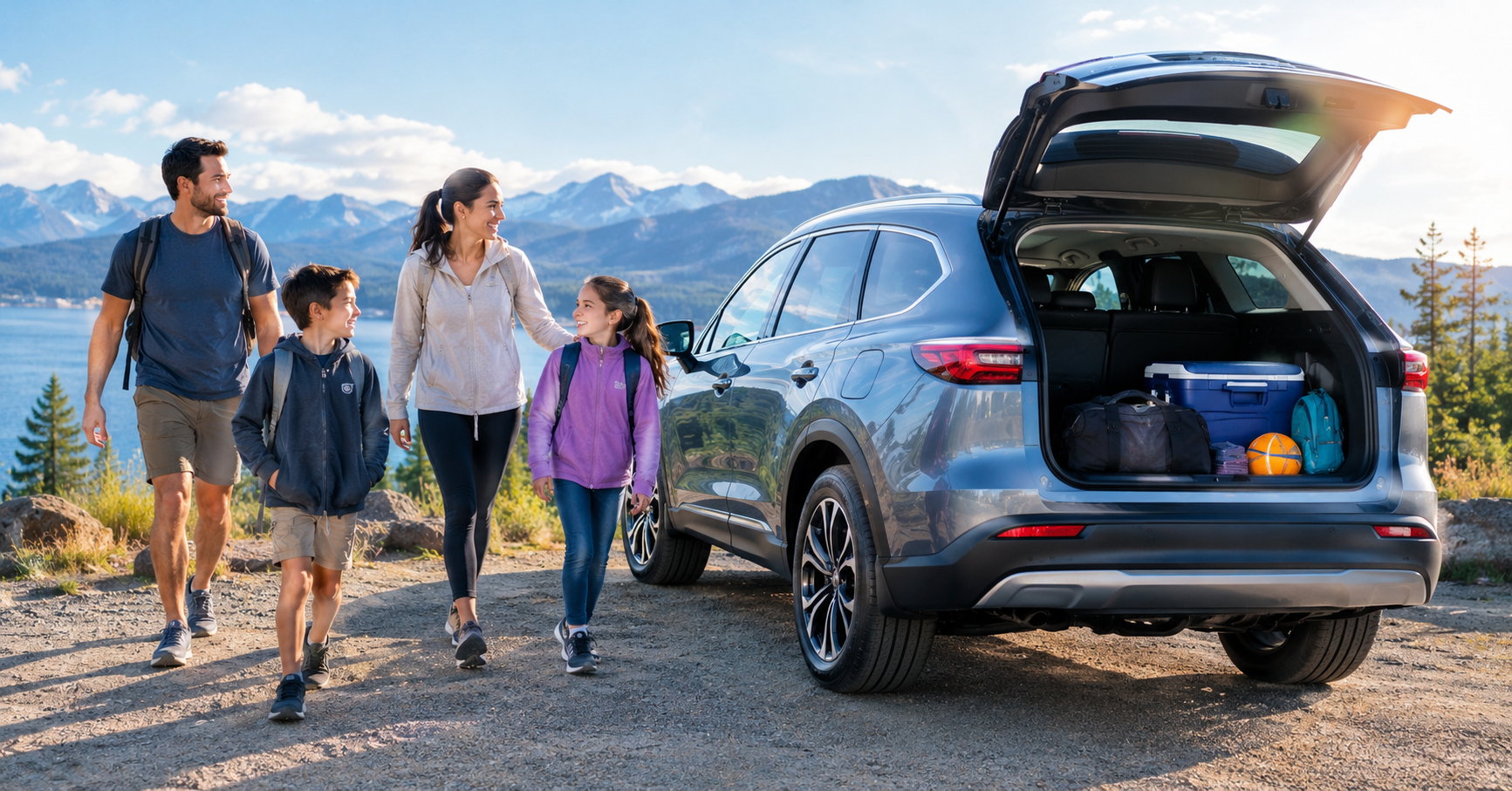
Choosing a family car is about more than finding enough seats. The right vehicle needs to protect your passengers, accommodate child safety seats, handle school drop-offs, fit groceries and sports equipment, and remain comfortable on long road trips. Ideally, it should also deliver dependable performance without stretching your household budget.
This guide covers 10 family-friendly vehicles for different household sizes, budgets, and driving habits. From the practical Honda CR-V to the spacious Toyota Grand Highlander and versatile Nissan Pathfinder, these vehicles deserve a place on your shopping list. You’ll also learn what to look for in child-seat compatibility, third-row access, ownership costs, and safety features before making a decision.
How to Choose the Best Family Cars in 2026
A family vehicle must work in everyday situations, not just look appealing in a showroom. A spacious cabin is useful, but it means little if installing a child safety seat is difficult or the third row leaves older children uncomfortable.
When comparing the best cars for families 2026, focus on five essential factors: safety, interior space, convenience, efficiency, and total ownership costs.
Safety and driver-assistance technology
Safety should be the starting point. Crash-test results help buyers understand how well a vehicle protects occupants in different types of collisions. Modern driver-assistance systems can also help drivers detect potential hazards and respond more quickly.
Look for features such as automatic emergency braking, blind-spot monitoring, rear cross-traffic alerts, lane-departure warnings, and rear-seat reminders. However, available features vary by trim, and these systems cannot replace attentive driving.
Safety ratings can change when testing requirements become more demanding. Always check the results for the exact model year and confirm whether a particular trim or production date affects eligibility for a safety award.
Passenger space and cargo capacity
Families with one or two children may find a two-row SUV perfectly adequate. Households with three children, teenagers, or frequent passengers may benefit from a three-row SUV or minivan.
Consider how much cargo space remains when all seats are occupied. A vehicle might offer generous storage with the third row folded but leave little room for luggage when seven or eight passengers are traveling together.
Comfort and everyday convenience
Features such as rear climate controls, multiple charging ports, easy-to-clean upholstery, accessible storage compartments, and smartphone connectivity can make daily driving easier.
Pay attention to practical details, too. Wide-opening doors can simplify child-seat installation, while a low cargo floor can make loading strollers and heavy shopping bags less tiring.
Fuel economy and ownership expenses
The purchase price represents only part of a vehicle’s financial impact. Insurance, fuel or electricity, maintenance, tires, financing, and depreciation can significantly affect the household budget.
Hybrids and electric vehicles may reduce some operating expenses, but the best option depends on your driving habits, local energy prices, charging access, and upfront budget.
Quick Comparison: 10 Best Cars for Families 2026
| Vehicle | Best For | Body Style | Main Advantage |
|---|---|---|---|
| Honda CR-V | Small families | Compact SUV | Everyday practicality |
| Toyota RAV4 | Commuters and active families | Compact SUV | Efficiency-focused ownership |
| Hyundai Ioniq 5 | Families considering an EV | Electric SUV | Quiet driving and flexible interior space |
| Hyundai Santa Fe | Growing families | Three-row SUV | Versatile seating |
| Kia Sorento | Families needing extra seats | Three-row SUV | Flexible passenger arrangements |
| Toyota Grand Highlander | Larger families | Three-row SUV | Spacious third row and hybrid availability |
| Hyundai Palisade | Comfort-focused families | Three-row SUV | Passenger comfort and convenience |
| Honda Pilot | Families needing up to eight seats | Three-row SUV | Practical family layout |
| Subaru Ascent | All-weather driving | Three-row SUV | Standard all-wheel drive |
| Nissan Pathfinder | Large families and road trips | Three-row SUV | Flexible seating for up to eight |
Note: Seating capacity, safety equipment, powertrains, pricing, and available features vary by model year and trim. Check the specifications of the exact vehicle you intend to purchase.
1. Honda CR-V: Best Compact SUV for Small Families
The Honda CR-V is an excellent starting point for families who want useful interior space without the bulk of a full-size SUV. It can handle school drop-offs, commuting, grocery shopping, and weekend outings without feeling unnecessarily large for everyday driving.
Its appeal lies in balance. The CR-V offers a comfortable cabin, practical cargo space, and manageable dimensions that make parking and maneuvering in crowded neighborhoods easier. Hybrid versions also provide an option for drivers who want to reduce gasoline consumption.
Why families should consider it
- Everyday practicality: Its compact dimensions suit urban driving while providing useful room for passengers and luggage.
- Flexible cargo space: The rear area can accommodate groceries, strollers, backpacks, and weekend bags.
- Comfortable cabin: The straightforward interior suits daily commuting and family errands.
- Hybrid availability: Applicable hybrid versions can appeal to families seeking better fuel efficiency.
The main limitation is its two-row layout. Families with three children who all need child safety seats should test the exact arrangement before committing. The CR-V may also be less suitable for households that regularly transport six or seven people.
Best for: Parents with one or two children who want a versatile daily driver rather than a large three-row vehicle.
2. Toyota RAV4: Best Compact SUV for Efficiency-Minded Families
The Toyota RAV4 is another strong option for households that need a practical crossover for commuting, errands, and family outings. Its compact SUV format makes it a natural alternative to the CR-V, particularly for shoppers interested in efficient powertrains.
For families that spend considerable time behind the wheel, fuel economy can have a meaningful effect on annual expenses. Hybrid versions of the RAV4 are worth considering for drivers who want to reduce gasoline use without depending on public charging stations.
What makes the RAV4 appealing?
- Manageable size: It is easier to park than many larger SUVs.
- Everyday flexibility: The cabin and cargo area suit ordinary family responsibilities.
- Hybrid option: Depending on the configuration, a hybrid can be attractive for frequent drivers.
- Versatile character: It can serve as both a commuter vehicle and a weekend-trip companion.
As with the CR-V, the RAV4 does not provide a third row. Families with several children should check rear-seat width and child-seat compatibility rather than assume three restraints will fit simply because the vehicle has a relatively spacious cabin.
Compare fuel-economy estimates, equipment, warranty terms, and purchase prices before deciding between the RAV4 and its competitors. A more efficient vehicle is not automatically the least expensive to own if its initial price or financing costs are substantially higher.
Best for: Small families seeking a practical SUV with efficiency-focused powertrain options.
3. Hyundai Ioniq 5: Best Electric SUV for Families
Families interested in switching to an electric vehicle should consider the Hyundai Ioniq 5. Its electric powertrain delivers quiet operation, while its flexible cabin makes it more than a vehicle for solo commuters.
The Ioniq 5 is worth considering for households that want to reduce their use of gasoline and can charge conveniently at home or work. Electric driving can be particularly convenient for families whose daily travel follows predictable routes.
Advantages of an electric family vehicle
- Quiet driving: Electric powertrains can create a calmer cabin during everyday trips.
- Convenient home charging: Drivers with suitable home charging can begin many days with a charged battery.
- Potential operating savings: Electricity may cost less per mile than gasoline, depending on local prices and charging habits.
- Modern technology: An electric SUV can provide a contemporary driving experience and useful connectivity features.
Electric ownership requires planning. Families should consider daily mileage, cold-weather driving, highway use, charging access, and the availability of reliable chargers along common road-trip routes. Public charging can be less convenient than refueling a gasoline vehicle, particularly during busy travel periods.
Before buying, check the estimated range for the specific configuration, charging capability, warranty coverage, and any applicable incentives. Make sure the vehicle can also accommodate your children’s restraints and usual luggage.
Best for: Families with convenient charging access who want a quiet, modern electric SUV for everyday travel.
4. Hyundai Santa Fe: Best Three-Row SUV for Growing Families
When a family outgrows a compact SUV, the Hyundai Santa Fe offers a useful step up. Its three-row configuration provides additional flexibility for school carpools, visiting relatives, and occasional trips with extra passengers.
The Santa Fe is a family-oriented SUV that combines practical seating arrangements with modern convenience features. It is worth considering for households that want more passenger capacity without moving directly to a full-size SUV.
Why it works for growing households
- Additional seating: The third row provides more flexibility when a two-row SUV is no longer sufficient.
- Everyday versatility: It can serve as a school-run vehicle during the week and a road-trip vehicle on weekends.
- Available technology: Driver-assistance and convenience features can make busy routines easier.
- Middle-ground size: It provides three-row flexibility without the dimensions of a full-size SUV.
As with most vehicles in this category, the third row should be evaluated in person. It may work well for children and shorter trips but feel restrictive for taller teenagers or adults on extended journeys.
Pay attention to cargo space with all three rows in use. A vehicle may have plenty of room behind the second row but leave limited space for suitcases when every seat is occupied. If your family frequently travels with seven people and full luggage, a larger model may be more suitable.
Best for: Growing families who need three-row flexibility and want to avoid the size of a full-size SUV.
5. Kia Sorento: Best Flexible SUV for Growing Families
The Kia Sorento is another three-row SUV worth considering when a family needs more seating options without moving to a substantially larger vehicle. Its appeal comes from its combination of passenger flexibility, family-oriented features, and available powertrain choices.
Key benefits for family life
- Three-row flexibility: Extra seats can help with carpools, visiting family, and occasional additional passengers.
- Powertrain choices: Depending on the configuration, shoppers may be able to compare gasoline and electrified options.
- Useful dimensions: It may be easier to manage than a full-size SUV in tight parking spaces.
- Available family technology: Driver-assistance and infotainment features can improve convenience.
The main question is how often your family will use the third row. If it is needed only occasionally, the Sorento may be a sensible compromise. If all three rows will be occupied most days, compare its passenger space directly with larger vehicles such as the Grand Highlander, Palisade, and Pilot.
Families with three child safety seats should test their actual restraints in the intended seating positions. The number of seat belts does not tell the whole story: restraint width, buckle placement, anchor locations, and access to the third row can all affect usability.
Best for: Families who need occasional extra seating and want a versatile three-row SUV.
6. Toyota Grand Highlander: Best Spacious Three-Row Hybrid SUV
For larger families, the Toyota Grand Highlander is one of the most compelling vehicles to examine. Its spacious cabin and adult-friendly third row address a common weakness of midsize three-row SUVs: fitting passengers in every row while retaining useful cargo space.
Hybrid availability makes the Grand Highlander particularly relevant for households that regularly carry several passengers and cover substantial distances. It combines the flexibility of a larger SUV with an option for reducing gasoline consumption without relying on external charging.
Why the Grand Highlander stands out
- Roomier third row: Its passenger space makes it a strong candidate for families with older children or adults who ride in the back.
- Family-trip practicality: A larger cabin can make longer journeys more comfortable.
- Hybrid availability: Hybrid versions offer an option for reducing fuel consumption without requiring external charging.
- Flexible seating: The three-row layout accommodates larger households and carpools.
Imagine a family of five heading out for a weekend away. Two children ride in the second row, another passenger uses the third row, and everyone brings a bag. In a smaller SUV, the arrangement could feel cramped. A vehicle with a roomier third row and a more useful cargo area can make the trip considerably easier.
There are trade-offs. A larger SUV typically costs more to purchase than a compact crossover, occupies more parking space, and may have higher tire and insurance expenses. Hybrid versions can also carry a price premium, so compare total ownership costs rather than focusing exclusively on fuel savings.
Best for: Larger families who frequently use all three rows and want to consider a hybrid powertrain.
7. Hyundai Palisade: Best Three-Row SUV for Comfort
The Hyundai Palisade deserves attention from families who prioritize passenger comfort and a well-equipped interior. It is designed around the needs of households that regularly carry children, relatives, and friends, making it a strong alternative to smaller three-row SUVs.
What families may appreciate
- Passenger-focused cabin: The Palisade is worth considering for families who spend considerable time on the road.
- Three-row layout: Extra seating provides flexibility for carpools and extended-family outings.
- Available convenience features: Depending on the trim, equipment may include comfort and technology features that make longer drives easier.
- Road-trip suitability: Its larger interior can be useful when children, luggage, and travel supplies all need space.
Before choosing a trim, compare standard equipment with the features that are genuinely important to your household. A premium package may be worthwhile if it adds useful safety or comfort equipment, but decorative upgrades alone may not justify a large increase in cost.
Test the Palisade with the whole family if possible. Check whether children can reach their seats comfortably, whether adults can enter and exit the third row without difficulty, and whether the cargo area remains adequate when all seats are occupied.
Best for: Families who want a comfortable, feature-rich three-row SUV for daily driving and longer trips.
8. Honda Pilot: Best Mainstream SUV for Larger Families
The Honda Pilot is a practical option for households that regularly transport several passengers. With seating for up to eight in applicable configurations, it offers the kind of flexibility parents may need for school activities, sports teams, and family gatherings.
Its traditional three-row design makes it a useful vehicle to compare with the Palisade, Grand Highlander, and Pathfinder.
Reasons to consider the Pilot
- Room for a larger household: Some configurations seat up to eight passengers.
- Three-row versatility: The layout can accommodate children, older relatives, or additional passengers.
- Practical everyday design: The Pilot can handle school runs, shopping trips, and weekend travel.
- Family-oriented layout: Its seating and storage arrangements serve a range of passenger needs.
Families should pay close attention to seating configuration. Depending on the trim, the second row may use a bench seat or separate seats, and that distinction can influence whether the vehicle fits your child-seat arrangement and how easily passengers reach the third row.
Do not assume that an eight-seat configuration automatically works best for every family. A seven-seat layout may provide easier access or more comfortable seating, depending on your needs. Try loading strollers, sports bags, and other bulky equipment with all seats in use.
Best for: Families who need a versatile three-row SUV and regularly carry several passengers.
9. Subaru Ascent: Best Family SUV for All-Weather Driving
The Subaru Ascent is a strong candidate for families who regularly encounter rain, snow, or changing road conditions. Its standard all-wheel drive is an important distinction for shoppers who want additional traction without selecting an optional drivetrain.
Its three-row layout also gives families more passenger flexibility than a typical compact SUV.
Where the Ascent makes sense
- Standard all-wheel drive: Useful for drivers who encounter challenging weather and road surfaces.
- Three-row seating: Additional seats provide flexibility for children and visiting passengers.
- Family-focused practicality: Its format suits daily commuting, outdoor activities, and family travel.
- Everyday versatility: It can serve as a household’s primary vehicle for errands and road trips.
All-wheel drive is not a substitute for appropriate tires, careful driving, or safe following distances. It can help a vehicle accelerate on slippery surfaces, but it does not eliminate the extra stopping distance that may occur on ice or snow.
The Ascent’s third row should also be evaluated against your family’s needs. If adults regularly ride in the back, compare available legroom and entry access with larger three-row competitors. For families who mainly use the rear seats for children, it may be a more natural fit.
Best for: Families who want three rows and value standard all-wheel drive for changing weather conditions.
10. Nissan Pathfinder: Best Traditional Three-Row Family SUV
The Nissan Pathfinder rounds out this list as a traditional three-row SUV for families that need substantial passenger capacity. It can seat up to eight in applicable configurations and is designed for households that regularly transport several people.
Why the Pathfinder belongs on your shortlist
- Flexible passenger capacity: Applicable configurations can accommodate up to eight occupants.
- Family-trip capability: Its larger body and three-row arrangement suit vacations and group travel.
- Traditional SUV format: It may appeal to shoppers who prefer a conventional SUV over a minivan or electric vehicle.
- Versatile seating: The cabin can accommodate larger families and additional passengers.
As with every three-row vehicle, check the space behind the third row. The amount of cargo room available with every seat occupied can matter more than the headline maximum cargo figure, which is often measured with rear seats folded.
Compare the Pathfinder with the Honda Pilot, Hyundai Palisade, and Toyota Grand Highlander. The best choice will depend on the passenger configuration you need, the features included at your preferred price, and how the vehicle feels during a real-world test drive.
Best for: Larger families who want a conventional three-row SUV with flexible seating.
Are Minivans Still Worth Considering in 2026?
Minivans remain practical family vehicles, particularly for households with several young children. Sliding doors can make loading children into car seats easier in tight parking spaces, while flexible seating and a low floor simplify carrying strollers, luggage, and bulky equipment.
Models such as the Honda Odyssey, Toyota Sienna, and Kia Carnival deserve consideration when interior flexibility is a priority. Their layouts can make it easier to move between rows, install child restraints, and transport a mixture of passengers and cargo.
However, families should pay close attention to current crash-test results. Updated moderate-overlap front crash testing has created new challenges for minivans, and some models received less favorable results in the latest evaluations. This does not mean every minivan is unsafe or that an SUV is automatically safer in every situation.
Instead, compare the specific model’s current safety performance alongside the advantages of each body style. A minivan may still be the best practical fit for your household, provided you carefully evaluate its crash protection, restraint compatibility, and equipment.
Family Car Safety: What Parents Should Check Before Buying
Safety ratings are important, but they are only part of the decision. A vehicle must also work with your family’s child restraints and provide the features you need to drive confidently.
1. Check current crash-test ratings
Review the latest crash-test results for the exact model year. Look at the specific tests completed, the results, and any restrictions related to trim or production date. Do not assume that a rating for one configuration automatically applies to every version of a vehicle.
Also review the available driver-assistance features. Automatic emergency braking, blind-spot monitoring, lane-departure warnings, and rear cross-traffic alerts can provide additional support, but their availability and operation vary. These systems assist drivers; they do not replace attention or responsible driving.
2. Test your actual child safety seats
A vehicle can have a spacious-looking rear seat yet prove difficult to use with a particular child restraint. Before purchasing, bring your car seats to the dealership and check the intended seating positions.
Confirm that each seat can be installed securely according to both the child-seat instructions and the vehicle owner’s manual. Check that neighboring seats do not interfere with one another and that buckles and harnesses remain accessible.
3. Understand lower anchors and top tethers
The LATCH system uses lower anchors and top tethers to help secure compatible child restraints. Follow the instructions for your specific seat and vehicle, including any weight limits. A child restraint should not be attached using both the lower anchors and the seat belt unless both manufacturers explicitly allow that installation method.
Forward-facing child safety seats should use the top tether as directed by the manufacturer. The combined weight limit for a child and restraint can affect when the vehicle’s lower anchors should no longer be used for installation, so consult the manuals rather than relying on a universal assumption.
4. Keep children in the back seat
Children younger than 13 are generally safest riding in the back seat. The correct restraint depends on a child’s age, height, weight, and developmental needs. Many children between ages 8 and 12 still need a booster seat to position the vehicle’s seat belt correctly.
Never choose a restraint solely because a child appears old enough to stop using one. Follow the seat manufacturer’s limits and make sure the lap belt rests low across the hips while the shoulder belt crosses the chest and shoulder.
5. Evaluate everyday visibility and access
Check the driver’s view when children are seated in the back and assess whether the head restraints or cargo interfere with visibility. Test the rear doors, child safety locks, rear-seat reminders, and any available camera systems.
For a three-row SUV, have passengers enter and exit each row. Make sure a child in a car seat does not block access for another child, and consider whether grandparents or other adult passengers can comfortably use the third row.
What Does a Family Car Really Cost?
The purchase price is only one part of a vehicle’s financial impact. Insurance, fuel or electricity, maintenance, tires, financing, and depreciation can substantially increase the total cost of ownership.
For planning purposes, some estimates put annual new-vehicle ownership costs at more than $12,000. Your actual expenses will depend on the vehicle, annual mileage, financing, insurance, local energy prices, maintenance needs, and depreciation. Treat broad estimates as budgeting references rather than predictions of what your household will pay.
Build a realistic ownership budget
Before choosing among the best cars for families 2026, estimate the following expenses:
- Purchase or financing: Compare the total amount financed, interest rate, loan term, and down payment.
- Insurance: Request quotes for the specific models and trims you are considering.
- Fuel or electricity: Estimate annual mileage and calculate energy costs using local prices.
- Maintenance and repairs: Review scheduled service requirements and warranty coverage.
- Tires: Larger and heavier vehicles may require more expensive replacement tires.
- Depreciation: Consider how resale value could affect the total cost of ownership.
- Charging equipment: If you choose an EV, include any necessary home-charging installation and related expenses.
A slightly more expensive hybrid may be worthwhile for a family that drives many miles each year. For a household that travels only short distances, the fuel savings may not justify a large upfront premium. Similarly, a three-row SUV may be worth the added cost if it consistently makes family travel easier or eliminates the need for a second vehicle.
A Practical Test-Drive Checklist for Parents
Photos and specifications cannot tell you everything about a family vehicle. A structured test drive helps reveal issues that may become frustrating after the purchase.
- Bring your family: Check seating comfort for everyone who will regularly travel in the vehicle.
- Install your child seats: Confirm that they fit securely in the intended positions.
- Load your everyday equipment: Test the cargo area with a stroller, school bags, sports gear, or other common items.
- Try every row: Evaluate legroom, headroom, access, and comfort in the third row where applicable.
- Test visibility: Adjust the mirrors and check sightlines while the vehicle is parked and during the drive.
- Explore the controls: Make sure the climate system, infotainment, driver-assistance controls, and rear-seat features are easy to understand.
- Drive on familiar roads: Try urban streets, parking areas, and highway speeds where possible.
- Compare written quotes: Review the full price, financing, fees, insurance, and warranty information before signing.
If you are deciding between two models, repeat the same tests in both. A direct comparison is often more useful than relying on a single short test drive or a list of features.
Final Verdict: Which Family Car Should You Buy in 2026?
The best family vehicle depends on how many people you carry, how often you travel, and what your household can comfortably afford.
- Best compact all-rounder: Honda CR-V, for its practical size and everyday versatility.
- Best compact option for efficiency-minded drivers: Toyota RAV4, particularly when comparing available hybrid versions.
- Best electric family SUV: Hyundai Ioniq 5, especially for households with convenient charging access.
- Best step up to three rows: Hyundai Santa Fe or Kia Sorento, depending on passenger and cargo needs.
- Best spacious hybrid-oriented choice: Toyota Grand Highlander, for families that regularly use the third row.
- Best comfort-focused three-row SUV: Hyundai Palisade.
- Best for larger households: Honda Pilot or Nissan Pathfinder, depending on the configuration that fits your family.
- Best for families prioritizing all-wheel drive: Subaru Ascent, with standard all-wheel drive.
Before making a final decision, verify current crash-test ratings, compare the equipment on your preferred trim, and install your actual child seats. Calculate the full cost of ownership rather than focusing only on the sticker price.
With the right combination of safety, passenger space, efficiency, and practicality, the best cars for families 2026 can make school runs less stressful, road trips more comfortable, and everyday driving easier for everyone on board.
Frequently Asked Questions
What is the best family car for 2026?
The Honda CR-V is a strong choice for small families seeking a practical two-row SUV. Larger households should compare the Toyota Grand Highlander, Hyundai Palisade, Honda Pilot, Kia Sorento, and Nissan Pathfinder. The best choice depends on passenger capacity, child-seat fit, cargo requirements, budget, and current safety ratings.
What is the safest family SUV for 2026?
Safety depends on the exact model year, configuration, and crash-test results. Several electric SUVs and three-row models have earned strong safety recognition, but ratings vary by vehicle and testing criteria. Check the latest crash-test results for the exact model and trim before buying.
Are minivans still a good choice for families in 2026?
Yes. Minivans remain practical because sliding doors, flexible seating, and generous interior space can simplify life with children. However, recent crash-test requirements have created challenges for some minivans. Compare current safety performance alongside convenience, passenger space, and child-seat compatibility.
Which family SUV has the most usable third-row space?
The Toyota Grand Highlander is a strong candidate for families who prioritize third-row comfort and space. However, comfort depends on passenger height, seating position, and vehicle configuration. Test the third row with the people who will use it regularly rather than relying on specifications alone.
Can three child safety seats fit in an SUV?
Sometimes, but it depends on the vehicle’s rear-seat dimensions, the child restraints, and the intended seating positions. Three seats that fit individually may not fit together safely or allow convenient buckle access. Bring all the seats to the dealership, follow the manufacturers’ instructions, and confirm that each restraint can be installed correctly.
Is a hybrid or gasoline SUV better for a family?
A hybrid can be attractive for families that drive frequently and want to reduce gasoline use without depending on external charging. A gasoline SUV may have a lower purchase price and can make sense for households with modest annual mileage. Compare the upfront cost, expected fuel savings, maintenance, insurance, and ownership period before deciding.
Is an electric SUV practical for family road trips?
An electric SUV can work well for road trips if its range, charging speed, and charging network match your travel habits. Families should plan charging stops, allow for possible range changes in cold weather, and confirm charger availability along their route. Convenient home charging can make everyday use particularly easy.
What should parents prioritize when buying a family car?
Prioritize current crash-test performance, correct child-seat installation, adequate passenger and cargo space, and a budget that includes insurance, energy, maintenance, and depreciation. Also consider visibility, rear-seat access, useful driver-assistance features, and how comfortably your family fits in the vehicle.
Are larger SUVs always safer than compact SUVs?
No. Vehicle size alone does not establish safety. Crash-test performance, structural design, restraint systems, driver-assistance technology, and the exact model configuration all matter. Compare current ratings from reputable testing organizations instead of assuming that a larger vehicle is automatically the safer choice.
How much should I budget for a family car?
Your budget should account for the purchase price or loan payment, insurance, fuel or electricity, maintenance, tires, and depreciation. Annual ownership expenses vary substantially by vehicle and household. Obtain personalized quotes and calculate costs based on your annual mileage.