BMW once explored a four-door version of its 3 Series Compact, a prototype that could have offered buyers a more practical and affordable entry into the German automaker’s lineup. The one-off E36/5 recently made its public debut, revealing an unusual chapter in BMW’s efforts to compete in the compact car segment.
BMW 1 Series: An Affordable Entry Into the Brand
Although the BMW 1 Series hatchback has never been sold in the United States, where the model was offered only as a coupe, it has been a popular choice in Europe for more than 20 years. In some markets, it has even become BMW’s best-selling model, offering a less expensive alternative to the 3 Series.
The first two generations of the 1 Series stood out for their rear-wheel-drive layouts, which gave them a distinctive driving character. However, BMW’s own research found that most owners either did not care about the rear-wheel-drive configuration or did not know their cars had it.
For the third generation, BMW switched to a front-wheel-drive platform based on Mini architecture to improve practicality and create more interior space. Although the change sacrificed the earlier models’ ability to slide their rear ends outward, the additional room helped increase sales and strengthened the model’s appeal.
The 2 Series retained its rear-wheel-drive layout, while the 1 Series continued to play an important role in BMW’s lineup, even as the X1 consistently outsold it in several markets.
The BMW 3 Series Compact Came First
The 1 Series was not BMW’s first mass-market hatchback. That distinction belongs to the 3 Series Compact, specifically the E36/5, which debuted in March 1994.
The model was designed to provide a more affordable way into the BMW brand, following a strategy that the 1 Series would adopt a decade later. BMW produced two generations of the 3 Series Compact, but only the first generation was sold in the United States.
The original E36/5 resembled a 3 Series coupe with its rear section shortened, but it also incorporated numerous components from the older E30 generation to keep costs down. The model performed well enough to justify a successor, the E46/5, although the second-generation Compact never reached the U.S. market because its predecessor had failed to meet sales expectations.
Both generations were offered exclusively as two-door models. Behind the scenes, however, BMW considered a more practical four-door version that ultimately failed to receive approval from the company’s board.
Inside BMW’s Four-Door 3 Series Compact Prototype
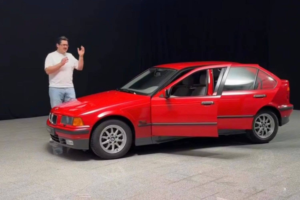
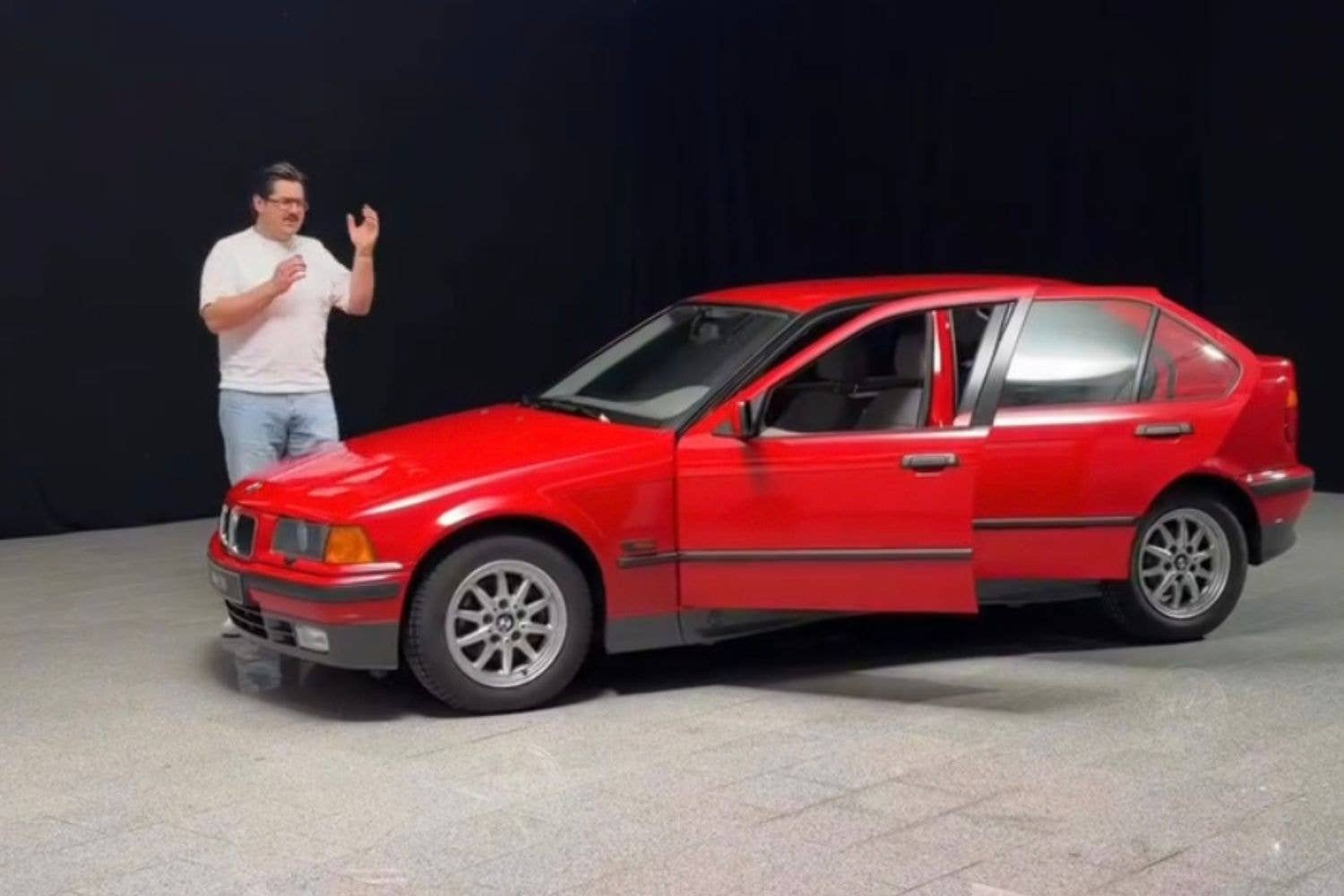
BMW Classic recently gave Retro Garage Official an opportunity to examine the unique prototype. The four-door E36/5 3 Series Compact made its public debut for the first time, providing a look at BMW’s early attempt to expand its presence in the so-called Golf class.
Rather than simply adding rear doors to the existing Compact, BMW based the prototype on the 3 Series sedan. Engineers then shortened its rear section, replacing the conventional trunk lid with a hatchback tailgate.
The prototype began as a 316i that apparently wore Boston Green paint before being repainted Hellrot, or Bright Red.
Its construction combines components from different versions of the E36. The tailgate came directly from the two-door Compact, while the dashboard was also taken from the smaller model. The doors, meanwhile, clearly came from the sedan.
The car features manually operated windows at all four corners, although BMW retained the power-window switches and the seat-heater button. Despite its unconventional combination of parts, the prototype remains a functioning vehicle.
Why BMW Never Approved the Four-Door Compact
BMW has not provided an exact explanation for why the four-door 3 Series Compact never reached production. Cost, however, may have been the most likely obstacle.
The model could have ended up priced too close to the standard 3 Series sedan, undermining its purpose as a more affordable entry-level BMW. That would have made it difficult to justify the additional development work required to bring the prototype to market.
Practicality may also have presented a challenge. The E36 3 Series did not offer particularly generous trunk space, and folding the rear seats could have improved cargo capacity. With all the seats in use, however, the available storage space might have been extremely limited.
Developing the four-door Compact would also have required additional structural reinforcement compared with the two-door model, increasing costs further. Rather than heavily modifying the E36 platform, BMW might have found it more practical to develop an entirely new vehicle.
The Prototype’s Legacy in BMW’s Lineup
Although BMW’s board never approved the four-door 3 Series Compact, the company continued to pursue the idea of a smaller, more accessible model. The prototype can be viewed as a precursor to the 1 Series and, to some extent, the 2 Series.
Its development reflected BMW’s interest in offering a vehicle positioned below the 3 Series, creating a more affordable entry point without abandoning the brand’s identity. While the four-door Compact never entered production, the broader concept eventually became an important part of BMW’s model lineup.