BMW has built approximately 67 million cars since 1928, marking a major milestone for the automaker as it approaches its 110th anniversary. From its first license-built Austin Seven to today’s global production network, the BMW brand has grown into a manufacturer producing more than two million vehicles annually.
The company’s first car took nearly three years to reach almost 16,000 units. Today, BMW Group plants can produce that many vehicles in less than three days, reflecting the scale of its worldwide manufacturing operations.
The estimated 67 million total covers BMW-badged cars only, excluding MINI and Rolls-Royce models. BMW acknowledged that calculating the precise figure is difficult, given the company’s long history, changing production facilities and more than 30 manufacturing sites worldwide.
BMW Car History: Major Milestones From 1916 to 2026
- 1916: Bayerische Flugzeugwerke is founded on March 7, BMW’s official founding date.
- 1923: The R 32 becomes BMW’s first motorcycle.
- 1928: BMW takes over Fahrzeugfabrik Eisenach and the Dixi 3/15.
- 1929: The BMW 3/15 PS DA 2 becomes the first car to carry the BMW badge.
- 1933: The BMW 303 introduces the brand’s first six-cylinder engine and kidney grille.
- 1940: The 328 Touring Coupe wins the Mille Miglia.
- 1952: The 501 enters production as the first BMW car built in Bavaria.
- 1955: Isetta production begins.
- 1959: The Quandt family keeps BMW independent, and the 700 launches.
- 1962: The Neue Klasse 1500 enters production.
- 1966: The 1600-2 launches the 02 Series, and BMW takes over Glas and Dingolfing.
- 1968: The 2002, New Six sedans and E9 coupes arrive.
- 1972: The 5 Series launches, and BMW Motorsport GmbH is founded.
- 1973: Rosslyn, South Africa, becomes BMW’s first plant outside Germany.
- 1975: The 3 Series launches.
- 1977: The 7 Series launches.
- 1978: The M1 debuts.
- 1986: The M3 launches, and Regensburg begins production.
- 1987: The 750i introduces BMW’s first V12 engine.
- 1994: Spartanburg begins production, and BMW acquires the Rover Group.
- 1999: The X5 becomes BMW’s first SUV.
- 2001: The new MINI goes on sale, built in Oxford.
- 2003: The Rolls-Royce Phantom enters production at Goodwood, and the BMW Brilliance joint venture is formed.
- 2005: Leipzig begins series production.
- 2013: The i3 becomes BMW’s first all-electric production car.
- 2019: San Luis Potosí, Mexico, begins production.
- 2025: Neue Klasse iX3 production begins in Debrecen, Hungary.
- 2026: BMW reaches approximately 67 million brand cars built since 1928.
Why BMW Counts Its Cars From 1928, Not 1916
BMW officially traces its founding to March 7, 1916, when Bayerische Flugzeugwerke was established in Munich from Gustav Otto’s aircraft factory. The BMW name originated with another company: Karl Rapp’s aircraft engine business became Bayerische Motoren Werke in 1917.
A restructuring in 1922 transferred the name and engine business to Bayerische Flugzeugwerke, explaining why BMW recognizes 1916 as its founding year. However, the company’s automotive history began later.
BMW entered the motorcycle business before making cars. The R 32, designed by Max Friz, debuted at the 1923 Berlin Motor Show with an air-cooled boxer engine and shaft drive, a configuration BMW Motorrad continues to use.
In the fall of 1928, BMW acquired Fahrzeugfabrik Eisenach, a struggling automaker in Thuringia that produced the Dixi 3/15 PS under license from Austin. The Dixi was essentially an Austin Seven carrying a different badge.
BMW continued building the small car while improving it. In July 1929, the updated BMW 3/15 PS DA 2 became the first automobile to wear the BMW roundel. Its most significant change was the addition of brakes on all four wheels.
The model’s name reflected its specifications: 3 represented its taxable horsepower rating, while 15 indicated its actual output. A roadster version, the 3/15 DA 3 Wartburg, followed in 1930 as BMW’s first sporty car.
BMW says nearly 16,000 examples of the 3/15 were built between March 1929 and February 1932, although some historical accounts put the figure as high as 18,976.
The BMW 303 Introduced the Kidney Grille in 1933
After the Austin license expired in 1932, BMW replaced the 3/15 with the 3/20, its first independently developed car. The following year, the BMW 303 debuted at the Berlin Motor Show in February 1933.
The 303 featured BMW’s first six-cylinder engine, a 1,182-cc inline-six producing 30 horsepower and a top speed of 90 km/h (56 mph). It also introduced the kidney grille, with two tall openings designed to provide cooling for the longer engine.
The 326 arrived in 1936 as BMW’s first four-door sedan. That same year, the company introduced the 328, a sports car that established its reputation in racing.
The 328 Touring Coupe achieved its biggest victory at the 1940 Mille Miglia, finishing first with Huschke von Hanstein and Walter Bäumer behind the wheel. The 335 luxury sedan went on sale in 1939, but government orders halted BMW car production in 1941.
During the remainder of World War II, BMW manufactured more than 30,000 aircraft engines. By 1945, forced laborers, including concentration camp prisoners, accounted for almost half of its workforce.
Every BMW car built before that point, from the 3/15 to the 335, had been manufactured in Eisenach, the location where the company’s automotive business nearly came to an end.
How BMW Lost Its Car Factory After World War II
Following Germany’s division after World War II, Eisenach fell within the Soviet zone. Production resumed there using prewar BMW designs, but after BMW severed its legal ties to the plant, the vehicles were sold under the EMW name, short for Eisenacher Motoren Werke.
In Britain, Bristol received plans for the BMW 327 and its six-cylinder engine as war reparations. Meanwhile, Allied restrictions on vehicle production forced BMW’s Munich operations to manufacture pots, pans and bicycles.
Motorcycle production resumed in 1948, but BMW had to rebuild its car business without a factory or an existing vehicle it could produce.
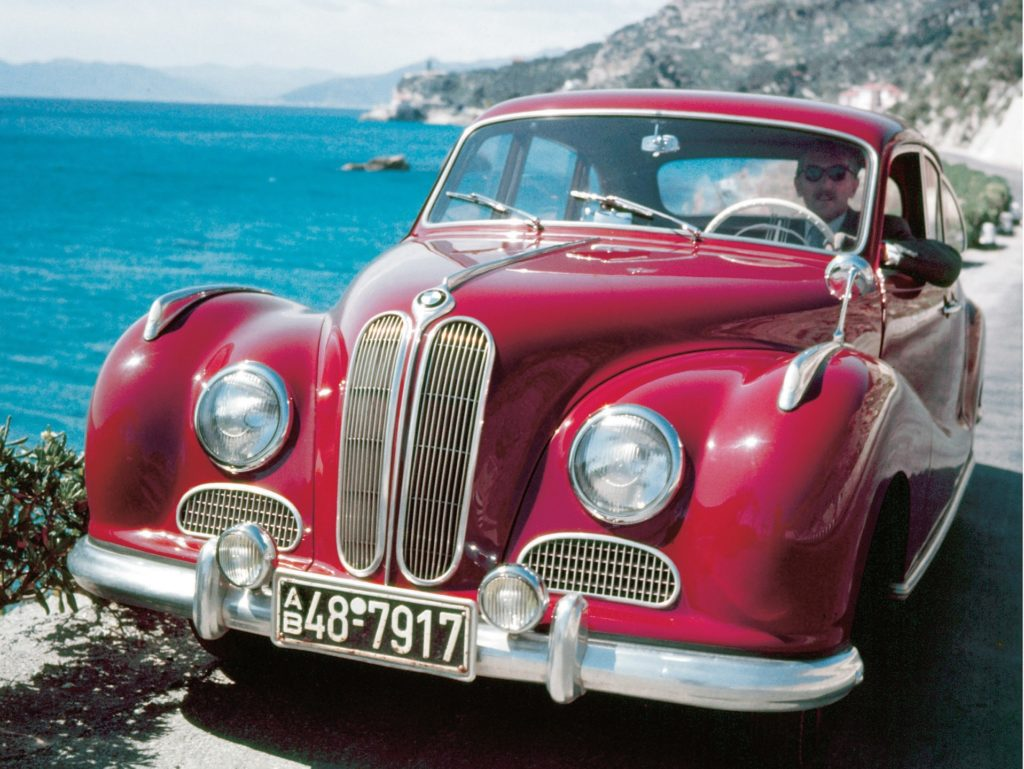
The company introduced the 501 luxury sedan at the first Frankfurt Motor Show in 1951. Deliveries began in late 1952 after body production started at Baur in Stuttgart.
The 501 was the first BMW car built in Bavaria. Its rounded styling earned it the nickname “Baroque Angel.” The subsequent 502 became the first postwar German car with a V8 engine.
Both luxury models were heavy and financially challenging for BMW. The company’s survival increasingly depended on a much smaller vehicle.
How the Isetta Helped BMW Survive the 1950s
BMW began producing the Isetta in April 1955. Based on an Italian design from Iso and powered by a single-cylinder motorcycle engine, the compact car offered a lower-cost alternative to the company’s larger vehicles.
By the end of production in 1962, BMW had built 161,360 Isettas. The model echoed the company’s early automotive beginnings: its first car had also been a small foreign-designed vehicle produced under license.
The elegant 503 and 507 arrived in 1955 but did little to improve BMW’s finances. The 600, a stretched Isetta featuring a side door and rear seat, also failed to turn the company’s financial position around. Approximately 35,000 were built between 1957 and 1959.
By 1959, BMW was close to bankruptcy, and management proposed a merger with Daimler-Benz. At the shareholders’ meeting on December 9, 1959, a lawyer representing BMW dealers delayed the vote, preventing the deal from proceeding.
The Quandt family, led by Herbert Quandt, became BMW’s largest shareholder and recapitalized the company. The investment allowed BMW to meet growing orders for the Giovanni Michelotti-designed 700 and finance its next generation of cars.
The Neue Klasse and BMW 2002 Changed the Company’s Future
The BMW 1500 became the vehicle that helped restore the company’s finances. Unveiled at the 1961 Frankfurt Motor Show, it attracted more orders than BMW could fulfill and entered production in 1962.
The Neue Klasse, or New Class, sedan introduced the Hofmeister kink in the C-pillar. Alongside the 1600, 1800 and 2000, it gave BMW a profitable midsize lineup.
In 1963, BMW paid its first dividend since World War II. Demand soon outgrew the Munich factory, prompting the company to acquire Hans Glas and its Dingolfing plant in 1966. The facility remains part of BMW’s production network.
The shorter two-door 1600-2 debuted at the 1966 Geneva Motor Show, launching the 02 Series. The 2002 followed in 1968 after product planner Helmut Werner Bönsch installed a 2.0-liter M10 four-cylinder engine in his own 1600-2, while U.S. importer Max Hoffman sought a sportier model for the American market.
BMW built approximately 837,000 02 Series cars through 1977. That total included 1,672 examples of the 2002 turbo, introduced in 1973 as Europe’s first turbocharged production car, just as the oil crisis began.
In 1968, BMW also introduced the M30 inline-six, the New Six 2500 and 2800 sedans, and the E9 coupes. The E9 later produced the 3.0 CSL, helping establish BMW as a touring car racing force during the 1970s.
The 1970s Established BMW’s Modern Model Lineup
The E12 5 Series arrived in 1972 and introduced the naming system BMW continues to use. On May 1 of that year, BMW Motorsport GmbH began operations with 35 employees under Jochen Neerpasch.
The 3.0 CSL won its touring car class at Le Mans in 1973 and secured six European Touring Car Championships between 1973 and 1979.
BMW also expanded manufacturing beyond Germany. In 1973, the company took full ownership of an assembly operation in Rosslyn, South Africa, its first overseas plant. Production of the 5 Series began there in 1974.
The E21 3 Series followed in 1975, built in Munich. BMW introduced the 6 Series coupe in 1976 and the 7 Series in 1977, completing a lineup that stretched from compact sedans to flagship luxury cars.
The decade ended with the M1 in 1978. Developed by BMW Motorsport for racing and road use, the mid-engine sports car produced 277 horsepower and carried a price of DM 100,000.
From the M3 to the X5: BMW’s Expansion in the 1980s and 1990s
The E30 3 Series launched in 1982, expanding the model from a two-door sedan into a broader range that eventually included a convertible, a Touring wagon and the M3.
BMW Motorsport also expanded its road-car lineup. The M535i arrived in 1980, followed by the hand-built M5 in 1984, powered by a 286-horsepower six-cylinder engine derived from the M1. The M3 debuted in 1986, developed for both racing and road use.
BMW introduced its first diesel car in 1983 and its first all-wheel-drive model, the 325iX, in 1985. In October 1987, the 750i entered production with BMW’s first V12 engine, a 5.0-liter unit producing 300 horsepower.
The 8 Series coupe debuted at the 1989 Frankfurt Motor Show with the same engine. BMW built approximately 30,600 examples before production ended in 1999.
Manufacturing expanded into new regions. Regensburg opened in 1986 with production of the E30, while BMW began building cars in the United States at Spartanburg, South Carolina, in 1994, starting with the 318i.
The Z3 roadster followed in 1995, and the X5 arrived in 1999 as BMW’s first SUV. Spartanburg has since produced more than six million vehicles.
BMW’s acquisition of the Rover Group from British Aerospace in 1994 proved difficult, and the company sold Rover in 2000. However, the period also brought MINI and Rolls-Royce into BMW’s portfolio. BMW secured the Rolls-Royce name through a 1998 agreement.
MINI, Rolls-Royce and Electric Cars Expand BMW’s Reach
The new MINI went on sale in July 2001, built at Plant Oxford in England. The first Rolls-Royce of the BMW era, the Phantom, began production at a new factory in Goodwood in 2003.
Neither brand is included in BMW’s 67 million vehicle total, which counts BMW-badged cars only.
BMW continued expanding its global manufacturing footprint. The BMW Brilliance joint venture in Shenyang, China, was formed in March 2003, and BMW increased its stake to 75% in 2022.
Leipzig began series production with the E90 3 Series in March 2005 and built its four millionth car in December 2025. The San Luis Potosí plant in Mexico opened in 2019 and now produces the 3 Series, 2 Series Coupe and M2.
BMW’s vehicle lineup also began shifting toward electrification. The i3 launched in 2013 as the company’s first all-electric production car, with Leipzig building more than 250,000 examples by 2022.
The i8 plug-in hybrid sports car followed in 2014. In 2016, BMW introduced plug-in hybrid versions of the 3 Series and 7 Series, the 330e and 740e.
By 2025, fully electric models accounted for around 18% of BMW Group sales.
The BMW 3 Series Is the Brand’s Best-Selling Model
The 3 Series leads BMW’s sales history by a significant margin. The company says it has built more than 18 million examples since 1975 across 18 plants in 13 countries.
That means more than one in four BMW cars ever produced has been a 3 Series. The E46 generation alone reached 3,266,885 units, making it the brand’s best-selling model ever, according to BMW.
The 3 Series has also played a central role in BMW’s manufacturing expansion. Every new BMW plant opened since Regensburg has begun production with a 3 Series, with Debrecen in Hungary the only exception.
Regensburg alone has produced 8.7 million cars.
How Quickly BMW Is Approaching 70 Million Cars
BMW Group plants built 2,456,561 BMW, MINI and Rolls-Royce vehicles in 2025, averaging approximately 6,700 cars a day.
The BMW brand alone delivered 2,169,761 vehicles to customers that year, while Spartanburg remained the company’s largest individual factory.
Because the 67 million milestone includes only BMW-brand cars, the company is adding slightly more than two million vehicles annually to that total, putting the 70 million mark within reach around 2028.
The latest addition is the Neue Klasse iX3, which began series production at Debrecen in late October 2025. Nine months later, the plant built its 50,000th iX3, a ramp-up BMW describes as the fastest of any new factory it has opened.
The Neue Klasse i3 sedan followed in Munich in August 2026. BMW plans to introduce around 40 new and updated models featuring Neue Klasse technology by the end of 2027.
The Neue Klasse name first appeared on the BMW 1500, the car that helped rescue the company in the 1960s. More than six decades later, BMW is once again relying on the name as it continues expanding its global vehicle production.