
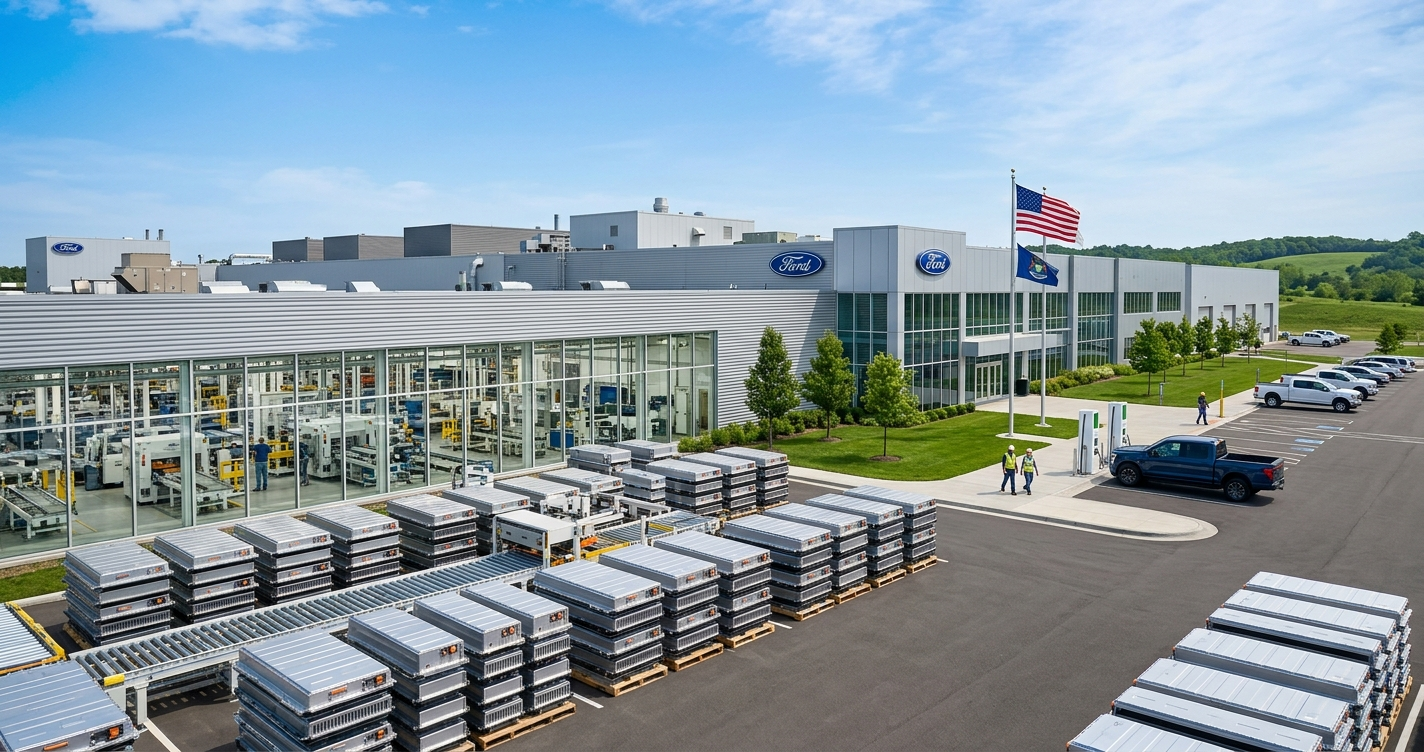
Ford has officially begun battery production at its long-awaited Michigan battery plant, marking a significant milestone for the project. The facility is now manufacturing lithium-iron phosphate (LFP) battery packs using technology licensed from China’s Contemporary Amperex Technology Co. (CATL), following the completion of construction.
Production Begins at Ford’s Michigan Battery Facility
CATL Vice President Meng Xiangfeng confirmed earlier this week that construction of the Michigan plant has been completed and battery production began in June.
In addition to licensing the LFP battery technology, CATL played a role in constructing the facility and continues to support its day-to-day operations.
Project Faced Political and Regulatory Scrutiny
Ford and CATL first announced the battery plant and licensing agreement in February 2023, during Joe Biden’s presidency and before President Donald Trump’s One Big Beautiful Bill Act revised provisions of the Inflation Reduction Act.
The agreement drew scrutiny from the outset. House Republicans initially sought to prevent batteries connected to Chinese companies from qualifying for federal tax credits. Although the production credit was removed in early versions of the legislation, the final law preserved it for batteries and grandfathered Ford’s existing CATL agreement.
As recently as January, the Republican chair of a House committee sent a letter to Ford CEO Jim Farley questioning the company’s plan to manufacture energy-storage batteries using CATL technology.
Plant Capacity and Investment Revised
Under the original agreement, the Michigan facility would have qualified Ford for a government subsidy of $45 per kilowatt-hour of batteries produced at the site.
The plant was initially designed to deliver annual production capacity of 35 gigawatt-hours (GWh), enough to supply up to 400,000 electric vehicles.
Ford later revised those plans, reducing its investment in the facility to $2 billion while lowering expected annual production capacity to 20 GWh.
Ford Expands Battery Strategy Beyond Electric Vehicles
Ford has also adjusted its plans for the CATL-licensed LFP batteries. Rather than using them exclusively in electric vehicles, the automaker now intends to deploy them in battery energy-storage systems as well.
According to the company, that strategy is already underway at the Ford and CATL factory in Kentucky. Ford ultimately plans to deploy at least 20 GWh of these batteries annually for use in energy-storage systems.
The start of production at the Michigan facility marks the completion of a project that has undergone significant political scrutiny, investment changes, and strategic adjustments while bringing CATL-licensed battery technology into Ford’s U.S. manufacturing operations.