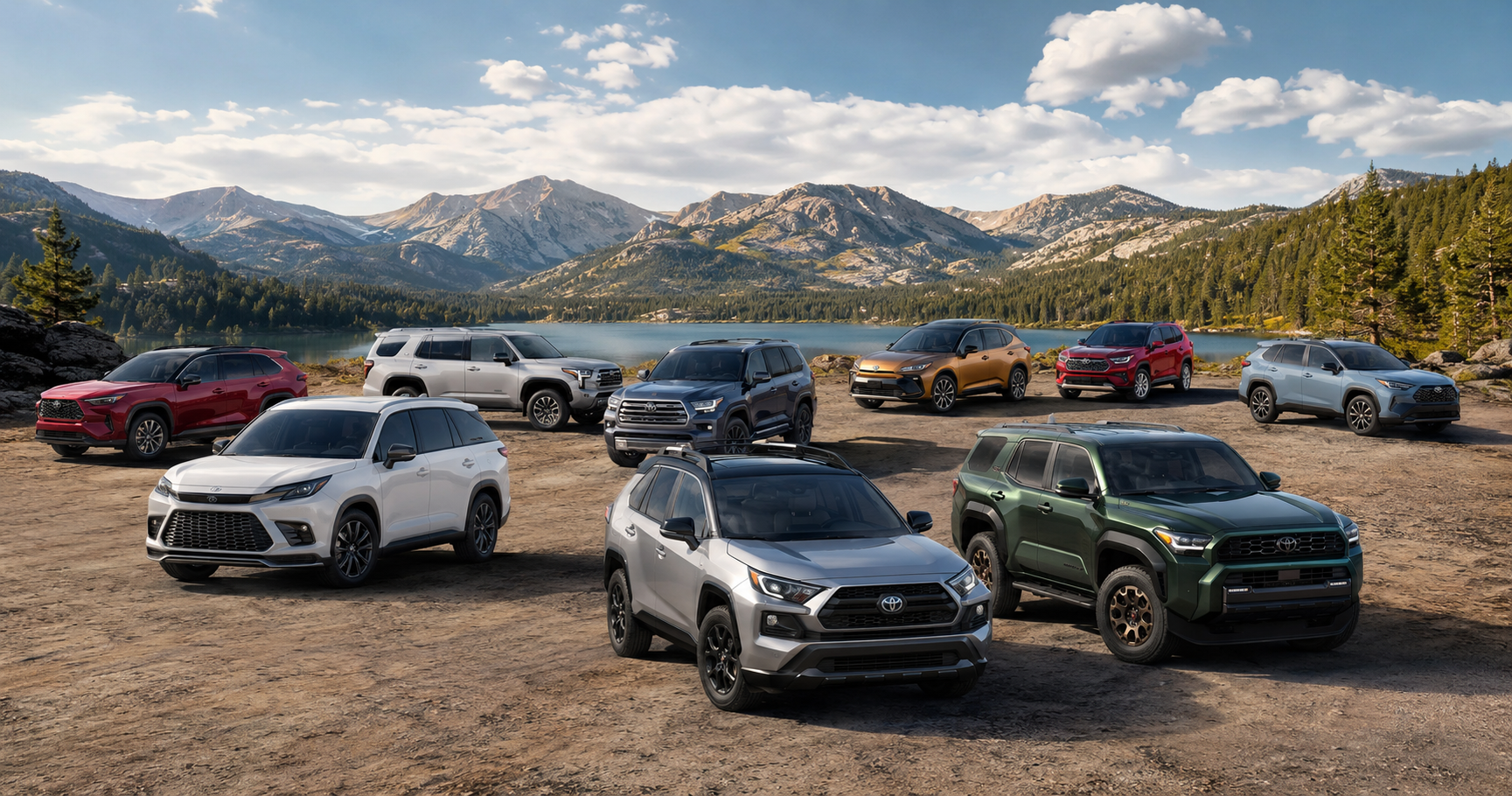
Toyota SUV Models cover almost every type of American buyer in 2026. From the affordable Corolla Cross and redesigned all-hybrid RAV4 to the rugged 4Runner and Land Cruiser, Toyota offers SUVs for commuters, families, off-road enthusiasts, road-trippers and shoppers considering an electric vehicle.
The biggest story for 2026 is Toyota’s continued expansion of electrified powertrains. The RAV4 is now hybrid-only, the Crown Signia is hybrid-only, the Land Cruiser and Sequoia use Toyota’s i-FORCE MAX hybrid system, and the bZ gives buyers an all-electric option.
But choosing among Toyota’s SUVs is not simply a matter of picking the newest model. Price, passenger space, fuel economy, towing ability, drivetrain, cargo capacity and intended use can make one model dramatically better suited to your needs than another.
This guide breaks down the 2026 Toyota SUV lineup, explains the differences between the major models and highlights which Toyota SUV makes the most sense for different types of buyers.
Toyota SUV Models at a Glance
Toyota’s 2026 U.S. SUV and crossover range stretches from relatively affordable compact transportation to large three-row SUVs and serious off-road vehicles.
| Model | Starting Price* | Powertrain | Best For |
|---|---|---|---|
| Corolla Cross | $24,635 | Gas / Hybrid | Budget-conscious city drivers |
| RAV4 | $33,350 | Hybrid / PHEV | Best all-around choice |
| Crown Signia | $44,390 | Hybrid | Comfort and premium feel |
| Highlander | $46,270 | Gas / Hybrid | Families needing three rows |
| Grand Highlander | $42,855 gas / $46,205 hybrid | Gas / Hybrid / Hybrid MAX | Families needing more interior space |
| 4Runner | $41,570 | Turbo gas / i-FORCE MAX | Off-road adventures |
| Land Cruiser | $57,600 | i-FORCE MAX hybrid | Serious off-road touring |
| Sequoia | $66,120 | i-FORCE MAX V6 hybrid | Full-size towing and families |
| bZ | $36,350 | Electric | EV-focused buyers |
*Starting prices shown are based on the 2026 U.S.-market research supplied for this guide and include destination where specified.
The lineup can broadly be divided into four groups: compact crossovers such as the Corolla Cross and RAV4, family-oriented SUVs such as the Highlander and Grand Highlander, rugged body-on-frame models such as the 4Runner, Land Cruiser and Sequoia, and the electric bZ.
1. Toyota Corolla Cross: The Affordable Compact SUV
The Corolla Cross is the entry point to the Toyota SUV range. With a starting price of about $24,635 for the gas model, it is one of the most accessible ways to get into a new Toyota crossover.
Its compact dimensions make it particularly attractive for urban drivers. It is easier to maneuver and park than larger Toyota SUVs while still providing the higher seating position and practical cargo area many buyers want from a crossover.
For shoppers who prioritize affordability, everyday usability and Toyota’s reputation for durability, the Corolla Cross is a logical starting point.
Corolla Cross vs. RAV4
The RAV4 is larger, more powerful and more versatile, but the Corolla Cross makes more sense if purchase price and urban maneuverability are the priorities.
2. Toyota Corolla Cross Hybrid: Better Efficiency in a Small SUV
The Corolla Cross Hybrid raises the appeal of Toyota’s smallest U.S. SUV by combining compact dimensions with a more efficient hybrid powertrain. The hybrid starts around $28,995 and offers standard all-wheel drive.
Fuel economy is one of its strongest advantages, with approximately 42 mpg combined cited in the supplied 2026 research. That makes the hybrid particularly attractive to commuters who spend significant time in city traffic.
Choose the Corolla Cross Hybrid if you want a small SUV, standard AWD and strong fuel economy without moving into the larger and more expensive RAV4.
3. Toyota RAV4: The Mainstream All-Around Choice
The 2026 RAV4 represents one of the most important changes in the Toyota SUV lineup. Toyota has eliminated the traditional gas-only RAV4, making every 2026 model a hybrid, while the performance-oriented GR Sport is offered as a plug-in hybrid.
Pricing starts at approximately $33,350, while the range-topping versions reach about $49,950.
The RAV4 remains the sweet spot for many American buyers because it sits between the compact Corolla Cross and larger family SUVs. It provides enough space for everyday family use without the size and cost of a three-row SUV.
Why the 2026 RAV4 Stands Out
- Every model uses hybrid technology.
- Strong fuel economy, with approximately 43/42 mpg figures cited for configurations in the supplied research.
- Available plug-in hybrid technology.
- Modern safety and connectivity technology.
- More capability than a small crossover without becoming a large SUV.
For shoppers who want one Toyota SUV capable of handling commuting, family errands, weekend trips and highway travel, the RAV4 is arguably the lineup’s strongest all-purpose option.
4. Toyota RAV4 Plug-in Hybrid: Performance Meets Efficiency
The RAV4’s plug-in hybrid strategy adds another layer to the lineup. Instead of choosing strictly between a conventional hybrid and a full EV, buyers can use electric driving for shorter trips while retaining the flexibility of a gasoline engine for longer journeys.
The 2026 GR Sport plug-in hybrid also gives the RAV4 lineup a performance-oriented flagship. Its approximately $49,950 top price places it well above the entry RAV4 but below many premium-brand plug-in SUVs.
A plug-in hybrid makes the most sense for drivers who can regularly charge at home or work and whose daily driving fits within the vehicle’s electric-driving capability, while still wanting gasoline backup for road trips.
5. Toyota Crown Signia: A Premium Hybrid Alternative
The Crown Signia occupies an unusual position in the Toyota range. It is more premium-oriented than the RAV4 but remains less expensive and less overtly luxurious than many luxury-brand SUVs.
Starting at approximately $44,390, the Crown Signia is hybrid-only. The supplied research cites approximately 39/37/38 mpg figures and a 0-to-60-mph time of about 7.1 seconds.
Its appeal is less about rugged off-road capability and more about comfortable road manners, upscale presentation and efficient long-distance transportation.
For 2026, Toyota adds a two-tone black-roof option to the Limited model, giving buyers another way to distinguish the vehicle.
Crown Signia vs. RAV4
The RAV4 is the more mainstream and versatile choice. The Crown Signia is better suited to buyers who are willing to spend more for a more premium interior and road-trip-oriented experience.
6. Toyota Highlander: A Three-Row Family SUV
The Highlander remains one of Toyota’s most recognizable family SUVs. It offers three rows of seating and a choice between gasoline and hybrid powertrains.
The 2026 gas model starts around $46,270 in the supplied pricing data and uses a 2.4-liter turbocharged engine producing 265 horsepower. Standard AWD and a 5,000-pound towing rating add useful versatility.
The Highlander is particularly appealing to families who need three rows but do not want to move into the much larger footprint of a full-size SUV.
Highlander Hybrid
The hybrid version is the logical choice for drivers who regularly carry passengers and want to reduce fuel consumption. It combines the Highlander’s family-oriented layout with Toyota’s established hybrid technology.
For frequent commuting and school runs, the hybrid can make more sense than buying a larger SUV solely for additional power.
7. Toyota Grand Highlander: More Space for Larger Families
The Grand Highlander addresses one of the Highlander’s biggest limitations: interior space.
It provides a roomier three-row cabin and is designed to accommodate up to eight passengers. Toyota’s larger family SUV also offers up to 5,000 pounds of towing capability.
Pricing begins around $42,855 for the gas version and approximately $46,205 for the hybrid according to the supplied research. Powertrain choices include gas, hybrid and Hybrid MAX configurations.
The key distinction is simple: if the regular Highlander feels just a little too tight for your family, the Grand Highlander is the natural step up.
8. Toyota 4Runner: The Rugged SUV for Off-Road Adventures
The 4Runner is fundamentally different from Toyota’s crossover SUVs. It is built around a rugged body-on-frame architecture and is designed for buyers who prioritize trail capability, durability and utility.
The 2026 model enters the second year of its sixth generation with nine grades, ranging from SR5 through serious off-road versions such as TRD Pro and Trailhunter.
Pricing ranges from approximately $41,570 to nearly $70,000 depending on configuration.
For people who regularly drive on dirt roads, trails, rough terrain or remote camping routes, the 4Runner’s mechanical capability makes it much more appropriate than a conventional crossover.
4Runner i-FORCE MAX
The available i-FORCE MAX hybrid system produces 326 horsepower and 465 lb-ft of torque according to the supplied research. It is not simply a fuel-saving hybrid; Toyota has engineered it around strong torque and performance.
The system is standard on grades including TRD Pro, Trailhunter and Platinum. For serious off-road buyers, the hybrid’s additional output can be more important than maximum fuel economy.
9. Toyota Land Cruiser: The Legendary Adventure SUV
The Land Cruiser occupies a special place among Toyota SUV models. Its reputation is built around durability and off-road travel, and the current U.S. version combines that mission with modern hybrid technology.
For 2026, the Land Cruiser uses Toyota’s i-FORCE MAX hybrid system, producing 326 horsepower. Pricing begins at approximately $57,600 and reaches about $62,445.
Full-time four-wheel drive and a towing capacity of up to 6,000 pounds make it a strong option for buyers who want an SUV capable of handling both highway travel and demanding terrain.
Land Cruiser vs. 4Runner
The 4Runner is the more overtly adventure-focused choice, particularly in specialized TRD Pro and Trailhunter configurations. The Land Cruiser emphasizes a more premium adventure experience while retaining serious off-road capability.
10. Toyota Sequoia: The Full-Size Three-Row SUV
At the top of Toyota’s traditional SUV range sits the Sequoia. It is the largest Toyota SUV in the U.S. lineup and is designed for buyers who need maximum towing ability, three-row seating and full-size SUV capability.
Pricing ranges from approximately $66,120 to $86,530.
Its i-FORCE MAX V6 hybrid produces 437 horsepower and 583 lb-ft of torque. Certain configurations can tow up to 9,520 pounds, making the Sequoia one of the strongest choices in the Toyota range for serious towing.
However, size does not automatically mean maximum practicality. The supplied research notes that the Sequoia’s third-row and cargo space can lag behind some competitors. Buyers should therefore test the seating and cargo area personally before purchasing.
11. Toyota bZ: The Electric Toyota SUV
The 2026 Toyota bZ represents Toyota’s fully electric SUV offering in the U.S. market. Importantly, Toyota has moved away from the previous bZ4X naming for this model year, using the shorter bZ name.
Pricing is approximately $36,350 to $46,750, depending on configuration. The supplied research cites EPA-estimated range figures of approximately 236 to 314 miles, with output reaching as high as 338 horsepower.
The bZ also benefits from faster NACS charging capability compared with the earlier model, addressing one of the most important practical considerations for EV buyers.
Is the bZ a Good Buy?
The answer depends heavily on how you drive. An EV-focused household with convenient home charging may find the bZ appealing, particularly if its range meets daily needs.
However, the vehicle faces intense competition from newer EVs that can offer compelling combinations of range, charging speed, space and price. That makes careful comparison essential.
Important 2026 Accuracy Note: bZ Woodland and C-HR
Some online lists of Toyota SUV models incorrectly include a U.S.-market 2026 bZ Woodland and a new U.S.-market electric C-HR.
Those claims should not be treated as confirmed facts for this guide. The research supplied for this article found no verified U.S. Toyota press release confirming a 2026 bZ Woodland with the frequently quoted 375 horsepower and 281-mile range.
Likewise, the C-HR is not part of Toyota’s 2026 U.S. SUV lineup described in the verified research. Therefore, neither model should be presented as a confirmed U.S.-market 2026 Toyota SUV.
This distinction matters because search results can mix U.S., European and speculative information. Buyers should always verify a vehicle’s availability, specifications and pricing for the United States before making a purchase decision.
Which Toyota SUV Is Best for Families?
There is no single answer because family needs vary dramatically.
- Best compact family SUV: RAV4.
- Best affordable option: Corolla Cross.
- Best three-row choice: Highlander.
- Best for larger families: Grand Highlander.
- Best for maximum towing: Sequoia.
- Best for family adventures: 4Runner or Land Cruiser.
The Grand Highlander deserves particular attention for families who frequently use all three rows. A third row that is technically available is not necessarily a third row adults will enjoy using, so buyers should compare actual passenger space rather than relying solely on seating counts.
Which Toyota SUV Gets the Best Fuel Economy?
If fuel economy is the priority, Toyota’s smaller hybrid SUVs are the logical starting point.
The Corolla Cross Hybrid is cited at approximately 42 mpg combined, while the Crown Signia is listed around 38 mpg combined. The redesigned 2026 RAV4 also makes efficiency central to its identity because every RAV4 is now a hybrid.
Plug-in hybrids can offer an additional advantage for drivers with reliable charging access. They can potentially handle short daily journeys using electricity while retaining gasoline-powered flexibility for long trips.
Large off-road SUVs such as the 4Runner and Sequoia demonstrate a different philosophy. Their hybrid systems emphasize torque and capability, so shoppers should not assume that every Toyota hybrid is designed primarily to maximize mpg.
Which Toyota SUV Is Best for Off-Road Driving?
For serious off-road use, the shortlist is relatively clear: 4Runner, Land Cruiser and Sequoia.
4Runner
The 4Runner is the most natural choice for enthusiasts who want specialized off-road grades and a rugged platform.
Land Cruiser
The Land Cruiser combines serious off-road hardware with a more premium adventure-oriented character.
Sequoia
The Sequoia offers impressive capability and towing strength, but its much larger dimensions make it less maneuverable on narrow trails.
For most trail-focused buyers, the 4Runner is the most straightforward answer. For buyers who want long-distance expedition capability with a more upscale environment, the Land Cruiser deserves a closer look.
Which Toyota SUV Is Best for Seniors?
Older drivers often benefit from a combination of easy entry and exit, good outward visibility, comfortable seats, manageable dimensions and advanced driver-assistance technology.
The Corolla Cross and RAV4 can be attractive because they provide SUV-like seating height without the bulk of the Sequoia. The Crown Signia is worth considering for shoppers who place a higher priority on comfort and premium presentation.
Technology should also be evaluated in person. A feature-rich vehicle is only helpful when the driver can understand and comfortably use its controls.
Which Toyota SUV Has the Most Cargo and Towing Capability?
The answer depends on whether you mean maximum cargo utility or towing.
The Sequoia is the full-size towing leader in this Toyota lineup, with up to 9,520 pounds of capacity in certain configurations. The Land Cruiser can tow up to 6,000 pounds, while the 4Runner and Grand Highlander are cited around the 5,000-pound range.
For cargo, larger does not always mean better in every configuration. Three-row SUVs can sacrifice usable space behind the third row. Families should measure the actual luggage, strollers, sports equipment or camping gear they carry regularly.
Toyota SUV Hybrid Models: What Buyers Need to Know
Toyota’s hybrid strategy is one of the biggest reasons its SUV lineup stands out in 2026.
Hybrid systems combine gasoline engines with electric motors to improve efficiency and, in some models, increase performance. The technology is used across very different vehicle types, from the economical Corolla Cross to the powerful Sequoia.
Among the key hybrid Toyota SUVs for 2026 are:
- Corolla Cross Hybrid
- RAV4 Hybrid
- RAV4 Plug-in Hybrid
- Crown Signia
- Highlander Hybrid
- Grand Highlander Hybrid
- 4Runner i-FORCE MAX
- Land Cruiser i-FORCE MAX
- Sequoia i-FORCE MAX
The important lesson is that “hybrid” does not automatically mean “small” or “slow.” Toyota uses electrification both for fuel efficiency and for additional torque and power.
Toyota Electric SUV Models in 2026
For the verified U.S. lineup covered by this research, the Toyota bZ is the confirmed fully electric SUV. It offers approximately 236 to 314 miles of EPA-estimated range depending on configuration.
EV shoppers should look beyond the range number. Home-charging availability, charging speed, public charging access, winter conditions and highway driving habits can all affect the ownership experience.
The bZ makes the most sense for buyers whose daily routine is compatible with an EV and who value Toyota’s approach to electrification. Buyers who regularly make very long highway trips should compare charging infrastructure and charging times before deciding.
Toyota SUV Prices: What Should You Expect to Pay?
The 2026 Toyota SUV lineup spans a very wide price range.
- Under $30,000: Corolla Cross.
- $30,000–$40,000: RAV4 and bZ territory.
- $40,000–$50,000: Crown Signia, Highlander, Grand Highlander and lower 4Runner grades.
- $50,000–$65,000: higher 4Runner grades and Land Cruiser.
- $65,000+: Sequoia and premium configurations.
Remember that MSRP is only part of the ownership equation. Insurance, financing, fuel or electricity, maintenance, tires, registration and depreciation can materially change the cost of owning an SUV over several years.
Toyota SUV Models Ranked From Smallest to Largest
- Corolla Cross
- RAV4
- Crown Signia
- 4Runner
- Highlander
- Grand Highlander
- Land Cruiser
- Sequoia
This ranking is a practical size guide rather than a strict dimensional measurement across every specification. The 4Runner and Land Cruiser, for example, have fundamentally different design missions from Toyota’s crossover SUVs.
Toyota SUV Models Ranked by Value
Best affordable value: Corolla Cross. It delivers the basic SUV formula without requiring a large budget.
Best overall value: RAV4. Its combination of size, efficiency, technology and hybrid availability makes it one of the easiest Toyota SUVs to recommend broadly.
Best family value: Grand Highlander. The additional interior space makes it compelling for households that regularly use three rows.
Best off-road value: 4Runner. It provides genuine rugged capability without moving into Land Cruiser or Sequoia pricing.
Best premium hybrid value: Crown Signia. It targets buyers who want a more upscale experience without necessarily switching to a luxury brand.
Toyota SUV Reliability and Ownership
Toyota’s reputation for long-term reliability and resale value remains a major reason buyers consider the brand. However, reliability should not be treated as a substitute for evaluating the specific vehicle, powertrain and ownership requirements.
Hybrid systems have become a core part of Toyota’s strategy rather than an experimental technology limited to a handful of vehicles. Meanwhile, the 4Runner, Land Cruiser and Sequoia demonstrate how Toyota is applying electrification to larger, more capable SUVs.
Prospective buyers should compare warranty coverage, maintenance schedules, tire costs, insurance rates and expected depreciation before making a final decision.
Toyota SUV Safety Features and Driver Assistance
Safety is another common thread across the Toyota range. Toyota Safety Sense technologies provide a suite of driver-assistance features, with specific equipment varying by model and trim.
Depending on the vehicle, buyers can encounter technologies such as:
- Automatic emergency braking and pre-collision assistance
- Adaptive cruise control
- Lane-departure and lane-assistance technologies
- Blind-spot monitoring
- Rear cross-traffic alerts
- Parking assistance
Buyers should compare the exact safety equipment on the trim they intend to purchase rather than assuming every feature is standard across the entire lineup.
Toyota SUV Technology and Connectivity
Modern Toyota SUVs increasingly focus on connected technology, touchscreen interfaces, smartphone integration and digital displays.
Features available across portions of the lineup include Toyota Audio Multimedia, wireless Apple CarPlay, wireless Android Auto, wireless smartphone charging and upgraded audio systems.
The technology experience varies significantly by model and trim, so a test drive should include more than checking the engine. Spend time adjusting climate controls, pairing a phone, checking camera views and evaluating screen visibility.
AWD vs. 4WD: Which Toyota SUV Drivetrain Do You Need?
All-wheel drive and four-wheel drive are not interchangeable terms.
AWD is particularly useful for everyday driving in rain, snow and slippery conditions. It is common on Toyota’s crossover SUVs and can improve traction without turning the vehicle into a dedicated off-roader.
Four-wheel-drive systems on vehicles such as the 4Runner and Land Cruiser are designed with substantially more demanding terrain in mind.
If you mainly drive paved roads and occasionally encounter snow, AWD may be all you need. If you regularly tackle rocky trails, deep dirt, steep terrain or remote backcountry routes, a purpose-built 4WD SUV makes considerably more sense.
Best Toyota SUVs for City Driving
City drivers generally benefit from smaller dimensions, strong visibility, efficient powertrains and easy parking.
The Corolla Cross is the most obvious choice for shoppers who prioritize compact dimensions. The RAV4 adds more space while remaining manageable in urban environments.
Moving to a Sequoia simply because it provides more space can be counterproductive for someone who spends most of the week navigating tight parking garages and crowded city streets.
Best Toyota SUVs for Long Road Trips
Long-distance drivers should prioritize comfortable seating, highway stability, cargo capacity, fuel economy and driver assistance.
The RAV4 is a strong all-around option. The Crown Signia adds a more premium road-trip character, while the Grand Highlander is better for families carrying several passengers and substantial luggage.
The Land Cruiser and 4Runner make sense when the road trip includes genuine off-road destinations rather than simply highway travel.
Toyota SUVs for Camping and Outdoor Adventures
Camping changes the requirements dramatically. Ground clearance, traction, towing ability, cargo space and rugged construction become more important than fuel economy alone.
The 4Runner is one of the strongest choices for enthusiasts because its platform and specialized grades are designed around outdoor use. The Land Cruiser adds a more premium approach to adventure travel.
The Sequoia is attractive for large families and heavy trailers, although its larger dimensions can make difficult trails less convenient.
For electric buyers, the bZ should be evaluated primarily around charging access and the specific demands of the trip rather than assumed to be a direct replacement for Toyota’s dedicated off-road SUVs.
Toyota SUV vs. Honda, Subaru, Ford, Hyundai, Kia and Jeep
Toyota competes across several SUV categories, so the right comparison depends on the vehicle being considered.
Honda is a natural alternative for buyers shopping family crossovers. Subaru has strong appeal among drivers who prioritize standard AWD and outdoor-oriented vehicles. Ford competes strongly in larger and rugged SUV categories, while Hyundai and Kia offer aggressive technology, styling and warranty propositions.
Jeep remains a major competitor for buyers focused heavily on off-road capability.
Toyota’s strongest differentiator is the breadth of its hybrid strategy combined with its long-established reputation for durability and resale value.
How to Choose the Right Toyota SUV for Your Needs
- Set your realistic budget. Include taxes, insurance, financing and maintenance.
- Count your passengers. Decide whether two rows are enough or three rows are essential.
- Choose the powertrain. Decide between gasoline, hybrid, plug-in hybrid and electric.
- Calculate towing needs. Do not buy a larger SUV simply for occasional light towing.
- Determine drivetrain requirements. AWD and serious 4WD serve different purposes.
- Measure your cargo. Bring the items you regularly carry to a test drive if possible.
- Consider ownership costs. Compare fuel, insurance, maintenance and depreciation.
The best Toyota SUV is ultimately the one that matches your actual lifestyle rather than the vehicle with the longest feature list.
Toyota SUV Models: Pros and Cons
Pros
- Very broad U.S. SUV lineup.
- Extensive hybrid availability.
- Strong reputation for reliability and resale value.
- Options for families, commuters and off-road enthusiasts.
- Modern safety and connectivity technology.
- Strong towing options at the upper end of the range.
Cons
- Higher trims can become expensive quickly.
- Large hybrid SUVs do not necessarily deliver exceptional fuel economy.
- The bZ faces strong competition in the EV market.
- The Sequoia’s third-row and cargo practicality can trail some rivals.
- Rugged models sacrifice some efficiency and maneuverability for capability.
Are Toyota SUVs Worth Buying in 2026?
For many buyers, yes. Toyota’s 2026 lineup is unusually broad, and its greatest strength is not any single SUV but the range of choices available under one brand.
A first-time SUV buyer can start with the Corolla Cross. A mainstream family can choose the RAV4. A larger household can move into the Highlander or Grand Highlander. Adventure enthusiasts have the 4Runner and Land Cruiser, while buyers needing maximum towing capability can step up to the Sequoia.
Meanwhile, Toyota’s aggressive hybrid strategy gives buyers more electrified choices without forcing every shopper into a fully electric vehicle.
The biggest caveat is price. The more specialized the SUV becomes, the more expensive it gets. Buyers should therefore avoid paying for capabilities they will never use.
Final Verdict: The Best Toyota SUV for Every Type of Buyer
After looking across the entire 2026 U.S. lineup, the winners depend on the buyer.
- Best overall: 2026 Toyota RAV4.
- Best budget SUV: Toyota Corolla Cross.
- Best small hybrid: Corolla Cross Hybrid.
- Best premium-oriented hybrid: Crown Signia.
- Best family SUV: Grand Highlander.
- Best compact family SUV: RAV4.
- Best off-road SUV: 4Runner.
- Best premium adventure SUV: Land Cruiser.
- Best towing SUV: Sequoia.
- Best Toyota EV: bZ.
The biggest takeaway from the 2026 lineup is that Toyota no longer has a single definition of what an SUV should be. The brand offers compact crossovers, efficient hybrids, plug-in hybrids, three-row family vehicles, body-on-frame off-roaders, full-size towing machines and an all-electric SUV.
That variety is precisely why comparing Toyota SUV Models by price alone is a mistake. The right choice depends on how many people you carry, how much you tow, where you drive, how much you value fuel economy and whether your future driving routine favors gasoline, hybrid or electric power.
Frequently Asked Questions About Toyota SUV Models
What Toyota SUV models are available in 2026?
The verified U.S. lineup covered by this guide includes the Corolla Cross, RAV4, Crown Signia, Highlander, Grand Highlander, 4Runner, Land Cruiser, Sequoia and bZ.
What is the cheapest Toyota SUV?
The 2026 Corolla Cross gas model is the least expensive Toyota SUV in the supplied U.S. pricing data, starting at approximately $24,635 including destination.
Which Toyota SUV gets the best gas mileage?
The Corolla Cross Hybrid is among the most fuel-efficient Toyota SUVs, with approximately 42 mpg combined cited in the supplied research. The Crown Signia is also highly efficient at approximately 38 mpg combined.
Which Toyota SUV is best for families?
The Grand Highlander is one of the strongest choices for larger families because of its spacious three-row layout. The RAV4 is a better fit for families that do not need three rows.
Which Toyota SUV has three rows?
The Highlander, Grand Highlander and Sequoia offer three-row seating.
What is the largest Toyota SUV?
The Sequoia is Toyota’s largest U.S.-market SUV.
Which Toyota SUV is best for off-roading?
The 4Runner is the most obvious choice for dedicated off-road enthusiasts. The Land Cruiser is another excellent option, particularly for buyers who want serious capability with a more premium character.
Is the Toyota 4Runner a good family SUV?
Yes, particularly for families that value rugged capability, towing and outdoor activities. Families focused primarily on interior space and fuel economy may prefer the Grand Highlander.
Is the Toyota RAV4 available as a hybrid?
Yes. In fact, every 2026 RAV4 is a hybrid, while a plug-in hybrid GR Sport sits at the performance-oriented end of the range.
Does Toyota make a plug-in hybrid SUV?
Yes. The 2026 RAV4 lineup includes a plug-in hybrid configuration, including the GR Sport at the top of the range.
Which Toyota SUVs are available with AWD?
AWD availability varies by model and trim. The Corolla Cross Hybrid has standard AWD, while several other Toyota crossover and SUV models offer AWD or four-wheel-drive systems depending on configuration.
What is the difference between the RAV4 and Highlander?
The RAV4 is a smaller two-row SUV designed for everyday versatility and efficiency. The Highlander is larger and offers three rows, making it better suited to families that regularly carry more passengers.
What is the difference between the Highlander and Grand Highlander?
The Grand Highlander is larger and provides more usable passenger and cargo space, particularly in the third row. It is the better choice when interior room is a top priority.
Is the Toyota Land Cruiser a hybrid?
Yes. The 2026 U.S. Land Cruiser uses Toyota’s i-FORCE MAX hybrid powertrain and produces 326 horsepower.
Is the Toyota Sequoia a hybrid?
Yes. The Sequoia uses an i-FORCE MAX V6 hybrid system producing 437 horsepower and 583 lb-ft of torque.
What is Toyota’s best electric SUV?
The verified 2026 U.S. electric SUV in the supplied research is the Toyota bZ.
How far can the Toyota bZ travel on a full charge?
The 2026 Toyota bZ is listed with approximately 236 to 314 miles of EPA-estimated range depending on configuration.
Is the Toyota bZ Woodland available in the U.S. for 2026?
The research used for this article does not verify a 2026 U.S.-market bZ Woodland through an official Toyota U.S. source. Claims about a 375-horsepower, 281-mile bZ Woodland should therefore be treated as unconfirmed rather than established U.S. specifications.
Is the Toyota C-HR a 2026 U.S. electric SUV?
No. The C-HR should not be listed as a confirmed 2026 U.S.-market Toyota electric SUV based on the verified research used for this guide.
Which Toyota SUV is best for seniors?
The Corolla Cross and RAV4 can be particularly appealing because their compact-to-midsize dimensions, elevated seating positions and available driver-assistance technologies can make everyday driving easier. A personal test drive is essential.
Which Toyota SUV has the most cargo space?
The answer depends on the seating configuration and how cargo is measured. Larger SUVs provide more overall capacity, but the Sequoia’s third-row cargo area can lag some competitors, so shoppers should compare actual usable space.
Which Toyota SUV is best for towing?
The Sequoia is the strongest Toyota SUV for maximum towing, with up to 9,520 pounds in certain configurations. The Land Cruiser, 4Runner and Grand Highlander provide lower but still useful towing capacities.
Are Toyota SUVs reliable?
Toyota has a strong long-term reliability reputation, which remains one of the brand’s major selling points. However, reliability varies by vehicle and powertrain, so buyers should still research the exact model and maintain it according to Toyota’s recommendations.
How much does a new Toyota SUV cost?
For 2026, the supplied U.S. pricing ranges from approximately $24,635 for the Corolla Cross to more than $86,000 for a high-end Sequoia configuration.
Which Toyota SUV should I buy in 2026?
For most buyers, the RAV4 is the strongest all-around choice. Choose the Corolla Cross for affordability, Grand Highlander for family space, 4Runner for off-road driving, Land Cruiser for premium adventure use, Sequoia for maximum towing and bZ for an all-electric driving experience.