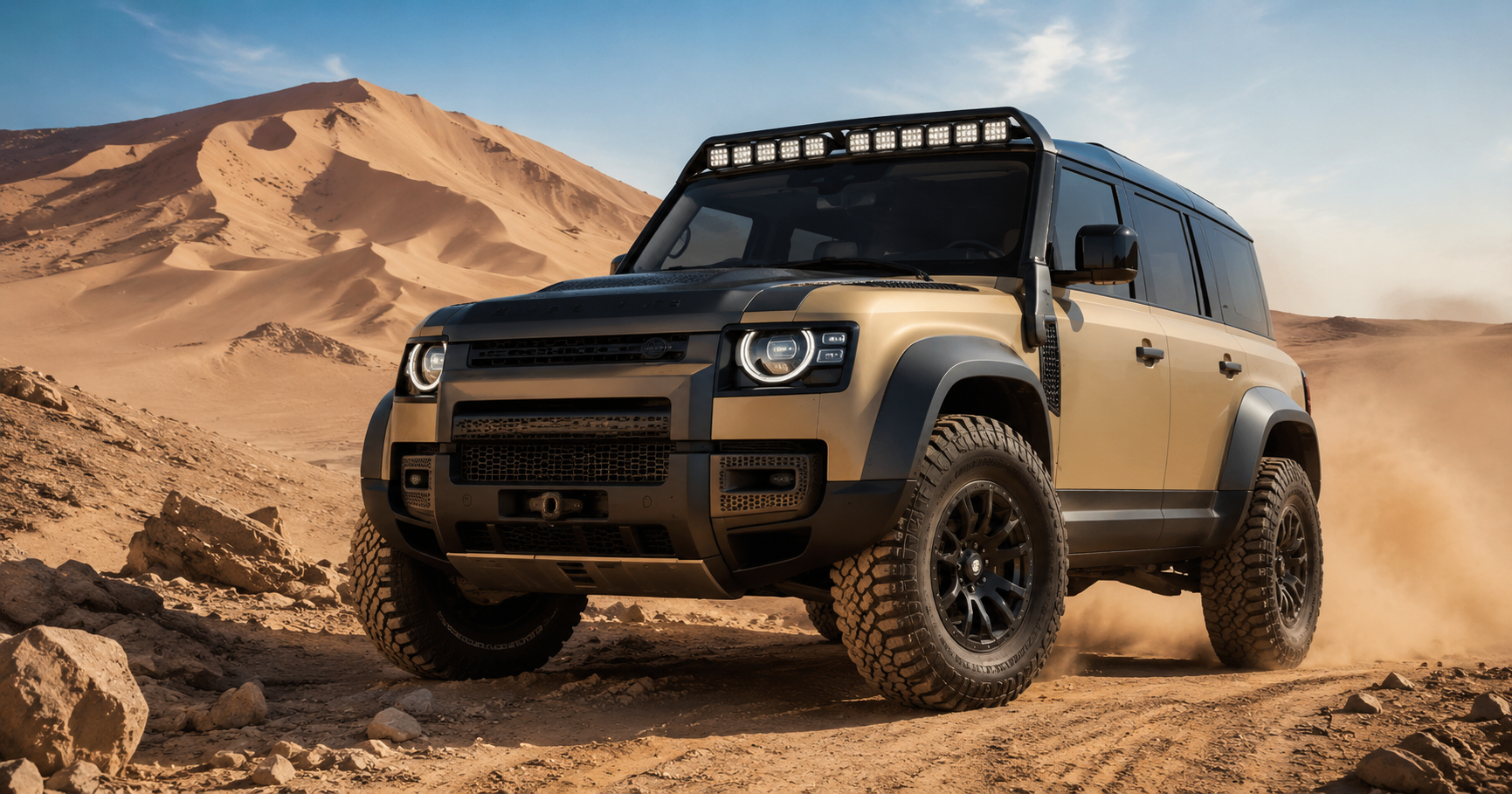
Land Rover has revealed the Defender Dakar Design Preview, a nearly finished concept that previews a street-legal production version of its Defender D7X-R Dakar rally car coming next year. The production Defender Dakar will bring several race-developed features to the road, including coil-spring suspension, 35-inch tires, 626 horsepower and new off-road drive modes.
From Dakar Race Car to Production Defender
Eight months ago, MotorTrend reported exclusively that Land Rover’s Defender subbrand was exploring ways to build a street-legal production version of the Defender D7X-R Dakar rally car. The newly revealed Defender Dakar Design Preview provides a close look at the production-intent vehicle.
The transition from race car to production model is helped by the Defender D7X-R’s origins. Under Dakar Rally rules, the race vehicle had to use a stock body and chassis, stock engine, stock transmission and differential cases with either stock gears or strengthened components, along with either the stock suspension or a custom setup that bolts directly into the stock mounting points.
As a result, the D7X-R is effectively an upgraded Defender Octa.
Rugged Suspension and 35-Inch Tires
The suspension required the biggest changes. Defender engineers replaced the air springs and hydraulic dampers with simpler, more rugged coil springs and gas dampers.
Because the race vehicle had to carry a full 145-gallon fuel tank, tools, spare parts and spare tires, it used extra dampers and stiffer rear springs. Those additional components will not be necessary on the production model.
The production Defender Dakar will continue with coil springs and Bilstein dampers. The suspension will sit behind new 21-inch wheels wrapped in 35-inch tires.
The race vehicles used much smaller 17-inch wheels with 35-inch BFGoodrich off-road race tires. The production Defender Dakar will have smaller sidewalls but is expected to retain similar wheel travel and ground clearance.
The D7X-R has similar wheel travel to a stock Octa, which uses 20- to 22-inch wheels and 33-inch tires, thanks to its larger-diameter tires. However, the race car has an additional 1.9 inches of ground clearance, bringing the total to 14.6 inches. That figure will likely carry over to the production Defender Dakar, while the Octa has 12.7 inches of ground clearance in its tallest setting.
626-HP V-8 and New Drive Modes
The drivetrain requires fewer changes. The D7X-R uses the stock BMW 4.4-liter twin-turbo V-8, detuned to 400 hp to comply with class rules. For production, Defender says the Dakar will receive the full 626 hp available in the Octa.
Torque will be rated at up to 553 lb-ft, however, compared with 590 lb-ft in the Octa.
Defender has not said whether the production model will retain the race vehicle’s stronger transmission gears, differential gears and axle half-shafts. It also has not confirmed whether the Dakar will use the race car’s mechanical limited-slip differentials or return to the Octa’s electronically controlled differentials.
The Defender Dakar will feature new drive modes, including Dunes and Gravel. It will also receive the “Airborne Detection” programming developed for the race vehicle to help ensure soft landings after jumps.
Many of the drivetrain components will be protected by an “enhanced” skid plate beneath the nose, along with additional underbody skid plates.
Race-Inspired Exterior Design
The production-intent vehicle also carries over many of the D7X-R’s distinctive body modifications, including large fender flares designed to accommodate the 35-inch tires.
The D7X-R had a track that was 2.3 inches wider than the Octa. Defender has not said whether the production vehicle will have the same wider track, although the photos give that impression.
The exterior package also includes an LED light pod above the windshield and carbon-fiber desert air intakes modified to keep high-speed sand out of the engine.
The Defender Dakar replaces the glass sunroof with a fixed metal roof and gets a carbon-fiber hood. At the rear, blank plates cover the tailgate where the spare tire mount was previously located, as the spare tire has been moved inside like it is on the race truck.
Race-Focused Interior
The racing influence continues inside the cabin. The front seats are designed specifically for the Defender Dakar and can be equipped with four-point harnesses.
The rear bench has been changed to accommodate two occupants instead of three, likely because of larger bolsters designed to keep passengers in place.
The cargo area includes dedicated storage compartments for helmets and an air compressor, along with a special spare-tire mount that shares the space.
Buyers will also have a “range of color options,” including the racing livery shown on the preview vehicle, which combines a Dakar Sand body color with a Yanbu Turquoise roof.
Limited Edition Defender Dakar
Land Rover will reveal pricing and technical details for the Defender Dakar at the 2027 Dakar Rally in January. Reservations will open at the same time, and the company says the model will be a limited edition.
Land Rover has not yet disclosed how many Defender Dakar models will be produced or how many will be sold in America. The Defender Octa starts at $160,750, and the Octa-based special-edition Defender Dakar is expected to start no lower and will almost certainly cost more.