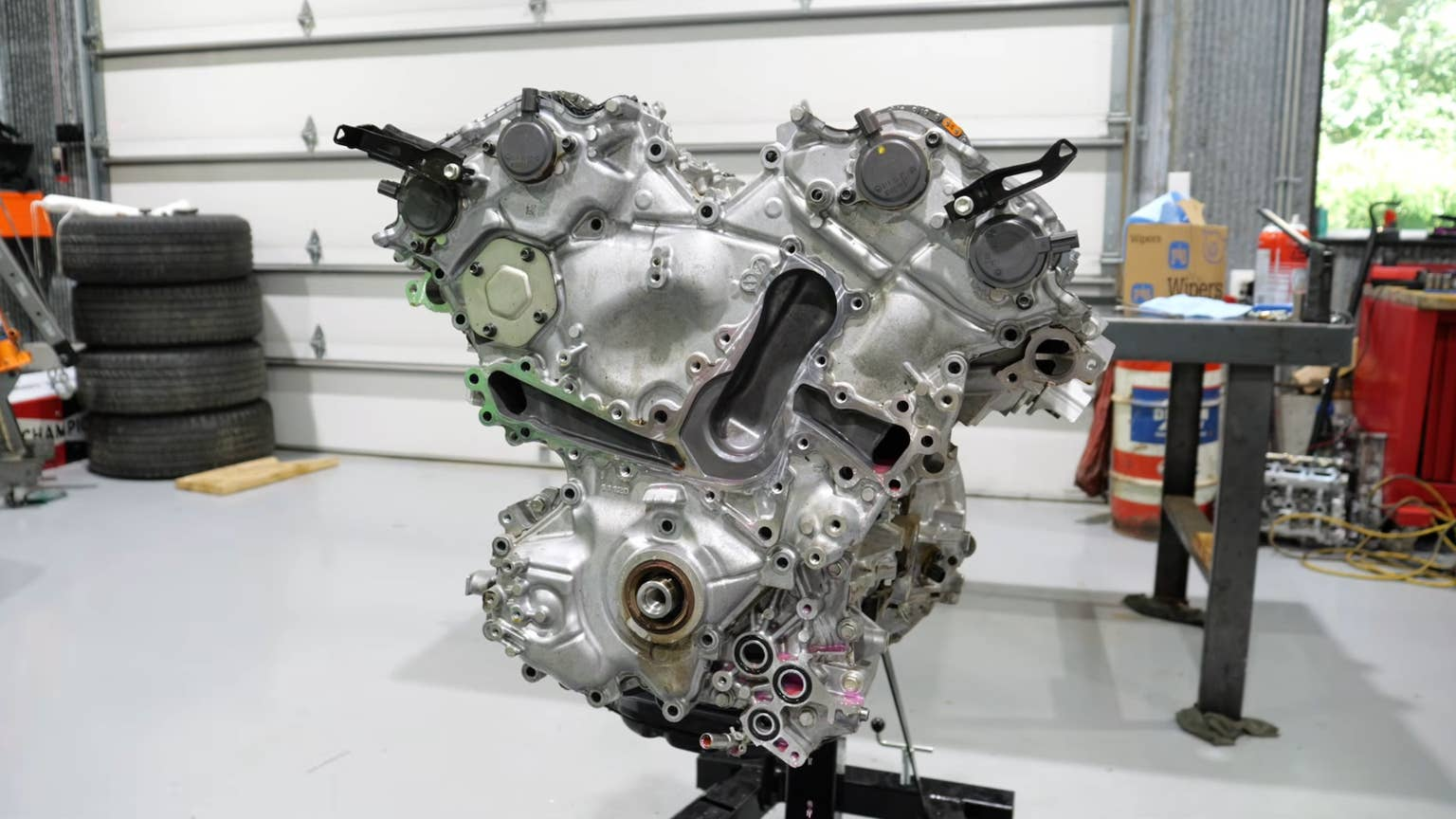
The Toyota V35A V6 is facing another troubling development after a teardown of a replacement engine from a 2022 Tundra revealed a failed main bearing, raising questions about whether some engines installed under the recall could experience separate failures.
Toyota’s V35A V6 Recall
Toyota’s twin-turbo 3.4-liter V35A-FTS V6, used in the latest Toyota Tundra, Sequoia and Lexus LX, has been at the center of a massive recall involving catastrophic bearing failures.
Toyota has blamed leftover machining debris from the factory that can enter the engine and damage the crankshaft bearings. The company’s response has included replacing engines in affected vehicles, but a new teardown shows that at least one replacement engine also suffered a serious bearing failure.
Replacement Engine Identified in Tundra Teardown
The latest teardown was conducted by I Do Cars, a channel familiar with V35A engine failures. The engine reportedly came from a 2022 Tundra with around 64,000 miles and initially appeared to be another vehicle affected by the recall.
However, evidence inside the engine showed that it was not the truck’s original powerplant. The lower intake manifold carried a build date of January 21, 2026, while additional date stamps inside the engine supported the same conclusion.
The engine was a replacement long block, meaning the Tundra had already undergone an engine swap following the recall.
Clean Replacement Engine Shows Signs of Failure
For much of the teardown, the replacement engine appeared remarkably clean. The spark plugs were fresh, the valve train was spotless, and there was no visible varnish or sludge beneath the valve covers.
Both turbos spun like new, while the water pump, timing chains, guides and oil pump showed very little wear. With both cylinder heads removed, the pistons, combustion chambers and cylinder walls also appeared unusually clean for an engine with so many miles.
The first significant warning appeared during the timing-system teardown. Metallic debris had accumulated behind one of the timing idler gears, despite the timing components themselves appearing nearly untouched.
Removing the oil pan revealed metallic material in the oil, indicating that bearing material was circulating through the engine. When the bed plate was removed, the source became clear: the third main bearing had spun, seized onto the crankshaft journal and sent metallic shrapnel throughout the engine.
Notably, the front main bearing—the bearing covered by Toyota’s recall—appeared to be in perfect condition.
What the Teardown Shows About Toyota’s V6
The teardown does not establish that every replacement V35A engine will fail, nor does it disprove Toyota’s explanation that leftover machining debris caused the original bearing failures.
Instead, it shows that a replacement engine that appeared exceptionally clean still suffered a spun main bearing. I Do Cars noted that much of the metallic debris likely appeared after the bearing failed, making it difficult to determine whether debris caused the failure or was simply a consequence of the damaged bearing.
For owners of these trucks, unusual knocking sounds, low oil pressure warnings or metal particles found during oil changes are signs that warrant an engine inspection, particularly if the vehicle has already been recalled or received an engine replacement.
Toyota Has Not Detailed Additional Fixes
Toyota has not said whether engines built after January 2026 received additional fixes beyond the recall repair.
For now, the teardown represents a single case rather than proof of a broader problem. But it shows that replacing an engine does not necessarily eliminate every potential issue involving Toyota’s twin-turbo V6.