The Volkswagen Mission Efficiency has arrived as a near-production electric vehicle prototype with an extreme focus on aerodynamics, and Volkswagen says it sets a new record for the lowest drag coefficient of any road-approved car at 0.158.
That figure puts the prototype ahead of several of the world’s most aerodynamic cars while also delivering remarkably low energy consumption figures. However, Volkswagen’s reported numbers are not EPA-rated figures.
Volkswagen Mission Efficiency Breaks Drag Record
With a drag coefficient of 0.158, the Mission Efficiency beats the 0.197 Cd recorded by the Lucid Air. The Mercedes EQS sedan and the now-discontinued Tesla Model S also rank among highly aerodynamic cars, with drag coefficients as low as 0.20 and 0.208, respectively.
Volkswagen also claims two efficiency records for the electric prototype. In an idealized constant-speed test at 68 km/h, the Mission Efficiency consumed 6.48 kWh/100 km, equivalent to about 6.48 kWh/62 miles or 323 MPGe.
In a real-world setting that included charging losses, consumption was 7.51 kWh/100 km, or about 7.51 kWh/62 miles and 279 MPGe.
The real-world test covered a 794-mile journey from Wolfsburg, Germany, to Vienna. The EV required only one charging stop and arrived with 164 km (102 miles) of range remaining.
Volkswagen notes that these figures are not EPA-rated.
Efficiency Drives the Mission Efficiency Design
The Mission Efficiency continues Volkswagen’s history of developing highly aerodynamic and efficient vehicles. In 2013, the automaker introduced the XL1 plug-in hybrid, which was one of the most economical production cars in the world at the time.
The new prototype follows that approach as the automotive industry moves toward electrification, while using technology designed for Volkswagen’s mass-market EVs.
Rather than relying on an entirely bespoke powertrain architecture, the Mission Efficiency uses MEB+ front-wheel-drive technology. The same technology underpins the ID. Polo and ID. Cross, which are designed to be affordable but are not likely to make their way stateside because of the market preference for larger vehicles.
The Mission Efficiency uses the 99-kW, or 133-horsepower, motor and high-voltage battery adopted from the ID. Polo.
A Body Designed to Cut Aerodynamic Drag
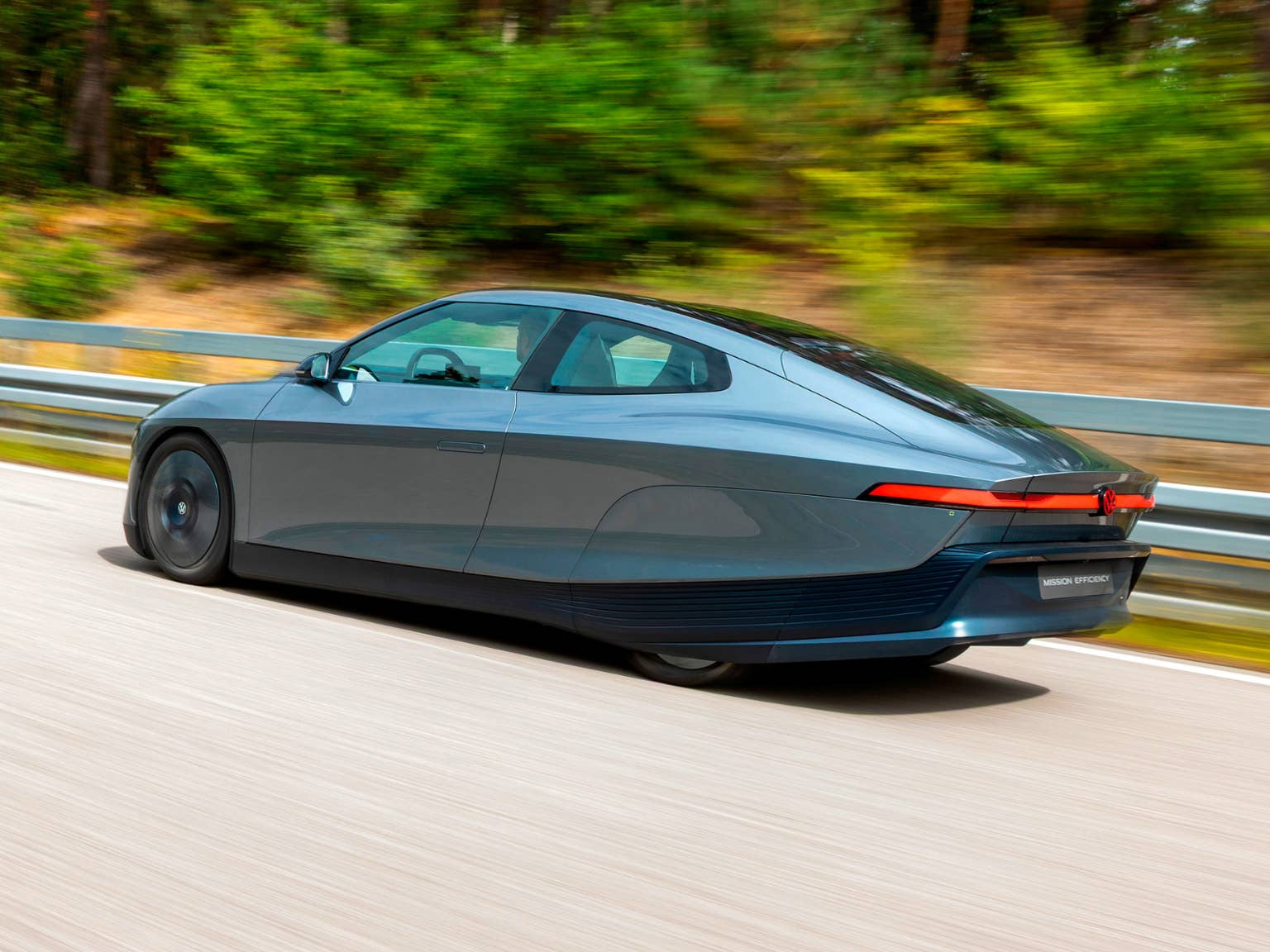
The prototype’s biggest distinction is its aero-focused design. It features a low-drag teardrop coupe body, a compact front profile, active cooling shutters and a fully enclosed underbody.
The rear wheels are also covered. While the design gives the car a futuristic appearance, Volkswagen says the covered wheels help reduce turbulence and aerodynamic drag.
Volkswagen says the Mission Efficiency consumes more than 30% less energy than the standard ID. Polo at speeds above 80 km/h (50 mph).
At 140 km/h (87 mph), the prototype requires approximately the same amount of energy as the small electric hatchback does at 100 km/h (62 mph).
Mission Efficiency Dimensions and Hardware
The Mission Efficiency measures 4,775 mm (188 inches) in length and 1,392 mm (55 inches) in height. It uses a 2+2 seating configuration, with limited rear-passenger space similar to the Toyota GR86.
The prototype also features a MacPherson front axle and hydraulic front brakes from the ID. Polo, along with new electromechanical rear brakes.
Could Volkswagen Put It Into Production?
Volkswagen has not announced production plans for the Mission Efficiency. However, the prototype is near production, is road-approved and uses affordable technologies from the ID. Polo and ID. Cross.
Those characteristics give the aerodynamic EV prototype several qualities that could support a market launch, although Volkswagen has not confirmed that will happen.
Range is an important consideration for EV buyers, and a production version of the Mission Efficiency could offer an approach centered on efficiency. That could be particularly significant in the U.S., where Volkswagen’s EV lineup appears to be in limbo following the end of ID.4 production in Chattanooga, Tennessee.
For now, the Mission Efficiency remains a prototype, but Volkswagen’s latest EV demonstrates the potential of combining mass-market technology with an aggressively aerodynamic design.