
The 2027 Hyundai Tucson design marks one of the biggest visual departures yet for Hyundai’s popular compact SUV. Instead of making a series of cautious styling updates, Hyundai is giving the next-generation Tucson a dramatically more upright, sculpted appearance that blends rugged proportions with a surprisingly premium character.
The fourth-generation Tucson is expected to arrive in showrooms late this year or early next year, beginning in Korea before expanding to other markets. Although Hyundai has not yet revealed the full technical specification, its design reveal provides an unusually clear look at the direction the company is taking.
The transformation goes well beyond a new grille or redesigned headlights. The 2027 Hyundai Tucson redesign brings a longer, wider and taller body, a stretched wheelbase, more rear-seat headroom, larger door openings and more cargo space. Inside, the new Hyundai Tucson adopts a cleaner, more upscale dashboard centered around Hyundai’s latest Pleos infotainment technology.
In other words, Hyundai appears to be positioning the 2027 Tucson as something more distinctive than a conventional compact crossover. It still needs to compete with extremely popular models such as the Toyota RAV4 and Honda CR-V, but its new design gives it a personality that should be difficult to confuse with anything else in the segment.
A New Design Philosophy for the Hyundai Tucson
Hyundai has developed a reputation for dramatically changing the appearance of its vehicles when introducing a new generation, and the next-generation Tucson continues that strategy.
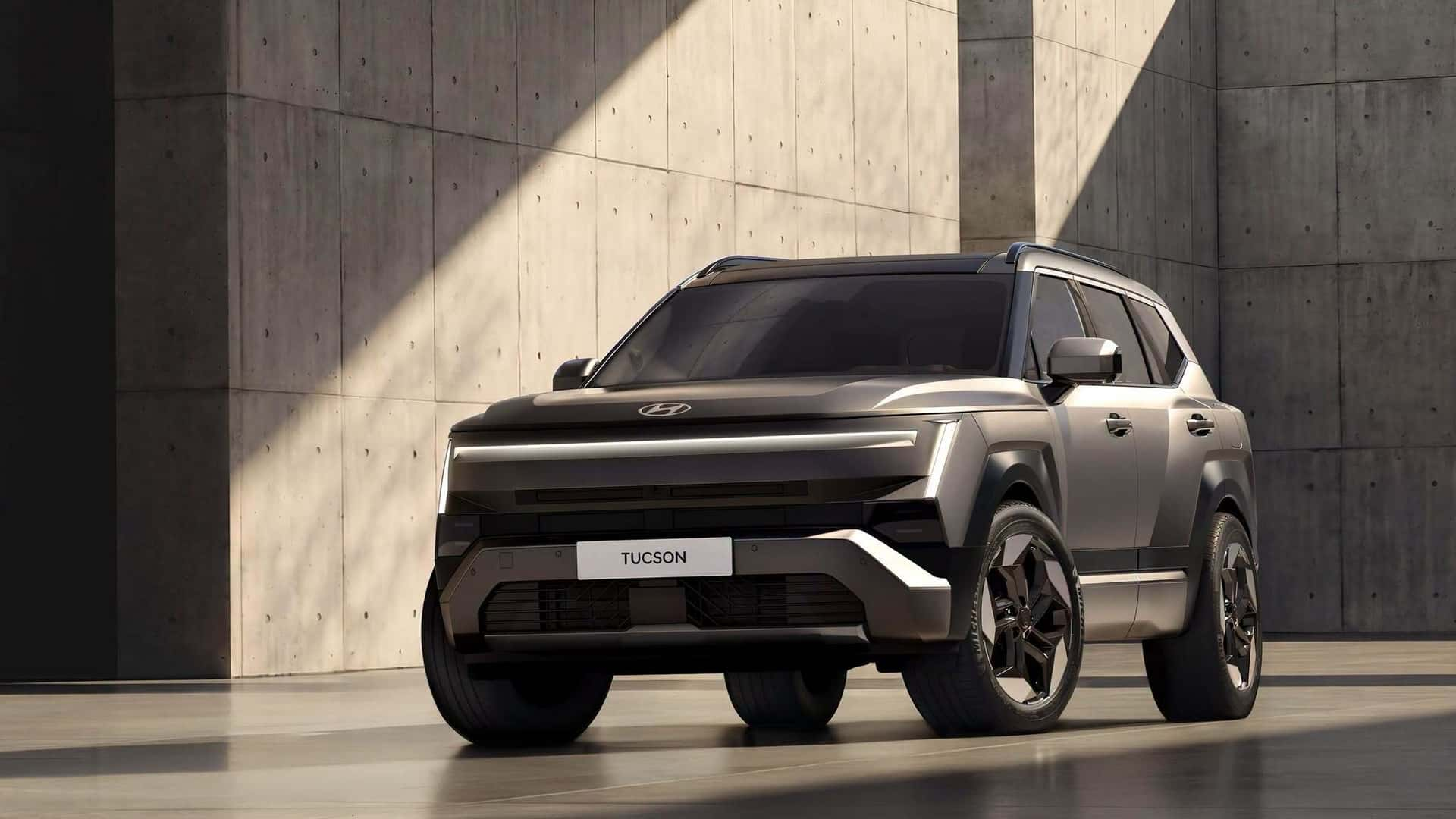
The previous Tucson already had a distinctive appearance, but the new Tucson design moves toward a much more geometric interpretation of the compact SUV. Its body surfaces appear more architectural, while the front and rear incorporate strong horizontal elements that visually emphasize the vehicle’s width.
This approach is closely connected to Hyundai’s Art of Steel design language. Rather than relying exclusively on flowing curves, the philosophy uses stronger surfaces, defined edges and contrasting geometric forms to make the vehicle appear more substantial.
The result is a Tucson that looks considerably more upright and muscular than the outgoing model. Hyundai has essentially taken the rugged visual language introduced by newer products such as the Santa Fe and Palisade and adapted it for a compact crossover with a more urban-oriented mission.
Why the Boxy Shape Matters
The move toward a Tucson boxy design is not simply an aesthetic decision. Boxier proportions can create a visual impression of greater interior volume, while upright bodywork can make an SUV appear more capable and substantial.
That matters in a segment where buyers increasingly want one vehicle to cover multiple roles. A compact crossover might spend most of its life commuting through city streets, yet owners still want it to look capable of handling weekend trips, camping excursions and outdoor activities.
Hyundai’s recent design direction recognizes that contradiction. The new Tucson looks rugged enough to suggest adventure but sophisticated enough to fit comfortably into an urban environment.
2027 Hyundai Tucson Exterior: Bigger, Wider and More Sculpted
The most obvious change to the 2027 Tucson exterior is its larger footprint.
Hyundai has confirmed that the new-generation vehicle grows in virtually every major dimension. The additional size is not merely cosmetic, either. Some of the increase is being used to improve passenger space and practicality.
Here is how the new model compares with the 2026 Tucson based on the dimensions Hyundai has released:
| Dimension | 2027 Hyundai Tucson | 2026 Hyundai Tucson | Change |
|---|---|---|---|
| Wheelbase | 109.6 inches | 108.5 inches | +1.1 inches |
| Length | 185 inches | 182.7 inches | +2.3 inches |
| Width | 75 inches | 73.4 inches | +1.6 inches |
| Height | 66.3 inches | 65.6 inches (FWD) | +1.3 inches |
| Second-row headroom | 40.6 inches | 39.5 inches | +1.1 inches |
The 2027 Tucson measures 185 inches long, representing a 2.3-inch increase over the outgoing model. Its wheelbase stretches to 109.6 inches, while width increases to 75 inches.
The SUV is also 66.3 inches tall. While these numbers may not sound revolutionary individually, together they contribute to a noticeably larger vehicle.
A Longer Wheelbase for More Interior Space
The 1.1-inch wheelbase increase is particularly important because wheelbase can have a direct relationship with cabin packaging. Hyundai says the redesigned SUV offers 1.1 inches of additional second-row headroom.
The rear doors also open significantly farther than before. Their opening angle increases from 73 degrees to 83 degrees.
That seemingly small engineering change could make a meaningful difference for families. Wider door openings can make it easier to install child seats, load passengers and move larger objects into the rear cabin.
It is one of the less visually obvious improvements in the Hyundai Tucson 2027, but it demonstrates that the redesign isn’t exclusively about appearance.
The Front End Is Designed to Make a Statement
The front fascia is arguably where the new Hyundai Tucson makes its strongest impression.
Hyundai has adopted a slim horizontal daytime-running-light signature that gives the SUV a futuristic appearance. Instead of treating the lighting as an isolated element, the designers integrate it into the overall architecture of the front end.
An illuminated H motif further strengthens the brand identity, while the horizontal treatment makes the vehicle appear wider and more planted.
This is an important distinction from many conventional compact SUVs. The Tucson does not appear to rely on a single oversized grille to communicate aggression. Instead, it uses the relationship between lighting, bodywork and horizontal surfaces to establish its visual identity.
Fender Flares Add a Rugged Character
Another major element of the 2027 Hyundai Tucson design is the heavily sculpted fender treatment.
The pronounced fender flares give the vehicle a broad-shouldered appearance, particularly when combined with large wheels. They also create a stronger visual separation between the body and the wheel openings.
The styling is unusually dramatic for a mainstream compact crossover. Hyundai appears to be deliberately pushing the Tucson toward a more premium and expressive appearance rather than allowing it to blend into the segment.
That strategy could prove particularly useful in a market where buyers have an enormous number of compact SUVs to choose from.
A Futuristic Rear Design
The visual transformation continues at the rear.
A full-width rear light bar echoes the front lighting treatment, giving the 2027 Tucson exterior a cohesive identity from either direction. The rear lighting is slim and horizontal, reinforcing the vehicle’s wider stance.
The rear bumper is also heavily sculpted. Combined with the broader body and larger wheels, the design makes the Tucson appear firmly planted on the road.
Hyundai has essentially used the same design principle at both ends of the vehicle: horizontal lighting emphasizes width, while angular body surfaces create a sense of strength.
That consistency is important because dramatic design can easily become disjointed when too many elements compete for attention. In the new Tucson, the various details appear to work toward a single visual objective.
How the 2027 Tucson Compares With the Competition
The compact SUV market is one of the most competitive segments in the automotive industry. Vehicles such as the Toyota RAV4 and Honda CR-V have built enormous reputations by emphasizing practicality, efficiency, reliability and broad consumer appeal.
Hyundai is not necessarily trying to beat those vehicles by copying their formula.
Instead, the 2027 Hyundai Tucson redesign appears designed to create a stronger emotional response. Its squared-off proportions, pronounced fenders and futuristic lighting give it an immediately recognizable appearance.
That could be an important advantage for Hyundai. In a crowded parking lot, being recognizable can matter almost as much as having a competitive specification sheet.
Rugged Without Going Full Off-Road
There is an interesting tension in the new design. The Tucson looks significantly more rugged, but it remains fundamentally a compact crossover designed primarily for everyday use.
That is not necessarily a weakness.
Most owners of compact SUVs rarely need serious off-road capability. What they often want is the appearance of capability combined with the comfort, efficiency and convenience of a daily driver.
The new Tucson appears to understand that market perfectly.
2027 Hyundai Tucson Interior: A More Premium Direction
The transformation isn’t limited to the exterior. The 2027 Hyundai Tucson interior follows the same premium-oriented philosophy.
The dashboard adopts a horizontal layout that visually stretches across the cabin. A large central touchscreen dominates the center of the dashboard, while a slim digital instrument display sits directly in front of the driver.
This layout is closely related to Hyundai’s approach for its redesigned Elantra, suggesting that the company is establishing a broader interior design language for its upcoming models.
The materials shown in the design reveal also contribute to the upscale impression. Soft-looking surfaces, light-colored upholstery, ambient lighting, perforated materials and wood-like trim create an environment that appears more expensive than the Tucson’s mainstream positioning might suggest.
Pleos Could Become a Major Interior Upgrade
One of the most significant technological changes is expected to be Hyundai’s new Pleos infotainment system.
Hyundai has not provided every technical detail about the Tucson’s system yet, but the redesigned cabin clearly makes infotainment a central component of the dashboard.
The exact screen size has not been confirmed. The design shown could potentially accommodate a display similar to the larger 17-inch unit used elsewhere in Hyundai’s lineup, although that should not be treated as a confirmed Tucson specification.
Importantly, Hyundai has retained conventional physical controls beneath the main display.
That decision could be welcomed by drivers who prefer tactile controls for frequently used functions. While many automakers are moving toward increasingly screen-dependent interiors, the new Tucson appears to maintain a balance between digital technology and traditional controls.
2027 Hyundai Tucson Powertrain Expectations
Hyundai has not released complete mechanical specifications for the new Tucson. This means buyers should treat any discussion of the powertrain as an expectation rather than a confirmed specification.
However, the current model’s powertrain strategy provides a reasonable indication of what Hyundai could carry forward.
The current Tucson lineup includes gasoline, hybrid and plug-in hybrid configurations. The redesigned model is expected to continue offering a range of electrified and conventional choices, potentially with improvements to performance and efficiency.
Expected configurations include:
- A conventional 2.5-liter inline-four gasoline engine.
- A hybrid system pairing a turbocharged 1.6-liter four-cylinder engine with an electric motor.
- A plug-in hybrid using the 1.6-liter turbocharged engine, a more powerful electric motor and a larger battery.
Front-wheel drive is also expected to remain available, with all-wheel drive continuing as an option.
For Hyundai, this would represent a relatively conservative approach mechanically while allowing the company to make the biggest statement through design, technology and packaging.
Will There Be a 2027 Tucson XRT or N Line?
Hyundai has indicated that a more rugged Tucson XRT is planned for the new generation.
That makes sense given the direction of the exterior design. The boxier body, larger proportions and stronger fender treatment provide a natural foundation for an adventure-oriented appearance package.
The future of an N Line or full N performance variant is less certain.
The United States previously received a Tucson N Line, but that version was discontinued for 2026. Unlike a full performance model, the previous N Line primarily delivered a sportier appearance without a significant horsepower increase.
There are rumors that Hyundai could introduce a sportier variant for the next generation, but Hyundai has not confirmed that a 2027 Tucson N or N Line will arrive.
Could the Tucson Eventually Get Extended-Range EV Technology?
Another intriguing possibility comes from Hyundai’s broader electrification strategy.
Hyundai CEO José Muñoz has said the company plans to launch its first extended-range electric vehicles in the following year. Whether the new Tucson becomes one of the vehicles to receive that technology remains unclear.
For now, there is no confirmed extended-range EV Tucson specification to discuss. Still, the possibility highlights how important the next-generation platform could become as Hyundai expands its electrified lineup.
What the Larger Dimensions Mean for Buyers
The size increase may be one of the most important parts of the 2027 Hyundai Tucson redesign for everyday owners.
Consider a family using the Tucson as its primary vehicle. The extra width can contribute to a roomier cabin, while the longer wheelbase can improve packaging. Additional rear headroom gives passengers more space, and the wider rear-door opening can simplify access.
The growth also gives Hyundai more flexibility when positioning the Tucson against competitors. It can maintain its compact-SUV identity while offering some of the space-related advantages buyers may associate with larger vehicles.
That could be especially valuable for customers who want a family-friendly SUV but don’t want to move up to a midsize model.
Why Hyundai Took Such a Big Design Risk
There is a strategic reason Hyundai can afford to be aggressive with the Tucson.
The Tucson is already one of Hyundai’s strongest-selling vehicles globally. In the United States, it has been the company’s sales leader by a significant margin, with Hyundai moving roughly 234,000 units in the cited year.
That creates a difficult balance for designers. A radical redesign can attract attention and new customers, but changing a successful formula also carries risk.
Hyundai’s solution appears to be separating the areas where it takes risks from those where it remains conservative.
- Exterior: Hyundai makes a dramatic visual change.
- Interior: The cabin receives a substantial technological and aesthetic upgrade.
- Dimensions: The Tucson becomes larger and more practical.
- Powertrains: The existing gasoline, hybrid and plug-in hybrid strategy may continue.
- Drivetrain: Front-wheel drive and available all-wheel drive are expected to remain part of the formula.
This approach allows Hyundai to modernize the Tucson without completely abandoning what made the vehicle successful.
2027 Hyundai Tucson Design: What Stands Out Most
Looking at the new generation as a whole, several design and packaging changes stand out.
1. A Much Boxier Silhouette
The squared-off body gives the Tucson a stronger SUV identity than the outgoing model. The upright appearance is particularly important because it visually separates the vehicle from softer, more rounded compact crossovers.
2. Full-Width Lighting
The front and rear light bars establish a recognizable lighting signature and make the Tucson appear wider and more futuristic.
3. Larger Exterior Dimensions
The 2.3-inch increase in overall length and 1.6-inch increase in width are meaningful changes for a compact crossover.
4. More Rear-Seat Space
Second-row headroom increases to 40.6 inches, up from 39.5 inches in the 2026 Tucson.
5. More Convenient Rear Access
The rear doors now open to 83 degrees, compared with 73 degrees previously, potentially making child-seat installation and passenger access easier.
6. A Premium-Looking Cabin
Soft materials, ambient lighting, a horizontal dashboard and a large central display give the cabin a more upscale character.
7. A Stronger Hyundai Identity
The illuminated H motif, geometric bodywork and Art of Steel philosophy help distinguish the next-generation Tucson from its competitors.
When Will the New Hyundai Tucson Arrive?
Hyundai has indicated that the new-generation Tucson will go on sale in Korea later this year, with other markets expected to follow in 2027.
The exact timing for the United States has not been fully detailed in the available design reveal. As a result, buyers should wait for Hyundai to announce final market-specific specifications, pricing, trim levels and availability.
Those details will ultimately determine whether the new Tucson is merely a visual success or a genuinely stronger competitor in the compact-SUV market.
What We Still Don’t Know About the 2027 Tucson
Despite the extensive design changes, Hyundai has deliberately kept many important details under wraps.
The company has not yet provided the complete powertrain specifications, final performance figures, fuel-economy numbers, battery capacities for electrified variants, pricing or complete trim structure.
That means the current reveal should be viewed primarily as a statement about design and packaging rather than a complete product launch.
The unanswered questions include:
- What will the final U.S. powertrain lineup look like?
- Will hybrid and plug-in hybrid models receive meaningful efficiency improvements?
- What will the Tucson’s final infotainment screen size be?
- How much cargo capacity will the larger body provide?
- What will the 2027 Tucson cost in the United States?
- Will Hyundai introduce a Tucson N Line or N performance model?
- Which trims will receive the XRT treatment?
- Could extended-range EV technology eventually reach the Tucson?
The Bottom Line on the 2027 Hyundai Tucson Design
The 2027 Hyundai Tucson design represents a clear change in philosophy for one of Hyundai’s most important vehicles.
Rather than simply refining the outgoing SUV, Hyundai has embraced a boxier silhouette, stronger geometric surfaces, wider proportions and futuristic lighting. The result is a vehicle that appears more rugged without abandoning its urban focus.
The interior follows the same trajectory. A horizontal dashboard, slim driver display, large central touchscreen, ambient lighting and upscale materials make the cabin feel closer to a premium vehicle than a traditional mainstream compact SUV.
Perhaps most importantly, the redesign isn’t just about visual drama. The Tucson is longer, wider and taller, with a longer wheelbase, additional second-row headroom and significantly wider rear-door openings.
Hyundai is therefore changing the Tucson in the areas where customers can immediately see and feel the difference while potentially keeping the familiar gasoline, hybrid and plug-in hybrid formula underneath.
If Hyundai executes the final product as effectively as this initial reveal suggests, the next-generation Tucson could become one of the most visually distinctive vehicles in the compact-SUV segment. Its biggest challenge will be proving that the bold new styling is backed by equally compelling technology, efficiency, practicality and value.
For now, though, one thing is clear: the 2027 Hyundai Tucson is not intended to disappear into the crowd.
2027 Hyundai Tucson FAQ
What is new about the 2027 Hyundai Tucson design?
The 2027 Hyundai Tucson receives a completely redesigned exterior and interior. The new model adopts a boxier shape, stronger sculpted surfaces, horizontal lighting elements, larger wheels and a more premium cabin.
Is the 2027 Hyundai Tucson bigger than the current model?
Yes. The new Tucson is 185 inches long, 75 inches wide and 66.3 inches tall. Its wheelbase grows to 109.6 inches. Hyundai also says second-row headroom increases to 40.6 inches.
What is the Hyundai Art of Steel design language?
Hyundai’s Art of Steel design direction emphasizes stronger architectural surfaces, pronounced edges and horizontal elements. The 2027 Tucson uses this philosophy to create a more geometric and sculpted appearance.
Will the 2027 Tucson have a hybrid?
Hyundai has not released the complete 2027 Tucson powertrain specification. However, the current Tucson offers gasoline, hybrid and plug-in hybrid powertrains, making continued electrified options a reasonable expectation rather than a confirmed final specification.
Will the 2027 Hyundai Tucson have all-wheel drive?
The current Tucson offers front-wheel drive and available all-wheel drive, and the new generation is expected to continue with that general drivetrain strategy. Hyundai has not yet released the complete final specification.
Will there be a 2027 Tucson XRT?
Yes. Hyundai has shown that a more rugged Tucson XRT is planned for the new generation. Details about its final equipment and specifications have not yet been fully announced.
Will Hyundai make a 2027 Tucson N Line?
Hyundai has not confirmed a 2027 Tucson N Line or full N performance model. The previous U.S.-market Tucson N Line was discontinued for 2026.
When will the new Hyundai Tucson go on sale?
The new-generation Tucson is expected to go on sale in Korea later this year, with other markets expected to follow in 2027. Exact U.S. timing and specifications remain subject to Hyundai’s official announcements.