Volkswagen is exploring a new way to improve crash safety by changing how an existing engine component works during a collision. A patent found by CarBuzz describes a redesigned support that could redirect the engine during a crash, helping dissipate energy instead of sending it toward the occupants.
Volkswagen Targets the Engine Mount
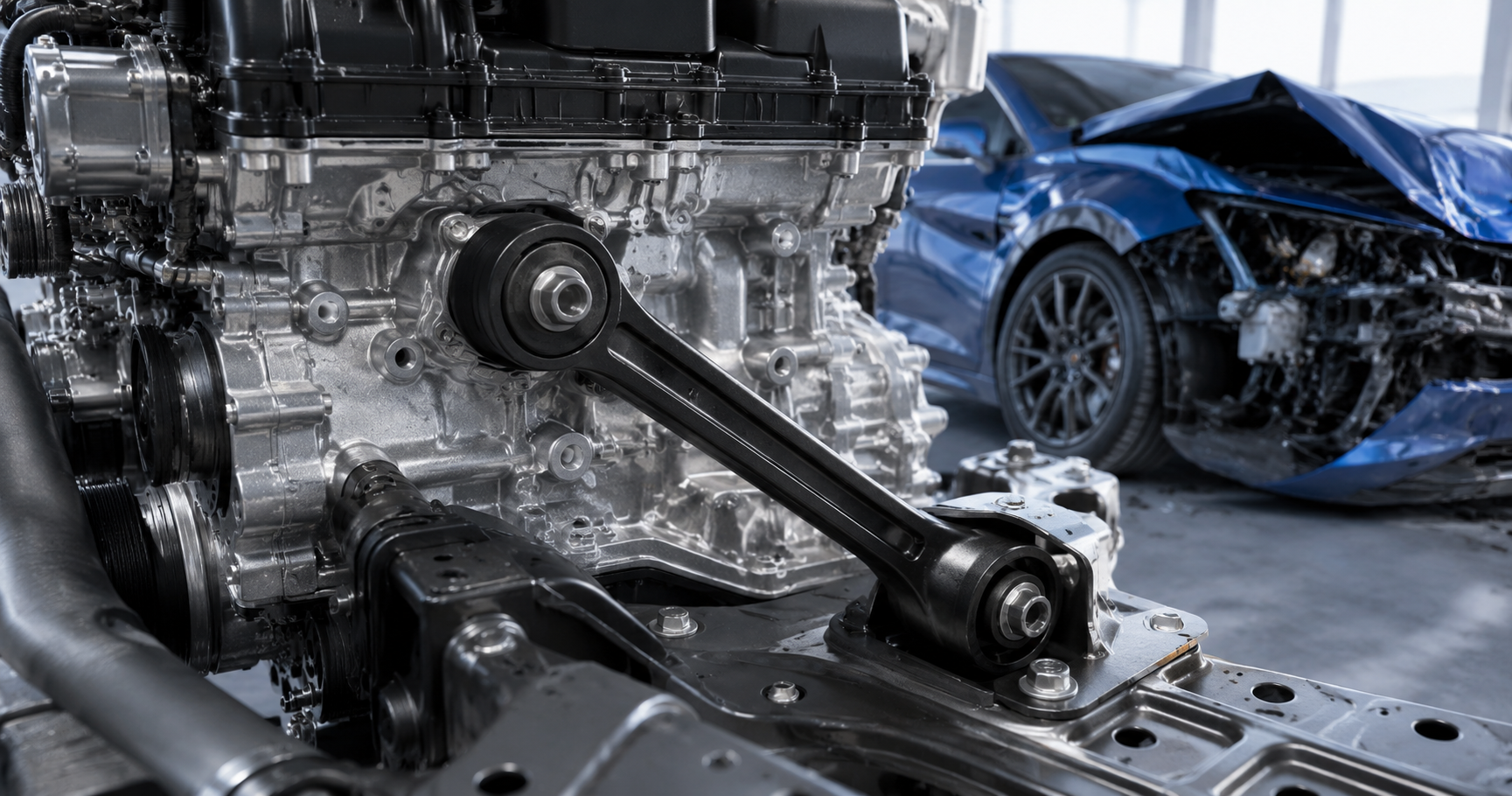
The component at the center of the patent is commonly known as a dogbone mount, a type of support found on front-drive vehicles. These mounts are positioned at the top and bottom of different engines and help hold the engine in place against the firewall or radiator support.
The proper terms for these components are “pendulum support” or “pendulum rod.” The name comes from their appearance, resembling the rod connecting a clock’s mechanism to its pendulum weight.
Volkswagen’s patent describes placing one of these supports underneath and behind the engine, where it functions as a lower engine mount. One end would connect to the vehicle through a bushing or bearing, while the engine side would use a more rigid bolted connection.
At first glance, the design resembles a conventional dogbone engine mount. The key difference is how Volkswagen intends the component to behave during a crash, along with the fact that only one side uses a rubber bushing or bearing.
A Controlled Failure Could Improve Crash Safety
Volkswagen’s proposed support is designed to fail differently from the existing part during an impact. With the older design, the support could fail unpredictably, allowing the engine to move in ways that do not necessarily help manage crash energy.
The new design is intended to control that movement more precisely. In Volkswagen’s example, a rearward force pushes the engine backward and bends the support. The engine moves farther toward the rear of the vehicle without moving upward and can instead be directed downward.
That controlled movement is designed to help absorb more energy without pushing the engine into the passenger compartment. The mountings would also bend and move in specific ways intended to absorb crash energy more effectively.
The approach is designed to reduce the amount of crash energy transmitted into the cabin through the subframe and other components.
The Design Could Also Limit Damage in Minor Crashes
The proposed mount could allow the vehicle to absorb more of the impact during a front-end crash, providing a potential safety benefit. Volkswagen could also design the component around a lower deformation limit, allowing it to avoid deforming during minor crashes that might otherwise result in expensive damage with the existing mount.
Why Volkswagen’s Patent Matters
Improving crash safety becomes increasingly difficult as automakers address more straightforward safety measures. Volkswagen’s patent focuses on changing the behavior of a component already used in vehicles rather than replacing the entire system.
The design described by Volkswagen is intended to make engine movement during a crash more controlled, helping the vehicle absorb impact energy while reducing its transmission into the passenger compartment.