Choosing between two Toyota RAV4 trims has usually been a matter of balancing price against equipment. For 2026, however, the decision is more interesting than ever. The redesigned RAV4 is now an all-hybrid lineup in the U.S., and even the entry-level model arrives with technology and safety features that used to push buyers toward more expensive trims.
Read also..
Toyota SUV Models: Complete Guide to Every Toyota SUV for 2026
So which one should you buy? For shoppers focused strictly on keeping the purchase price low, the LE makes a strong case. For families, commuters, and buyers who want their RAV4 to feel more upscale every day, the XLE Premium may justify the additional cost.
2026 Toyota RAV4 LE vs XLE: What’s Changed?
Before comparing equipment, it is important to understand what makes the 2026 RAV4 different from previous model years.
Toyota eliminated the gas-only RAV4 for 2026. The U.S. lineup is now centered on hybrid powertrains, with plug-in hybrid models forming a separate lineup arriving later in the year. That means buyers entering the RAV4 range are getting a hybrid from the start rather than having to pay extra to upgrade from a conventional gasoline engine.
Toyota has also reorganized the RAV4 lineup into different families. The Core group includes the LE, XLE/XLE Premium, and Limited, while Sport and Rugged families cover trims such as the SE, XSE, GR Sport, and Woodland.
For shoppers specifically searching for a Toyota RAV4 LE vs XLE comparison, there is an important naming detail. The supplied research indicates that U.S. materials commonly reference the XLE Premium rather than a standalone XLE in the 2026 lineup. As a result, the practical comparison here treats the XLE Premium as the relevant upgrade from the LE.
2026 RAV4 LE vs XLE Premium: Price Comparison
Price is where the difference between the two trims becomes easiest to understand.
The 2026 Toyota RAV4 LE Hybrid starts at approximately $31,900 for front-wheel drive. Choosing all-wheel drive raises the figure to roughly $33,300 to $33,350, depending on whether destination charges are included in the quoted price.
The XLE Premium Hybrid starts at approximately $36,100 with front-wheel drive. All-wheel drive generally adds about $1,400.
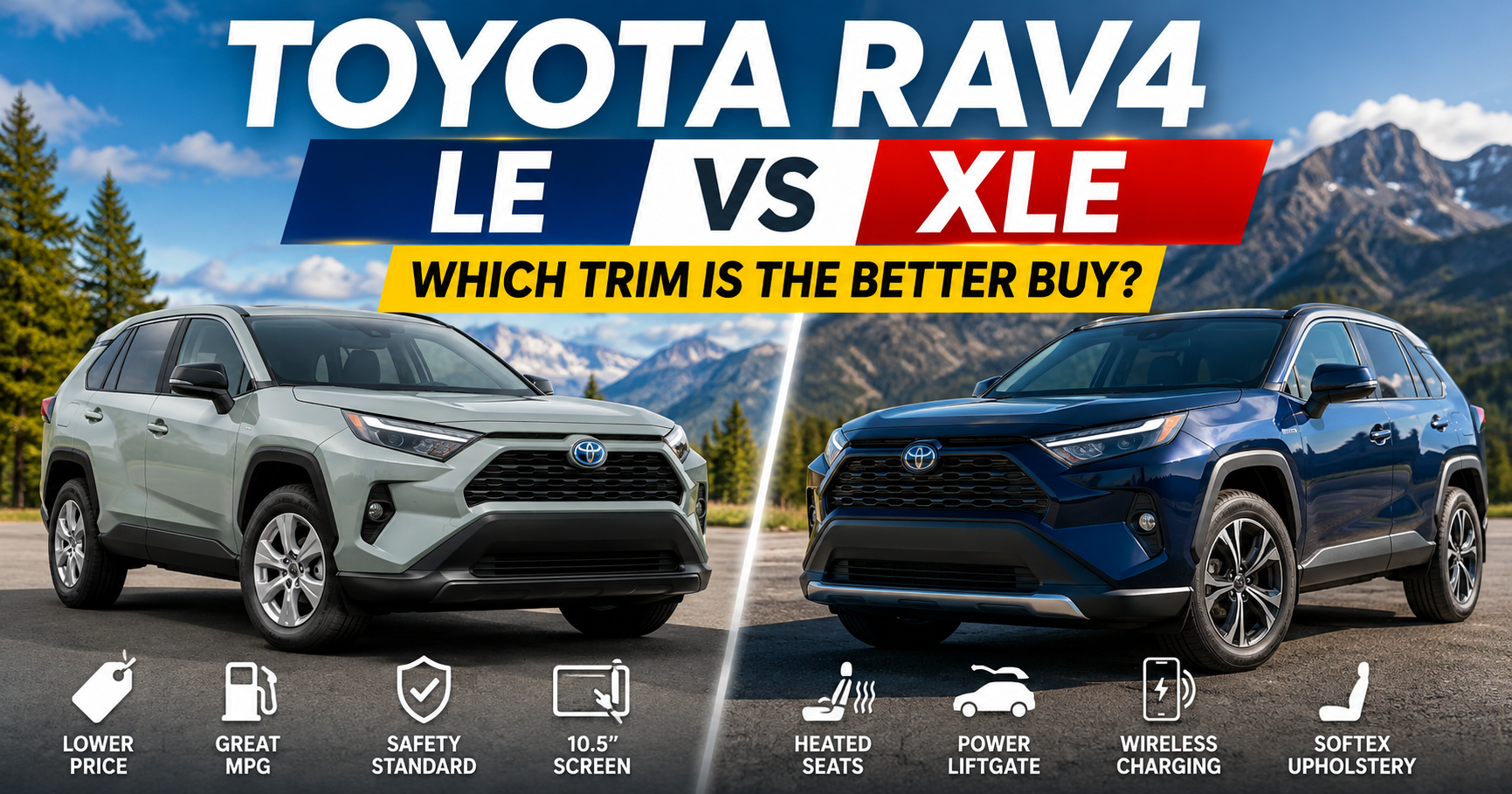
| Category | 2026 RAV4 LE | 2026 RAV4 XLE Premium |
|---|---|---|
| Powertrain | Hybrid | Hybrid |
| Starting price, FWD | About $31,900 | About $36,100 |
| AWD availability | Yes | Yes |
| Touchscreen | 10.5 inches | 10.5 inches |
| Digital gauge cluster | 12.3 inches | 12.3 inches |
| Safety Sense 4.0 | Standard | Standard |
| Upholstery | Cloth | SofTex synthetic leather |
| Heated front seats | Generally not included | Yes |
| Power liftgate | No | Yes |
| Wireless phone charging | No | Yes |
That means the typical move from an LE to an XLE Premium costs roughly $3,800 to $4,200, depending on drivetrain, destination charges, equipment, and market.
The important question is what you receive for that extra money. In this case, Toyota is not primarily charging buyers for a different engine or dramatically different technology package. Much of the additional money goes toward making the vehicle more comfortable and convenient to live with.
RAV4 LE vs XLE: Powertrain and Performance
If you’re comparing the Toyota RAV4 LE vs XLE from a performance perspective, there is relatively little separating the two.
Both are built around Toyota’s 2.5-liter four-cylinder hybrid powertrain and an electronically controlled continuously variable transmission. Front-wheel-drive versions produce approximately 226 horsepower, while all-wheel-drive models increase output to approximately 236 horsepower.
That is significant because upgrading from the LE to the XLE Premium does not fundamentally change the character of the RAV4. The additional money is not primarily buying more horsepower.
FWD vs AWD
Buyers also need to decide whether they actually need all-wheel drive.
Front-wheel-drive versions of the RAV4 can achieve up to approximately 43 mpg combined, depending on trim and configuration. AWD models provide additional traction and slightly more power, but fuel economy decreases somewhat.
For drivers who spend most of their time in mild climates and primarily use paved roads, FWD can be the more economical choice. Buyers who regularly encounter snow, poor road conditions, steep terrain, or simply want the added traction may prefer AWD.
2026 RAV4 LE vs XLE MPG and Fuel Economy
Fuel economy is one of the strongest reasons to consider the 2026 RAV4 in the first place.
The most efficient FWD hybrid configurations, including the LE and related trims, can reach approximately 47 mpg city, 40 mpg highway, and 43 mpg combined.
AWD models generally return slightly lower combined fuel economy, around the low-40-mpg range depending on configuration.
The key point in the Toyota RAV4 LE vs XLE debate is that moving to the XLE Premium does not sacrifice the basic hybrid efficiency buyers are seeking. The upgrade is therefore more about equipment than about changing the RAV4’s fundamental fuel-saving formula.
For a commuter driving thousands of miles each year, that combination of hybrid efficiency and compact-SUV practicality can be more important than a long list of luxury features.
What Does the 2026 RAV4 LE Include?
The biggest surprise about the LE is how much equipment Toyota includes at the bottom of the range.
The LE is no longer a stripped-down entry-level vehicle that forces buyers to compromise heavily on technology or safety. Its standard equipment includes several features that can make the base model perfectly acceptable for everyday driving.
Key RAV4 LE Features
- 2.5-liter hybrid powertrain
- Front-wheel drive or available all-wheel drive
- Up to approximately 43 mpg combined in efficient FWD configurations
- Toyota Safety Sense 4.0
- Blind-spot monitoring
- Rear cross-traffic alert
- 10.5-inch touchscreen
- 12.3-inch digital gauge cluster
- Wireless Apple CarPlay
- Wireless Android Auto
- Dual-zone climate control
This equipment list changes the traditional entry-level-trim equation. A buyer choosing the LE is not giving up the basic modern technology expected in a new vehicle.
Instead, the major compromises are concentrated around comfort, convenience, and premium interior equipment.
What Does the RAV4 XLE Premium Add?
The XLE Premium takes a different approach. Rather than dramatically changing the RAV4’s powertrain or core technology, it adds features that drivers interact with constantly.
Among the most important upgrades are SofTex synthetic leather upholstery, heated front seats, a power liftgate, and wireless smartphone charging.
Major XLE Premium Upgrades
- SofTex synthetic leather upholstery
- Heated front seats
- Power, height-adjustable liftgate
- Wireless phone charging
- Additional convenience features
- Additional USB-C connectivity depending on configuration
- Additional exterior and interior refinements
These features may sound less important than horsepower or fuel economy, but they can have a surprisingly large effect on daily ownership.
Consider the power liftgate. A driver loading groceries, luggage, sports equipment, or a stroller may use it repeatedly every week. Heated seats can become one of those features that seemed unnecessary during a test drive but quickly becomes a favorite during colder months.
The same applies to synthetic leather upholstery and wireless charging. None of these features changes the RAV4’s mechanical performance, but together they make the vehicle feel more complete.
Comfort: LE or XLE Premium?
If comfort is high on your priority list, the XLE Premium has the advantage.
The LE uses cloth upholstery and focuses on functionality. That can actually be a benefit for buyers who prefer simplicity and don’t want to pay extra for features they may not use.
The XLE Premium moves the interior closer to the experience many buyers expect from a more expensive crossover. SofTex upholstery gives the cabin a more upscale appearance, while heated front seats add another layer of comfort.
For a single driver who mainly uses the RAV4 for short commutes, the LE may be perfectly satisfactory. For a family spending hours in the vehicle every week, the XLE Premium’s comfort upgrades can be easier to justify.
Technology: Is the LE Already Good Enough?
This is one area where the LE makes an unusually strong case.
The 2026 RAV4 LE gets a 10.5-inch touchscreen and a 12.3-inch digital gauge cluster, along with wireless Apple CarPlay and Android Auto.
That means buyers do not necessarily need to climb the trim ladder simply to obtain a modern infotainment experience.
This is an important consideration when calculating the true value of the XLE Premium. If your main reason for upgrading is technology, you may find that the LE already provides much of what you want.
Higher trims can add larger or more sophisticated equipment, but the LE’s standard technology substantially reduces the pressure to spend more.
Safety: Toyota RAV4 LE vs XLE
Safety is another category in which the LE performs well.
Toyota Safety Sense 4.0 is standard across the lineup. The package includes technologies such as automated emergency braking with pedestrian detection, lane-departure warning with lane-keeping assistance, and adaptive cruise control.
Blind-spot monitoring and rear cross-traffic alert are also included in the equipment highlighted by the supplied research.
For buyers wondering whether the XLE Premium is necessary to obtain important safety technology, the answer is generally no. The LE already provides a comprehensive standard safety foundation.
That makes the LE particularly attractive to buyers who want to spend as little as possible without stepping into a vehicle that feels technologically outdated.
RAV4 Cargo Space and Practicality
The RAV4’s usefulness extends beyond its trim-level equipment.
The 2026 model provides approximately 37.8 cubic feet of cargo space behind the rear seats and approximately 70.4 cubic feet with the rear seats folded.
Seating capacity is five, with roughly 41.0 inches of front legroom and 37.8 inches of rear legroom.
Importantly, these basic dimensions are consistent across the trims being compared. In other words, moving from the LE to the XLE Premium is not primarily about gaining additional passenger or cargo space.
Both trims serve the same fundamental mission: providing a practical compact SUV for commuting, family transportation, shopping, road trips, and everyday utility.
Towing Capacity: LE vs XLE Premium
Towing is an area where configuration matters more than the trim badge alone.
The LE is rated at approximately 1,750 pounds for towing in the configurations highlighted by the research. Higher trims with the appropriate equipment can reach approximately 3,500 pounds.
That difference can matter if you regularly tow a trailer, small recreational equipment, or other loads.
If towing is one of your primary requirements, don’t simply compare LE and XLE Premium prices. Check the exact vehicle configuration and equipment package before signing a purchase agreement.
RAV4 LE Pros and Cons
Pros of the RAV4 LE
- Lowest entry price: It is the most affordable way into the 2026 hybrid RAV4 lineup.
- Strong fuel economy: Efficient FWD versions can reach approximately 43 mpg combined.
- Modern technology: The 10.5-inch screen and 12.3-inch digital cluster are standard.
- Strong safety package: Toyota Safety Sense 4.0 is standard.
- Practical interior: It provides the same basic cargo and passenger dimensions as higher trims.
- Excellent value for budget buyers: You avoid paying for comfort features you may not need.
Cons of the RAV4 LE
- No power liftgate.
- Cloth upholstery instead of SofTex.
- Heated front seats are generally not included.
- No wireless phone charger.
- Lower towing capacity than appropriately equipped higher trims.
- Fewer premium interior touches.
RAV4 XLE Premium Pros and Cons
Pros of the XLE Premium
- More comfortable cabin: SofTex upholstery creates a more premium environment.
- Heated front seats: A useful everyday comfort feature.
- Power liftgate: Particularly useful for families and frequent cargo haulers.
- Wireless charging: Makes smartphone use more convenient.
- Potentially higher towing capability: Available with the appropriate equipment.
- Strong overall value: It adds desirable features without moving all the way to the most expensive trims.
Cons of the XLE Premium
- Costs roughly $4,000 more than the LE in typical comparisons.
- Does not fundamentally transform the RAV4’s powertrain.
- Buyers who don’t value comfort upgrades may not recover the additional cost in perceived value.
- Some premium features still require moving to higher trims such as the XSE or Limited.
Is the RAV4 XLE Premium Worth the Extra Money?
This is ultimately the most important question in the Toyota RAV4 LE vs XLE comparison.
The answer depends on how you use your vehicle.
If you are trying to minimize the purchase price while retaining strong fuel economy, safety, and modern connectivity, the LE is difficult to dismiss. It gives you the core RAV4 experience without forcing you into a higher monthly payment simply to obtain a large touchscreen or advanced safety technology.
But if you’re going to keep the RAV4 for several years, the XLE Premium can make more financial and practical sense from an ownership perspective. A power liftgate, heated seats, synthetic leather, and wireless charging are features you may use almost every day.
The supplied research notes that experts such as Edmunds and Autoblog position the XLE Premium as a strong value point in the 2026 lineup. That assessment is understandable because it avoids the large price jump associated with the uppermost trims while addressing several of the LE’s most noticeable omissions.
Who Should Buy the 2026 RAV4 LE?
The LE is the better choice for several types of buyers.
- Budget-conscious shoppers: If keeping the purchase price as low as possible matters most, the LE gives you a strong starting point.
- High-mileage commuters: The hybrid powertrain and strong fuel economy make the LE appealing for drivers who spend a lot of time on the road.
- Technology-focused buyers: Since the LE already includes large displays and wireless smartphone connectivity, you may not need a higher trim.
- Fleet buyers: The lower MSRP can be more important than premium convenience equipment.
- Simple-interior shoppers: Some buyers genuinely prefer cloth seats and fewer luxury-oriented features.
Who Should Buy the RAV4 XLE Premium?
The XLE Premium is arguably the stronger choice for buyers who view the RAV4 as a long-term family vehicle rather than simply the lowest-cost way to own a hybrid SUV.
- Families: The power liftgate and heated seats can make everyday life easier.
- Long-term owners: If you plan to keep the vehicle for many years, comfort upgrades can become more valuable over time.
- Drivers who want a premium feel: SofTex upholstery gives the cabin a more upscale character.
- Frequent cargo haulers: The power liftgate can be especially useful when your hands are full.
- Buyers concerned about resale appeal: Popular mid-level features can potentially make a used vehicle attractive to a broader range of buyers.
What About the Higher RAV4 Trims?
The LE and XLE Premium are not the only options. Toyota’s 2026 RAV4 lineup also includes higher-end Core trims and separate Sport and Rugged variants.
Features such as a panoramic roof, a larger 12.9-inch display, and ventilated seats are associated with higher trims such as the XSE and Limited rather than the basic LE.
That reinforces why the XLE Premium occupies an interesting middle position. It adds many of the features people notice every day without requiring buyers to pay for every available luxury feature.
Toyota RAV4 LE vs XLE: Which Is Better for Families?
For a family, the XLE Premium generally has the stronger argument.
Families tend to use their vehicles in ways that expose the value of convenience features. Loading children and groceries into the vehicle, dealing with winter temperatures, carrying luggage, and using the cargo area repeatedly can make features such as heated seats and a power liftgate more than simple luxuries.
However, the LE remains a smart family choice when the budget is tight. It provides the same basic passenger capacity, cargo dimensions, hybrid powertrain, and core safety technology.
If the additional $4,000 would force you to compromise elsewhere in your household budget, buying the LE and keeping the money may be the more sensible decision.
Toyota RAV4 LE vs XLE: Which Offers Better Value?
On pure equipment-per-dollar analysis, the answer is surprisingly close.
The LE delivers the essentials exceptionally well. Its hybrid system, fuel economy, safety technology, large displays, smartphone integration, and practical interior mean there are few fundamental reasons to upgrade.
The XLE Premium wins on the quality-of-life side. Its features are not necessarily essential, but they are the kind of features that can make a vehicle feel significantly nicer after months and years of ownership.
This is why the XLE Premium has been identified by multiple sources in the supplied research as the value sweet spot of the 2026 RAV4 lineup.
Final Verdict: Toyota RAV4 LE vs XLE
So, which trim is the better buy?
The 2026 Toyota RAV4 LE is the better budget buy, while the XLE Premium is the better overall value for buyers who will use its comfort and convenience features.
The LE deserves serious consideration because Toyota has raised the standard equipment level significantly. You get the hybrid powertrain, strong fuel economy, Toyota Safety Sense 4.0, a 10.5-inch touchscreen, a 12.3-inch digital cluster, wireless smartphone connectivity, and practical SUV space without paying for premium trim equipment.
The XLE Premium, however, makes a compelling case for the additional roughly $3,800 to $4,200. SofTex upholstery, heated front seats, a power liftgate, and wireless charging are meaningful improvements for people who spend a lot of time in their vehicle.
If your goal is simply to get the most RAV4 for the lowest possible price, choose the LE.
If you want the trim that best balances price, comfort, convenience, and long-term satisfaction, the XLE Premium is the stronger recommendation.
In other words, the smartest choice in the Toyota RAV4 LE vs XLE debate comes down to whether you value saving money upfront or enjoying additional features every time you drive.
Frequently Asked Questions
Is the 2026 Toyota RAV4 LE a good value?
Yes. The 2026 RAV4 LE combines the hybrid powertrain with strong fuel economy, Toyota Safety Sense 4.0, a 10.5-inch touchscreen, a 12.3-inch digital gauge cluster, and wireless Apple CarPlay and Android Auto. Its biggest compromises involve comfort and convenience rather than core technology or safety.
What is the main difference between the RAV4 LE and XLE Premium?
The biggest differences involve comfort and convenience. The XLE Premium adds features such as SofTex synthetic leather upholstery, heated front seats, a power liftgate, and wireless phone charging, while the core hybrid powertrain and major technology features remain broadly similar.
How much more does the RAV4 XLE Premium cost than the LE?
The typical price difference is approximately $3,800 to $4,200, depending on drivetrain, destination charges, equipment, and market.
Does the 2026 RAV4 LE have Toyota Safety Sense 4.0?
Yes. Toyota Safety Sense 4.0 is standard on the 2026 RAV4 lineup, including the LE. The system includes advanced driver-assistance technologies such as automated emergency braking with pedestrian detection, lane-departure warning with lane-keeping assistance, and adaptive cruise control.
Does the RAV4 LE have wireless Apple CarPlay?
Yes. The 2026 RAV4 LE includes wireless Apple CarPlay and Android Auto along with its 10.5-inch touchscreen.
Does the RAV4 XLE Premium have heated seats?
Yes. Heated front seats are among the notable comfort upgrades associated with the XLE Premium.
Does the RAV4 LE have a power liftgate?
No. A power liftgate is one of the convenience features added as you move up to the XLE Premium.
Is AWD worth it on the 2026 RAV4?
AWD can be worthwhile for drivers who regularly deal with snow, slippery roads, rough terrain, or who simply prefer additional traction. FWD is more efficient and can reach approximately 43 mpg combined in the most efficient configurations. The right choice depends on your climate and driving conditions.
What is the 2026 RAV4 LE towing capacity?
The LE is rated at approximately 1,750 pounds in the configurations highlighted by the research. Properly equipped higher trims can reach approximately 3,500 pounds.
Is the RAV4 XLE Premium worth the extra $4,000?
For buyers who value heated seats, SofTex upholstery, a power liftgate, wireless charging, and additional convenience equipment, the upgrade can be worthwhile. If those features are not important to you, the LE provides most of the core RAV4 experience for substantially less money.
Bottom Line
The 2026 Toyota RAV4 makes the LE vs XLE decision unusually close because the base model is already well-equipped. Toyota has put substantial emphasis on standard safety, connectivity, displays, and hybrid efficiency, meaning buyers don’t have to climb the trim ladder to get the fundamentals right.
The LE is the rational choice for maximizing affordability. The XLE Premium is the choice for maximizing everyday comfort and convenience without jumping into the most expensive RAV4 trims.
For most buyers who can comfortably absorb the additional cost, the XLE Premium earns the overall value recommendation. But for shoppers who are disciplined about price, the LE remains one of the strongest arguments in favor of buying the 2026 RAV4 at its entry point.