Range Rover is moving toward smaller screens in future models, but the brand does not plan to counter screen fatigue by bringing back more physical buttons and dials. The approach reflects a broader shift among automakers responding to consumers who want more traditional controls and more reasonably sized displays.
Range Rover Is Reducing Screen Space
Touchscreens were once a much simpler part of vehicle interiors, but their role has expanded to the point that consumers have increasingly spoken up about wanting buttons back. Some automakers are responding, while others are continuing in a different direction.
Toyota and Honda are prime examples of brands retaining buttons, along with Hyundai and Kia. Volkswagen has addressed the issue with the ID. Polo and ID. Cross by designing cabins with an appropriate number of buttons without relying on an oversized screen.
Now, Land Rover, and more specifically Range Rover, has committed to reducing the amount of screen space in its future interiors.
Future Range Rover Models Will Follow the GT
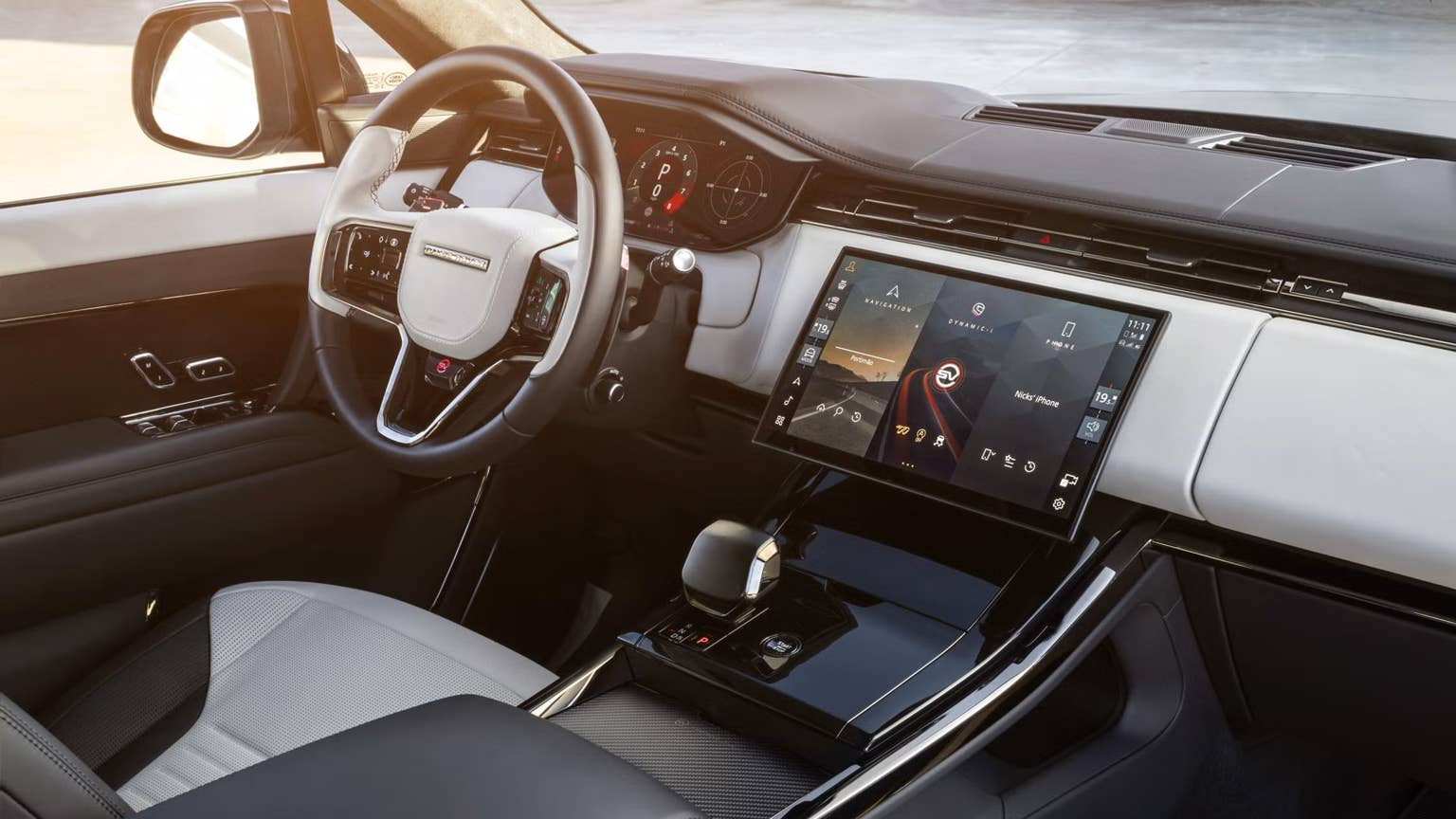
Most Range Rover-badged models currently share a similar dashboard layout, including a digital cluster, a touch panel for climate control and a large curved screen positioned in the center of the dashboard. The full-size Range Rovers retain a pair of dials, but the other models offer relatively few physical buttons.
That makes Range Rover’s decision to use smaller screens sound like a welcome change. However, a report from Go Auto indicates that future Range Rover models will follow the design approach of the upcoming GT.
For those familiar with the GT’s interior, that means the move toward smaller screens does not necessarily signal a return to a cabin filled with physical controls.
Range Rover Wants a More Minimalist Cabin
Range Rover global managing director Martin Limpert said the brand sees rivals moving toward cabins filled with technology, capability and both visual and acoustic noise.
“We see lots of (rivals) going the other way with their cabins – loaded with tech, loaded with capability, loaded with noise – visual and acoustic noise. We free our cabin from all that, and that is what makes us definitely unique,” Limpert said.
Ryan Miller, Range Rover’s global product and services marketing director, said future interiors will look much like those in the GT. He also said the marque will not go against its rivals on the “number of screens and tech.”
Smaller Screens, But Fewer Physical Controls
Although the GT uses smaller screens, that does not mean Range Rover is bringing back more physical controls. Instead, the interior appears to have even fewer of them, with the windows controlled by buttons as far as can be determined from the information provided.
The steering wheel controls may offer a more tactile feel, but Range Rover’s focus remains on reducing both visual and acoustic noise inside the cabin.
Miller explained the strategy by saying, “We’re looking to create a real tranquil sanctuary, an opportunity to detoxify through everyday life (with the) minimum number of screens we need to present the information that the driver needs (and) nothing more.”
A Risky Strategy Across the Range
Smaller screens may address part of the concern surrounding screen-heavy interiors, but Range Rover is not pairing that change with a return to more buttons and dials.
The automaker plans to apply this approach across all of its models, making consumer reaction the key test of whether the minimalist strategy works.